


From Broadway To 52nd Street
Our journey from Broadway to 52nd Street continues with Kismet that opened as a play on December 25, 1911 at the Knickerbocker Theatre and ran for 184 performances. However, it wasn’t until almost 42 years later to the day that it opened on Broadway as a musical on December 3, 1953. Two songs, Stranger In Paradise and Baubles, Bangles & Beads came from the musical composed by Robert Wright and George Forrest to become jazz standards. The musical ran for 583 performances with Ronald Coleman, Marlene Dietrich and Edward Arnold playing the musicals starring roles.
The Story: Haji, a wily beggar and poet is arrested on a minor infraction by the Wazir, who agrees to release him if he kills the Caliph. Hajj’s attempts fail and he is thrown in jail with his old enemy the sheik. He kills the sheik and escapes in his clothing. Learning his daughter is a concubine in the Wazir’s harem, Hajj drowns the Wazir and frees his daughter. The Caliph marries the daughter but by law must banish Hajj. When Hajj returns, the Caliph looks the other way and allows him to beg and recite poetry.
Broadway History: In the 1950s, Broadway musicals were a major part of American popular culture. Every season saw new stage musicals send songs to the top of the charts. Public demand, a booming economy and abundant creative talent kept Broadway hopping. To this day, the shows of the 1950s form the core of the musical theatre repertory. The best of these musicals integrated every element, offering recognizable characters singing in stories told with wit and genuine heart – in short, they applied the Rodgers & Hammerstein formula. The two songwriters were international celebrities, so the media treated each new Rodgers & Hammerstein stage show as a major event.
Oscar Hammerstein II died due to stomach cancer a few months after The Sound of Music opened, ending a career that spanned the golden age of musical theatre and film. After working with the innovative Jerome Kern Jerome and operetta master Sigmund Romberg, he did his finest work with Rodgers, and later coached young Stephen Sondheim. More than any other individual, Hammerstein had turned the once-innocuous Broadway musical into a potent dramatic form, and had turned lyrics into essential dramatic tools. He did it by being a superb storyteller and a dedicated craftsman. Even when dealing with serious issues, he always kept his focus on intriguing characters caught in remarkable situations.
Sponsored By

www.whatissuitetabu.com
Daily Dose Of Jazz…
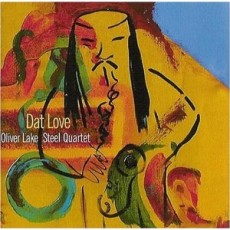
Oliver Lake was born in Marianna, Arkansas on September 14,1942 and his family moved to St. Louis when he was two. He began drawing at the age of thirteen and soon after began playing cymbals and the bass drum in a variety of drum and bugle corps. At 17, he began to take a serious interest in jazz and started playing percussion followed by alto saxophone. His piercing, bluesy, biting sound is his trademark and his explosive unpredictable solos are akin to Eric Dolphy.
During the 1960s Oliver taught school, worked in several contexts around St. Louis and led along with Julius Hemphill and Charles “Bobo” Shaw, BAG, the Black Artists Group. In 1972 Lake moved to Paris for two years working with his colleagues from BAG, returned to New York and immersed himself into the then burgeoning jazz loft scene. Like many other members of BAG, (Black Artists Group) and its Chicago-based sister organization, the Association for the Advancement of Creative Musicians (AACM), he moved to New York in the mid-’70s, working the fertile ground of the downtown loft scene and quickly establishing himself as one of its most adventurous and multi-faceted musician.
Oliver is co-founder of the internationally acclaimed World Saxophone Quartet with Julius Hemphill, Hamiet Bluiett and David Murray in 1977. Over the next two decades the group crossed over to new audiences, in part, due to their late 80s albums of Ellington and popular R&B tunes. He leads his own Steel Quartet and Big Band; has worked with hip hop artists Mos Def and A Tribe Called Quest and Me’shell Ndegeocello; has created a groundbreaking roots/reggae ensemble “Jump Up”; founded Passin’ Thru, Inc. – a non-profit dedicated to fostering, promoting and advancing the knowledge, understanding and appreciation of jazz, new music and other disciplines related to music.
Oliver Lake, the alto saxophonist, flautist, composer, poet and painter has collaborated with numerous notable choreographers, poets and a veritable Who’s Who of the progressive jazz scene of the late 20th century. He has recorded as a leader for Freedom, Black Saint, and Black Lion, Novus, Gramavision, Blue Heron Gazell, Soul Note and other record labels. The mainstay of the avant-garde and free jazz realms continually performs all over the U.S. as well as in Europe, Japan, the Middle East, Africa and Australia. He paints daily, using oil, acrylics, wood, canvas, and mixed media.
Daily Dose Of Jazz…
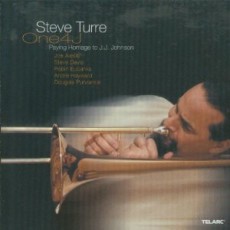
Steve Turre was born September 12, 1948 in Omaha, Nebraska but was raised in San Francisco, California to Mexican American parents. He began studying the violin but switched to trombone by age ten, later studying at the University of North Texas. By 1968 he was playing with Rahsaan Roland Kirk, went on to gig with Carlos Santana and toured with Ray Charles in 1972.
In 1970, encouraged by Kirk, Turre started playing conch and other seashells as musical lip-reed instrument. He has a collection of shells of various sizes, which he has picked up during his travels around the world. Turre leads “Sanctified Shells,” which is a “shell choir” made up of brass players who double on seashell releasing their first album in 1993.
Steve has had a long experience with Latin jazz he has become a skilled cowbell and Venezuelan maracas player. The internationally renowned trombonist, recording artist, arranger, and educator has won the Down Beat Reader’s poll for best trombonist in 1998, 1999, 2001, 2002 and 2006. He has been the trombonist for the Saturday Night Live band since 1985 and has taught jazz trombone at the Manhattan School of Music since 1988.
Turre has recorded 18 albums as a leader and has worked as a sideman on another 206 sessions with such luminaries as Monty Alexander, Carl Allen, Art Ensemble of Chicago, Frank Wess, Ray Barretto, Andy Bey, Art Blakey, Lester Bowie, Don Braden, Cecil Bridgewater, McCoy Tyner and Kenny Burrell among others. He continues to perform, record and tour.
Daily Dose Of Jazz…
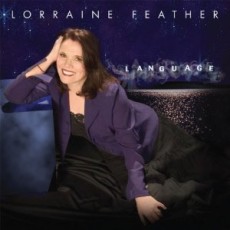
Lorraine Feather was born Billie Lorraine Feather in Manhattan on September 10, 1948 to jazz writer Leonard and Jane, a big band singer. Named after her godmother Billie Holiday, she began using her middle name in grade school.
Lorraine began working in television as a lyricist in 1992 and has received seven Emmy nominations. Her lyrics for children include work for ABC, PBS, Disney and MGM films; with composer Mark Watters wrote for Jessye Norman’s 1996 Olympic performance, and with Larry Grossman composed for Julie Andrews.
Feather’s work has been heard on numerous records covered extensively by artists such as Phyllis Hyman, Kenny Rankin, Patti Austin, Diane Schuur and Cleo Laine. Many of her own solo projects have featured contemporary lyrics to formerly instrumental pieces written by Duke Ellington, Fats Waller and other pre-bop composers. Feather’s recordings have received glowing reviews in every major jazz magazine including Down Beat and Jazz Times.
Loraine has gone on to lyric theatrical work, musical and the American Opera Projects presented excerpts of her work. Her latest release, titled “Attachments” has her penning twelve new sets of lyrics with musicians such as Dave Grusin, Joey Calderazzo, Russell Ferrante, Shelly Berg and Eddie Arkin composing the music. She continues to write, record and perform.
From Broadway To 52nd Street
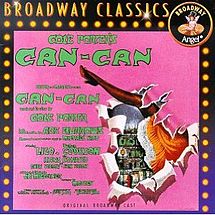
Can-Can was first seen on the stage of the Shubert Theatre on May 7, 1953 and the audience heard music composed by Cole Porter. The show ran for 892 performances. The original Broadway production ran for over two years starring Gwen Verdon in only her second Broadway role. Both she and and choreographer Michael Kidd won Tony Awards and were praised, the score and book received tepid reviews. However, three songs that rose to become jazz standards were I Love Paris, Just One Of Those Things and It’s All Right With Me.
The Story: In 1893 Paris, the dance hall Bal du Paradis in Montmartre owned by La Môme Pistache, is being threatened with closing by a self-righteous judge, Aristide Forestier. Offended by the scandalous but popular dance that the attractive dancers perform, the “Can-Can”, the judge sends the police to harass the owner and dancers, but the police like the dancers so much that they are reluctant to testify against them in court. Deciding to gather evidence, the judge takes a trip to the club. Once there, he and the owner, La Môme, fall in love but he gets the evidence to send the owner and girls to jail.
One of the dancers, Claudine, a laundry girl by day, has been pursued by art critic Hilaire, however, Claudine is in love with sculptor Boris but still arranges to have dinner with Hilaire to get a favorable review for her love. Conflicted between love and right and wrong, the judge conceded, “obscenity is in the eye of the beholder”. And gets caught in a scandalous kiss with the proprietress. Eventually, Hilaire writes a gushing review of Boris’s work. Judge Aristide loses his judgeship and is disbarred, but La Môme and the girls all go to court with him and all win their cases.
Jazz History: Live jazz was recorded, as early as 1935, but for some reason it was not considered feasible to reproduce it on 78 rpms for public consumption. This precedent was first broken in 1945 by Norman Granz, who, as one of jazz’s liveliest aficionados, originated in the early forties the notion of taking on tour for concert appearances a select group of musicians. It was an arrangement he called “Jazz at the Philharmonic”. In 1944, unbeknownst to the participating musicians, he recorded sections of a concert he was producing in Los Angeles. He then released them soon afterwards in a 12-inch 78 rpm album of three records, and there were just two tunes, “Lady Be Good” and “How High the Moon”, each of which covered three sides, or approximately fifteen minutes of playing time. His experiment proved a huge success and he released fifteen albums since then, the last an entire concert on three 12-inch LPs, amounting to about two hours of music. Other record companies followed suit, using the advantageous expanded playing time of the LP, and the record stores were stocked with live performances of all varieties and qualities, ranging from nightclub stints to private jam sessions.
Sponsored By
www.whatissuitetabu.com