

Daily Dose Of Jazz…
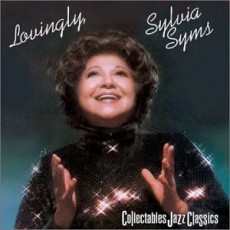
Sylvia Syms was born Sylvia Blagman on December 2, 1917 in Brooklyn, New York. As a child she contracted polio but overcame it and by the time she was a teenager she was hanging in the infamous jazz haunts on 52nd Street. She received informal training from Billie Holiday and in 1941 she made her debut at Kelly’s Stable.
In 1948, performing at the Cinderella Club in Greenwich Village she was seen by Mae West, who gave her a part in a show she was doing. Among others who observed her in nightclubs was Frank Sinatra who considered her the “world’s greatest saloon singer.” Sinatra subsequently conducted her 1982 album, Syms by Sinatra.
Signing a redocrd deal with Decca Records in 1956, Sylvia had her major success with a recording of I Could Have Danced All Night selling over a million copies garnering a gold disc. She would appear regularly at the Carlyle in Manhattan, at times, impromptu, while enjoying a cocktail in the bar of the Carlyle, she would walk on stage and perform with the cabaret’s other regular, Bobby Short.
She had a lung removed in 1972, despite which, she shortly thereafter performed as a well received Bloody Mary in South Pacific for several months at the Chateau de Ville Dinner. Vocalist Sylvia Syms, who recorded seventeen albums, appeared in six films and guested on The Tonight Show, Merv Griffin, Dinah Shore, Mike Douglas, Dick Cavett, Playboy’s Penthouse, and American Masters, passed away of a heart attack while on stage at the Oak Room in the Algonquin Hotel in New York City at age 74 on May 10, 1992.

Give The Gift Of Knowledge
More Posts: vocal
Daily Dose Of Jazz…
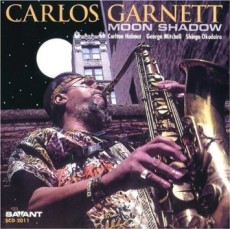
Carlos Garnett was born on December 1, 1938 in Red Tank, Panama Canal Zone. He became interested in jazz music after hearing the music of Louis Jordan and James Moody in film shorts He taught himself to play the saxophone as a teenager and played with soldiers from the nearby United States Army base. In 1957 he started playing in calypso and Latin groups.
After moving to New York in 1962 Garnett played in a rock ‘n’ roll group led by Leo Price. Around this time he also started learning music theory, being self-taught and having always played by ear. Jazz trumpeter Freddie Hubbard hired him in 1968 and introduced him to many New York musicians. His first recording was Hubbard’s 1969 album A Soul Experiment that contained two of his original compositions.
By the late 1960s and early 1970 Carlos played with Art Blakey’s Jazz Messengers, Charles Mingus and Miles Davis. He led his own group called the Universal Black Force, recording five albums between 1974 and 1977. In 1982 suffering from depression and drug abuse, he experienced a spiritual awakening and stopped playing music for years. He began performing again in 1991 and released the albums Fuego En Mi Alma, Under Nubian Skies and Moon Shadow.
In 2000 Garnett moved back to Panama, where he continues to perform actively and has assumed the role of Maestro, “Teacher”, to pass on to the next generation of young musicians in Panama, the music of jazz.
He has recorded with Russell Gunn, Dee Dee Bridgewater, Onaje Allan Gumbs, Mtume, Guilherme Franco, Norman Connors, Billy Hart, Kenny Kirkland, Anthony Jackson, Brad Jones, Andrew Hill and Pharoah Sanders.
As he continues to perform, he has performed in Japan, Austria and at three editions of the annual Panama Jazz Festival. The 9th Annual Panama Jazz Festival in 2012, organized by Panamanian pianist Danilo Perez, was dedicated to tenor saxophonist Carlos Garnett in recognition of his contribution to music.
Put A Dose In Your Pocket
More Posts: saxophone
Daily Dose Of Jazz…
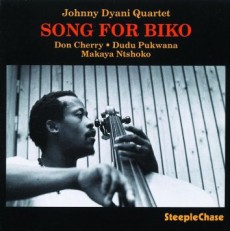
Johnny Mbizo Dyani was born on November 30, 1945 and grew up in the township of Duncan Village in East London, South Africa. In the early 1960s, the bassist was a member of South Africa’s first integrated jazz band, The Blue Notes with trumpeter Mongezi Feza, Dudu Pukwana on alto saxophone, Nikele Moyake on tenor saxophone, Chris McGregor on piano, and Louis Moholo on drums. Though the first integrated band they had to flee South Africa In 1964 to seek musical and political freedom.
In 1966, Dyani toured Argentina with Steve Lacy’s quartet and recorded with Lacy and Moholo The Forest and the Zoo. He moved to Copenhagen, Denmark in the early 70’s, and about ten years later to Sweden and recording many albums under his own name. He recorded with Dolar Brand aka Abdullah Ibrahim, Don Cherry, David Murray, Joseph Jarman, Clifford Jarvis, Don Moye, Han Bennik, Brotherhood of Breath, Mal Waldron, Pierre Dorge, Jukka Syrenius, Leo Smith and numerous others.
After his death of double bassist and pianist Johnny Dyani on October 24, 1986 in West Berlin, Germany, the remaining members of The Blue Notes reunited to record a moving tribute album, entitled Blue Notes for Johnny.
Jazz Is Global – Share
More Posts: bass

Daily Dose Of Jazz…
Dr. Michael White was born on November 29, 1954 in New Orleans, Louisiana. He is a classically trained clarinetist who began his jazz musical career as a teenager playing for Doc Paulin’s Brass Band in New Orleans. He was a member of an incarnation of the Fairview Baptist Church Marching Band.
Kid Sheik Colar, discovered him after hearing him onstage performing in Jackson Square in the French Quarter. He began working with the musician regularly following the encounter. A staunch jazz traditionalist, he can be heard on Wynton Marsalis’s 1989 album The Majesty of the Blues. Wynton also appears on White’s 1990 album titled “Crescent City Serenade”, along with Wendell Brunious and Walter Payton.
Michael has led several bands in the New Orleans area, and has accompanied various artists on other recording projects. Since 1979 he has played in the Young Tuxedo Brass Band. During the 1980s he led a band called The New Orleans Hot Seven.
In 1981, White founded The Original Liberty Jazz Band with the express intent of preserving the musical heritage of New Orleans. They perform an end-of-year concert at the Village Vanguard every year since the early 1990s, and in 2006 with former Presidents George H. W. Bush and Bill Clinton in attendance they performed at Tulane University commencement.
Putting on his education cap Michael is also a college professor who formerly taught Spanish, now teaches African-American Music at Xavier University, holds the Rosa and Charles Keller Endowed Chair in the Humanities of New Orleans Music and Culture. As a continuing component of his performances he also serves as guest director at several Jazz at Lincoln Center concerts relating to traditional New Orleans jazz.
Give A Gift Of Jazz – Share
More Posts: clarinet
Daily Dose Of Jazz…
Roy McCurdy was born November 28, 1936 in Rochester, New York. He attended the Eastman School of Music from sixteen to eighteen, during which time he also played professionally with Roy Eldridge, Eddie Vinson at seventeen. Among the influences he cites Louie Bellson, Shelly Manne, Sam Woodyard, Buddy Rich, Pap Joe Jones, and the bands of Duke Ellington, Jimmie Lunceford and Lionel Hampton.
He started out playing with the Jazz Brothers – Chuck and Gap Mangione, In 1960 he joined the Art Farmer-Benny Golson Jazztet, remaining for two years, as well as Bobby Timmons, Betty Carter and Sonny Simmons from 1963-64. He played on the classic album Sonny Meets Hawk!.
In 1965 he joined Cannonball Adderley Quintet in 1965 and stayed with the band, recording 18 albums until Adderley’s death. He recorded a half-dozen with Nat Adderley, and has also played and/or recorded with Count Basie, Nancy Wilson, Gene Ammons, Wes Montgomery, Ella Fitzgerald, Sarah Vaughan, Carmen McRae, Joe Williams, Herbie Hancock, Oscar Peterson,, Bud Powell, Art Pepper, Joe Zawinul, Betty Bennett and the jazz rock group Blood, Sweat and Tears.
He appears on the classic 1983 recording Jackson, Johnson, Brown & Company featuring Milt Jackson on vibes, trombonist J.J. Johnson, bassist Ray Brown, Tom Ranier on piano and John Collins on guitar.
As of 2010, in between performing and recording drummer Roy McCurdy is an Adjunct Professor in the Jazz Studies Department of the Thornton School of Music at the University of Southern California in Los Angeles, California.
Inspire A Young Mind
More Posts: drums