


Daily Dose Of Jazz…
Charles “Buddy” Bolden was born on September 6, 1877 in New Orleans, Louisiana and is regarded as a key figure in the development of a New Orleans style of ragtime music that would later come to be known as jazz.
He was known as “King Bolden” and his band was a top draw in New Orleans from about 1900 until 1907, when he was incapacitated by schizophrenia. He left no known surviving recordings, but he was known for his very loud sound and constant improvisation. Instead of imitating other cornetists, Bolden played music he heard “by ear” and adapted it to his horn. In doing so, he created an exciting and novel fusion of ragtime, black sacred music, marching-band music and rural blues.
He rearranged the typical New Orleans dance band of the time to better accommodate the blues; string instruments became the rhythm section, and the front-line instruments were clarinets, trombones, and Bolden’s cornet. Bolden was known for his powerful, loud, “wide open” playing style.
While there is substantial first hand oral history about Buddy Bolden, facts about his life continue to be lost amongst colorful myth. Stories about him being a barber by trade or that he published a scandal sheet called The Cricket have been repeated in print despite being debunked decades earlier.
Bolden suffered an episode of acute alcoholic psychosis in 1907 at the age of 30. With the full diagnosis of dementia praecox, he was admitted to the Louisiana State Insane Asylum at Jackson, where he spent the rest of his life until November 4, 1931 at age 54.
More Posts: cornet

Daily Dose Of Jazz…
Karen Borca was born September 5, 1948 in Green Bay, Wisconsin. The jazz bassoonist studied music at the University of Wisconsin where she met Cecil Taylor and became his teaching assistant during her senior year. She went on to play in his Cecil Taylor Unit.
By 1974 she was the teaching assistant to longtime Taylor sideman Jimmy Lyons, who Karen married and played with until his passing in 1986. She has continued to perform on the Lower East Side of New York City with musicians like William Parker, Marco Eneidi, Joel Futterman, Sonny Simmons, Alan Silva and Jackson Krall, while also leading her own band.
An accomplished sideman, she has recorded on albums with Joe Morris, Alna Silva, Paul Murphy, Bill Dixon and with Earth People. She has an impressive facility, playing with the litheness and imagination of a first-rate free jazz saxophonist. Bassoonist Karen Borca is one who has mastered an extremely difficult instrument and adapted it to free jazz that she continues to perform.
More Posts: bassoon
Daily Dose Of Jazz…
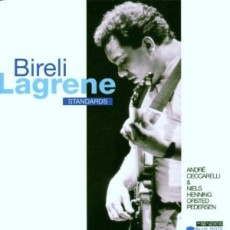
Biréli Lagrène was born September 4, 1966 in Soufflenheim, Bas-Rhin Alsace, France in a traditional manouche-Gypsy family and community. He started playing the guitar at the age of four. He grew up in the loving but tough environment of the “tzigane” or Romani Gypsies. His biggest influences came from family with a gifted violinist father. At age eight, he covered Django Reinhardt’s repertoire, at twelve won a Gypsy music festival in Strasbourg and later recorded his live performance on the double LP, “Route to Django”.
Offered the chance to leave for the U.S., Biréli met the greatest jazz musicians of the international scene such as Stephane Grappelli, Benny Goodman and Benny Carter. In 1984, he met Larry Coryell in New York, then later introduced to bassist Jaco Pastorious and ventured with him into jazz-fusion. Together, they toured Europe, which contributed a great deal to Lagrène’s musical emancipation.
Lagrène, a guitarist and bassist, came to prominence in the 1980s for his Django Reinhardt influenced style. He often performs within the swing; jazz-fusion and post bop mediums. He has also performed live with guitarist Al Di Meola, recorded “Gipsy Project” and “Gipsy Project & Friends” in 2002. He has thirty-seven albums and four film scores to date and continues to record, perform and tour.

Daily Dose Of Jazz…
David Sanchez was born on September 3, 1968 in Guaynabo, Puerto Rico and from an early age took up the conga when he was eight His earliest influences were Afro-Caribbean, danza, European and Latin classical. By age 12 David began playing the saxophone, attending La Escuela Libre de Musica, which emphasized formal musical studies.
Around the time he turned 14 he heard Miles Davis’ Basic Miles and Billy Holiday’s Lady In Satin. A few years later faced with college he chose Rutgers over Berklee for a better scholarship and nearer to New York City. While at Rutgers he studied with Kenny Baron, Ted Dunbar and John Purcell.
After a period freelancing in New York with many top Latin players including Paquito D’Rivera and Claudio Roditi, Sanchez joined Dizzy Gillespie’s United Nations Orchestra in 1990 and Dizzy became his mentor. With Dizzy’s group he toured 27 countries and 100 U.S. cities in 31 states.
Leaving the United Nation Orchestra, Sanchez continued to play in Dizzy’s trio until Dizzy’s death in 1993. He has toured with the Philip Morris Superband, recorded with Slide Hampton and his Jazz Masters, Roy Hargrove, Kenny Drew Jr., Ryan Kisor, Danilo Perez, Rachel Z and Hilton Ruiz.
The tenor saxophonist is well known as a leader with seven albums under his belt for Columbia Records. He won a Grammy for the “Best Large Jazz Ensemble Album” in 2004 for Coral. David Sanchez continues to compose, record, perform and tour.
More Posts: saxophone
Daily Dose Of Jazz…
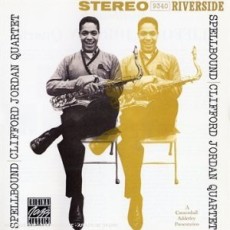
Clifford Laconia Jordan was born on September 2, 1931 in Chicago, Illinois and began his musical studies on the piano at an early age. While still in his hometown he took up the saxophone and had the opportunity to play with Max Roach, Sonny Stitt and a few rhythm and blues groups into the 50s. By 1957 at the age of 26, he made his move to New York City where he recorded three albums for Blue Note.
Over the course of his career Clifford recorded with Horace Silver, J. J. Johnson, Kenny Dorham, Lee Morgan, Max Roach and Paul Chambers. In 1964 he joined the Charles Mingus Sextet along with Eric Dolphy for the European tour. For a while he lived in Belgium, performed in Paris and toured Africa with Randy Weston.
Jordan’s later years saw him leading his own groups, performing with Cedar Walton’s Eastern Rebellion and even led his own big band. He recorded eighteen sessions as a leader and another 28 as a sideman. Saxophonist Clifford Jordan passed away on March 27, 1993 in Manhattan.
More Posts: saxophone