

Daily Dose Of Jazz…
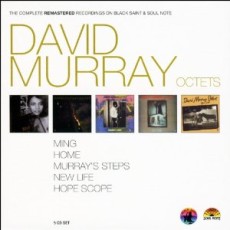
David Murray was born on February 19, 1955 in Oakland, California to musical parents, his mother played piano and his father, guitar. He was introduced to jazz while in the Berkeley school system playing alto in the school band. By thirteen he was in a local group called the Notations of Soul, but it was hearing Sonny Rollins that gave him the inspiration to switch from alto to tenor.
Influenced by Stanly Crouch while attending Pomona College, he moved to New York at 20 during the jazz loft era in lower Manhattan. Joining up with Crouch they opened their own loft space called Studio Infinity and Crouch occasionally played drums in Murray’s trio with Mark Dressler.
Murray’s early work was raw filed with multiphonics, extreme volume and upper register forays. By 1976 he recorded his first album “Flowers For Albert” and along with Julius Hemphill, Oliver Lake and Hamiet Bluiett became a founding member of the World Saxophone Quartet. Around the same time Joseph Papp commissioned David for a big band assemblage that enjoyed a modicum of critical success.
Through the 80’s he continued to play with the WSQ, his octet and various small bands, recording mostly for Italy’s Black Saint label, showcasing his rough and unformed talent as a composer. His recording dates became a flurry for the next two decades, leading more sessions than any other contemporary jazz musician. His playing matured and he began relying on the standard jazz repertoire when playing in small combo configurations. Yet by the time he was 40, his relative predictability was offset by his attention to the craft of playing and his inimitable style while his increased skill as a composer. In addition to winning a Grammy for Best Jazz Instrumental Group Performance for Blues for Coltrane: A Tribute to John Coltrane, over the course of his career he has been awarded a Guggenheim Fellowship, received a Bird Award, the Jazzpar Prize and has been named Musician of the Year by Newsday and Musician of the Decade by the Village Voice.
Murray mainly plays tenor saxophone and bass clarinet influenced in the free jazz genre of Albert Ayler and Archie Shepp. He has played with a host of world-renowned musicians, of which he is a member and continues to perform, record and tour.

Daily Dose Of Jazz…
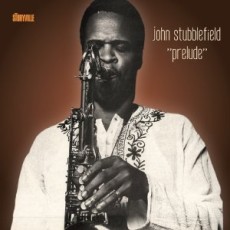
John Stubblefield was born on February 4, 1945 in Little Rock, Arkansas. He first studied the piano and then moved to saxophone as a teen absorbing the music of the itinerant blues and gospel performers moving in and out of his strictly segregated Black neighborhood.
At 17 Stubblefield made his recording debut with local R&B combo York Wilburn & the Thrillers, spent a year on the road with soul legend Solomon Burke, then studied music at A&M College in Pine Bluff while concurrently leading his own modern jazz quintet. In 1967 after graduation he settled in Chicago and signed on with the pioneering avant-garde jazz collective the Association for the Advancement of Creative Musicians. During this period he studied under Muhal Richard Abrams and appeared on Joseph Jarman’s landmark 1968 set As If It Were The Seasons.
Relocating to New York, John joined the Collective Black Artists playing with Mary Lou Williams, Tito Puente, and the Thad Jones/Mel Lewis Orchestra. By 1972 he joined Charles Mingus adding alto saxophone, oboe, flute, and bass clarinet to his arsenal. Suffering a falling-out with Mingus that effectively left Stubblefield blacklisted throughout much of the New York jazz community, he finally landed with Nat Adderley’s quintet. He briefly played behind Miles Davis in 1973 and during the mid-’70s served as an instructor with the famed Jazzmobile program.
He cut his first album Midnight Sun in 1976 followed by a few more projects in the eighties for the Enja and Soulmate labels. After the death Of Charles Mingus, his widow Sue formed the Mingus Big Band in 1992 and Stubblefield held the lead tenor chair and was an occasional director. Diagnosed with cancer in 2004 he remained a guiding force conducting much of the I Am Three album from his wheelchair.
Tenor saxophonist John Stubblefield collaborated with a who’s who list of modern jazz and avant-garde giants includes Charles Mingus, passed away on July 4, 2005. His contribution ranks him among the most powerful and innovative soloists of the post-Coltrane generation.
More Posts: saxophone
Daily Dose Of Jazz…
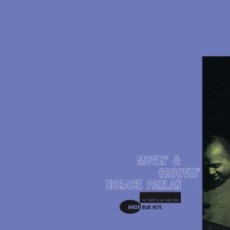
Horace Parlan was born on January 19, 1931 in Pittsburgh, PA who became an influential hard bop and post-bop pianist. Stricken with polio as a child that partially crippled his right hand, Parlan turned this would be handicap into what has been described as a “pungent left hand chord voicing style while complimenting highly rhythmic phrases with this right”.
He began playing in R&B bands in the 50’s until his move to New York where he joined Charles Mingus’ band from 1957 to 1959, a collaboration that greatly influenced Parlan’s career. Time would see him playing with Booker Ervin, Eddie Lockjaw Davis, Johnny Griffin and Rahsaan Roland Kirk; was the house rhythm section for Minton’s Playhouse in Harlem with bassist George Tucker and drummer Al Harewood while recording a strong series of sessions for Blue Note in the 60’s.
By 1973 Horace was on his way to Europe, settling in Copenhagen and gained international recognition through his Steeplechase recordings including exceptional duet dates with Archie Shepp. He also recorded with Dexter Gordon, Red Mitchell and in the 80’s with Frank Foster and Michael Urbaniak.
His later work, notably a series of duos with the tenor saxophonist Archie Shepp, including the album Goin’ Home, is steeped in gospel music. He has recorded nearly two-dozen albums as a leader and more as a sideman. In 2000 he was a recipient of the Ben Webster Prize given by the Ben Webster Foundation. Horace Parlan, the hard bop/post-bop pianist who attributes Ahmad Jamal and Bud Powell as his major influences, resided and performed regularly in Copenhagen, Denmark until his passing on February 23, 2017 in Korsør, Denmark.
More Posts: piano
Daily Dose Of Jazz…
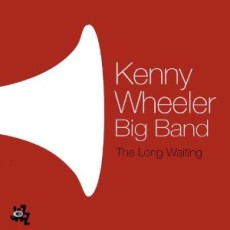
Kenny Wheeler was born Kenneth Vincent John Wheeler and came into this world on January 14, 1930, in Toronto, Canada. He began playing the cornet at the age of 12, becoming interested in jazz in his mid-teens. Spending a year at the Royal Conservatory in Toronto, he moved to Britain in 1952 at the age of 22 and found his way into the jazz scene of London playing with Tommy White, Tubby Hayes and Ronnie Scott.
In the 60’s Wheeler worked with John Dankworth, recording “Windmill Tilter” which is now a collector’s item since the master tapes have been lost. He has also enjoyed being active in free improvisation creating orchestral writing with passages of free improvisation infused in the bi band album “Song For Someone” in 1973 named Album of the Year by Melody Maker magazine in 1975.
Kenny’s lists of recordings or performances are too vast but includes Paul Gonsalves, Dave Holland, Anthony Braxton, Keith Jarrett, Steve Coleman, John Taylor, and Lee Konitz among a host of other notables in jazz.
Highly respected among his peers for his beautiful tone and extensive range on the trumpet and flugelhorn, Wheeler has written over one hundred compositions and is a skilled arranger for small groups and larger ensembles. His compositions blend lyrical melodies with a distinctive and ever changing harmonic palette. He has occasionally contributed to rock music recordings, is the patron of the Royal Academy Junior Jazz course, has been based in the UK since 1950 and remained faithful to the jazz genres of avant-garde, post bop, chamber jazz and free improvisation until his passing on September 18, 2014 at age 84 in London, England.

More Posts: flugelhorn,trumpet
Daily Dose Of Jazz…
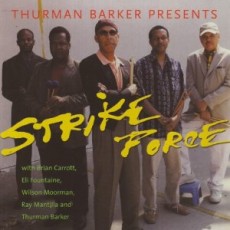
Drummer Thurman Barker was born January 8, 1948 in Chicago, Ilinois. His first professional gig was at the age of 16 with Mighty Joe Young but went on to finish his studies at Empire State College, the American Conservatory of Music and Roosevelt University.
Thurman has accompanied Billy Eckstine, Bette Midler, and Marvin Gaye; was the house percussionist at the Shubert Theatre in the 60’s. Late in the decade and through the 70’s he played with Muhal Richard Abrams, Pheeroah Aklaff, Anthony Braxton, Billy Bang, Henry Threadgill and Kalaparusha Maurice McIntyre.
Barker reunited with Braxton, recording and touring with him from 1978-80 and with Sam Rivers from 1979-80. In 1985 he joined the Jarman/Rivers trio and in 1987 played marimba with Cecil Taylor.
Since 1993 he has been an Associate Professor at Bard College.

More Posts: drums