

Daily Dose Of Jazz…
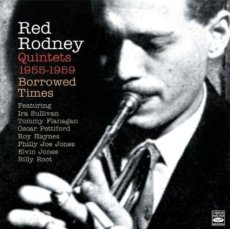
Red Rodney was born Robert Roland Chudnick on September 27, 1927 in Philadelphia, Pennsylvania. He became a professional musician at age 15 working in the mid-Forties Jerry Wald, Jimmy Dorsey, George Auld, Benny Goodman and Les Brown. Inspired by Dizzy Gillespie and Charlie Parker he turned to bebop and began playing with Claude Thornhill, Gene Krupa and Woody Herman.
Red joined Parker’s quintet in 1949 and was billed as Albino Red when playing in the racially segregated South. Leaving Parker he moved to join Charlie Ventura. Recording extensively over the next ten years he left jazz in 1958 due to diminishing opportunities, lack of acceptance as a white bebop trumpeter, and problems with the police about his drug addiction.
He continued to work in other musical fields and although he continued to be paid well, he supported his drug habit through theft and fraud, eventually spending 27 months in prison. In the early 1970s he was bankrupted by medical costs following a stroke and returned to jazz.
From 1980 to 1982, Rodney made five highly regarded albums with multi-instrumentalist Ira Sullivan, worked with The Rolling Stones drummer Charlie Watts, provided an early showcase for saxophonist Chris Potter, a member of his working group when Rodney recorded “Red Alert” in late 1990. Bebop and hard bop trumpeter Red Rodney passed away on May 27, 1994.

Give A Gift Of Jazz – Share
More Posts: trumpet
Daily Dose Of Jazz…
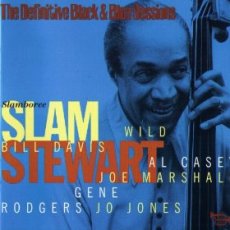
Slam Stewart was born Leroy Eliot Stewart on September 21, 1914 in Englewood, New Jersey. He originally played violin before switching to bass at the age of 20. While attending the Boston Conservancy he heard Ray Perry singing along with his violin giving him the inspiration to follow suit with his bass.
In 1937 Stewart teamed with Slim Gaillard forming the novelty jazz act Slim and Slam. The duo’s biggest hit was in 1938 with Flat Foot Floogie (With A Floy Floy).
Stewart found regular session work throughout the 1940s with Lester Young, Fats Waller, Coleman Hawkins, Erroll Garner, Art Tatum, Johnny Guarnieri, Red Norvo, Don Byas, Benny Goodman Sextet and Beryl Booker among others.
One of the most famous sessions he played on took place in 1945, when Stewart played with Dizzy Gillespie’s group during Charlie Parker’s tenure. Out of those sessions came some of the classic bebop tunes such as “Groovin’ High” and “Dizzy Atmosphere”.
Throughout the rest of his career, Stewart worked regularly and employed his unique and enjoyable bass-playing style trademark of bowing the bass (arco) while simultaneously humming or singing an octave higher until his death on December 10, 1987 in Binghamton, New York.
Inspire A Young Mind
More Posts: bass
Daily Dose Of Jazz…
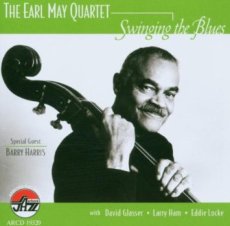
Earl May was born on September 17, 1927 in New York City first gravitated to drums, but at 14 acquired an acoustic bass, later making his professional debut at the Bronx’s 845 Club. While working an insurance job by day, 1949 saw May moonlighting across the New York club circuit, eventually catching the attention of drummer Connie Kay, who invited him to sit in behind Lester Young at Harlem’s now-legendary Minton’s Playhouse. He continued honing his craft in clubs like Minton’s Playhouse with musicians such as Lester Young and Mercer Ellington. A protégé of the legendary Charles Mingus, in 1951 Earl joined the Billy Taylor Trio, appearing regularly in such clubs as the Hickory House, Birdland and the Downbeat Club.
During the Fifties Earl also worked with Charlie Parker, Miles Davis, Quincy Jones, Gene Ammons, Sonny Stitt, Chet Baker, and Lorez Alexandria, Webster Young among others and recorded the classic “Lush Life” with John Coltrane. He left the Billy Taylor Trio in 1959 to form his own group and act as musical director and arranger for Gloria Lynne.
By the mid-sixties May took up the electric bass and led the Earl May Quartet at The New York Playboy Club and the group rapidly became the epitome of great music in the New York club scene.
Over the years Earl has performed or recorded with Dizzy Gillespie, Frank Foster, Cab Calloway, Tommy Flanagan, Barry Harris, Junior Mance, Benny Powell, Carmen Bradford, Frank Foster, Dizzy Gillespie, Linda Hopkins, Doc Cheatham, Charles Brown, Claude Williams, Jon Hendricks, Charles McPherson, Marlena Shaw, Ruth Brown, Winard Harper and Phyllis Hyman to name a few more.
Jazz bassist Earl May, one of the most prodigious and prolific bassists of the postwar era, lent his rich, round sound to every session and performance, was the only bassist to play with his left hand but kept the strings in their normal order and was a member of Local 802 since 1947, passed away on January 5, 2008. He was 80 years old.
Give The Gift Of Knowledge
More Posts: bass
Daily Dose Of Jazz…
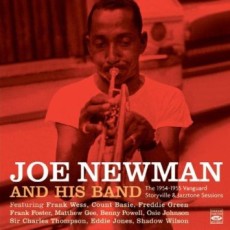
Joseph Dwight Newman was born on September 7, 1922 in New Orleans, Louisiana. A child of a pianist father, he had his first music lessons from David Jones. He continued his study of trumpet at Alabama State College where he also played, led and toured the school band, the Bama State Collegians.
By 1941 Joe joined Lionel Hampton for two years, before signing with Count Basie, a relationship that lasted for a total of thirteen years resulting in a number of small group recordings as leader, spent time with Illinois Jacquet, and then with J.C. Heard. He also played on Benny Goodman’s 1962 tour of the Soviet Union.
Leaving the Basie band in 1961, Newman helped found Jazz Interactions, of which he became president in 1967. Jazz Interactions was a charitable organization which provided an information service, brought jazz master classes into schools and colleges, and later maintained its own Jazz Interaction Orchestra, for whom Newman wrote.
In the 1970s and 1980s Newman toured internationally, recorded for various major record labels. He suffered a stroke in 1991, however, which seriously disabled him. Joe Newman, trumpeter, composer and educator best known for his years with Count Basie passed away on July 4, 1992.
Inspire A Young Mind
More Posts: trumpet
Daily Dose Of Jazz…
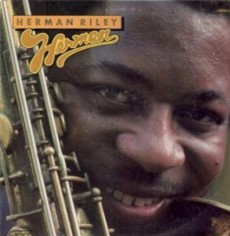
Herman Riley was born on August 31, 1933 in Algiers, Louisiana across the river from the French Quarter in New Orleans into a family setting where his mother Nell Brooks was a hard swinging jazz and gospel singer. He attended the L.B. Landry High School and under the influence of his music teacher William Houston, heard local jazzmen playing at assemblies and school dances.
In his mid-teens Herman took to the saxophone after seeing Illinois Jacquet but inspired by the locals he organized a jazz combo with his friends and took part in his school orchestra and marching band. It wasn’t long before he “was on the street, playing professionally”, taking short-lived gigs with R&B bandleaders like Ivory Joe Hunter, Guitar Slim and Paul Gayten. By the time he was majoring on cello and bassoon at Southern University in Baton Rouge, Louisiana, Riley had completed eight years of study of European music.
After two non-musical years in the US army and a short spell in New York, he ended up in San Diego, California, pursuing his music studies at City College, while playing in clubs and taking private lessons. After winning an award as outstanding solo artist at the 1962 California colleges’ jazz festival at Monterey, Riley felt confident enough to make for Los Angeles.
Recruited for some of LA’s better jazz groups, he played and recorded with Dolo Coker, Bobby Bryant, Smokey Robinson and the Miracles, Martha and the Vandellas, The Supremes, Della Reese, Sammy Davis Jr, Gene Ammons, Bobby Hutcherson and Blue Mitchell among others. Over the course of his illustrious career Riley added flute, oboe, cor anglais, clarinet and bass clarinet to the arsenal of saxophones that he carried to meet the demands of studio sessions. He toured with Quincy Jones, Benny Carter, Lionel Hampton, Mercer Ellington, Monk Montgomery, Jimmy Smith, Etta James, as well as with the Count Basie, Bill Berry and Juggernaut big bands. Quiet in manner and self-effacing, bebop and blues tenor saxophonist Herman Riley died on April 14, 2007 at the age of 73.
Inspire A Young Mind
More Posts: saxophone