

Daily Dose Of Jazz…
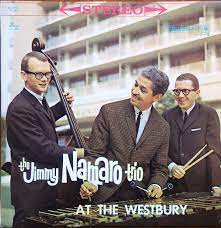
Jimmy Namaro was born James Namaro on April 14, 1913 in La Rosita, Mexico however, his family moved to Hamilton, Ontario in 1921. This is where he studied piano with Sid Walling and Eric Lewis.
He made his radio debut as a marimba player on CHML, Hamilton, and was heard in his teens on CFRB, Toronto, and on the CBC. In 1933, he was assistant conductor of a marimba band at the Chicago World’s Fair. Namaro subsequently pursued dual careers as the leader of pop or light jazz trios and quartets in nightclubs in Toronto, Canada and New York and as a popular CBC radio performer.
As a member of the Happy Gang from 1943 to 1959, he was also bandleader or soloist on several other CBC radio and television programs before moving to the United States in the Seventies. He was music director for Frankie Laine 1978-1993, with whom he toured the USA, Canada, and the UK. Namaro moved to Richmond, British Columbia, in 1987, where he continued to compose and to work with Laine.
His discography includes LPs Between 1958 and 1972 he recorded for Sparton, RCA Victor, Quality, Camden and others originally produced by the Canadian Talent Library Trust (CTL). Namaro wrote many jingles and composed music for CBC dramas such as the TV series Seaway, for the Broadway production Andorra, and for ballet. His paintings, in the primitive style, have had several exhibitions.
Vibraphonist, marimbist, percussionist, composer, painter Jimmy Namaro, who was naturalized Canadian around 1945, transitioned in Richmond, British Columbia on April 25, 1998.
More Posts: bandleader,composer,history,instrumental,jazz,marimba,music,percussion,vibarphone
Daily Dose Of Jazz…
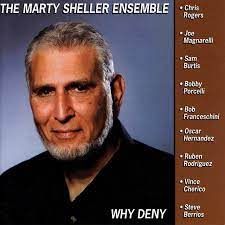
Marty Sheller was born March 15, 1940 in Newark, New Jersey. Sheller initially studied percussion, but switched to trumpet as a teenager. He played with Hugo Dickens in Harlem, and arranged for Sabu Martinez, before working with Afro-Latin percussionists such as Louie Ramirez and Frankie Malabe.
In 1962 he became a trumpeter in Mongo Santamaria’s band, and worked with Santamaria for more than forty years as a composer and arranger. He also had an extensive association with Fania Records. As their house arranger Marty worked with Joe Bataan, Ruben Blades, Willie Colon, Larry Harlow, Hector Lavoe, and Ismael Miranda.
Outside of Fania, he arranged for musicians, not limited to, George Benson, David Byrne, Jon Faddis, Giovanni Hidalgo, T.S. Monk, Idris Muhammad, Manny Oquendo, Dave Pike, Tito Puente, Shirley Scott, Woody Shaw, Lew Soloff, and Steve Turre.
In the 2000s, he led his own ensemble, which included the sidemen Chris Rogers, Joe Magnarelli, Sam Burtis, Bobby Porcelli, Bob Franceschini, Oscar Hernández, Ruben Rodriquez, Vince Cherico, and Steve Berrios.
Trumpeter and arranger Marty Sheller, who plays primarily in latin jazz idioms, continues to pursue his musical endeavors.

More Posts: arranger,bandleader,history,instrumental,jazz,music,trumpet
Daily Dose Of Jazz…
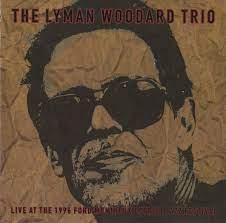
Lyman Woodard was born on March 3, 1942 in Owosso, Michigan. He started his musical career with a trio with drummer Melvin Davis and guitarist Dennis Coffey. They recorded the album Hair And Thangs that was released under Coffey’s name, however a single with It’s Your Thing and River Rouge was released under the name of Dennis Coffey and the Lyman Woodard Trio.
From the late 1960s, Woodard recorded with Motown acts, and served as musical director for Martha and the Vandellas. Establishing the jazz~funk band, the Lyman Woodard Organization in 1975 recorded Saturday Night Special, and in 1979, he recorded Don’t Stop The Groove, for the Corridor label. His 1987 recording, Dedicacion, featured violinist Regina Carter.
In March 2009, Wax Poetics Records reissued a limited pressing of his Saturday Night Special as a double LP on 180-gram vinyl.
Organist Lyman Woodard, who was based in Detroit, Michigan and was known for his ability to fuse Latin and Afro~Cuban inspired rhythms, transitioned on February 25, 2009 in his hometown of Owosso.
More Posts: bandleader,history,instrumental,jazz,music,organ,piano

Daily Dose Of Jazz…
Clotilde Rullaud was born March 1, 1978 in Reims, France and was immersed in the performing arts of music, theatre and dance from early childhood. At five, she began studying flute and singing at the conservatoire, before going on to complete her studies in jazz and improvised music at IACP in Paris, France and EDIM in Cachan, France. She explored opera singing with the tenor singer, Peterson Cowan.
Her musical identity developed through her travels through the Balkans, Ireland, Lebanon, the United States. Clotilde’s study of vocal techniques, inspired by Meredith Monk, fado, tango, Romani music, Turkish music, Persian music, Inuit throat singing and Bulgarian voices were also great influences.
She has recorded three albums as a vocalist and flutist, her 2007 debut with Hugo Lippi, Live au 7 Lézards She has also directed and produced a short film, and written and directed a multidisciplinary performance. With a repertoire spanning jazz, free improvisation and folk music, her career as a musician has led her to perform in France, Germany, Australia, Burkina Faso, China, South Korea, Japan, Luxembourg, the Netherlands, Switzerland, Taiwan, the United Kingdom and the United States.
Since 2007, Rullaud has taught at Martina A. Catella’s school, Les Glotte-Trotters in Paris, and conducted workshops for the festival Les Suds in Arles and for the Ateliers d’ethnomusicologie (ADEM) in Geneva, Switzerland. Moving to New York City in 2017 she collaborated with American pianist Chris McCarthy, producing Pieces of a Song, a repertoire of dark and beautiful pieces based on the writings of Diane di Prima, poetess of the Beat Generation.
She has performed with Olivier Hutman, Dano Haider, Antoine Paganotti, Tristan Macé, Albin Lebossé, Emmanuel Bex, Yann Cléry, Laurent Salzard, Gautier Garrigue, and Alexandre Saada, the latter collaboration produced A Woman’s Journey, a homage to American female protest songstresses.
She has received numerous awards for her work in both jazz and film. Vocalist, flutist and composer Clotilde Rulllaud, who is also an artistic director, filmmaker, producer and facilitator, continues to pursue the limits of her creativity.
More Posts: composer,flute,history,instrumental,jazz,music,vocal
Daily Dose Of Jazz…
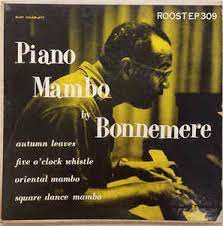
Edward Valentine Bonnemère was born on February 15, 1921 in Harlem, New York and during his school days was a church pianist. After military service in World War II he played with Claude Hopkins, and received his master’s degree from New York University.
In 1953 Eddie led a combo with Ray Barretto in the Savoy Ballroom. In 1955, he had a Mambo band, then in 1956 moved to Detroit, Michigan and became part of the house band at Baker’s Keyboard Lounge. He released a 10-inch album Ti-Pi-Tin / Five O’Clock Whistle on the Royal Roost label. He followed in 1959 with his trio recording Piano Bon-Bons and in 1960 The Sound of Memory. By 1964, with the participation of Kenny Burrell, he released his Jazz Orient-ed album on Prestige Records.
The mid-1960s, Bonnemère was one of the protagonists of an Africanization of the Catholic Mass spearheaded by Fr Clarence Rivers, as part of the Black Catholic Movement. Influenced by Mary Lou Williams he composed the Missa Hodierna for jazz ensemble and choir, which was first presented in 1966 during a service in Harlem’s St. Charles Borromeo Church. It was the first Jazz Mass ever in the United States. This mass was also performed in the Town Hall together with Howard McGhee’s instrumental composition Bless You.
In later years he worked as a church musician and composed the Missa Laetare and other liturgical works. He was also musical director of the Church of St. Thomas the Apostle in Manhattan, New York whose choir recorded his Mass for Every Season.
Pianist and composer Eddie Bonnemère transitioned on March 19, 1996 in New York City.

More Posts: bandleader,composer,history,instrumental,jazz,music,piano