

Daily Dose Of Jazz…
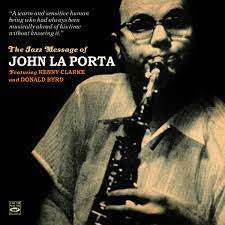
John Daniel LaPorta was born on April 13, 1920 in Philadelphia, Pennsylvania and started playing clarinet at the age of nine. He studied at the Mastbaum School in Philadelphia, alongside classmate Buddy DeFranco. As a teenager he played in local bands with Charlie Ventura and Bill Harris, and studied classically with Joseph Gigliotti of the Philadelphia Orchestra and Leon Russianoff at the Manhattan School of Music.
1942 saw him as a member of the Bob Chester big band for two years, then spent the following two years with the Woody Herman Orchestra. Beginning in 1947, he studied with Lennie Tristano, and with Teo Macero and Charles Mingus he was a member of the Jazz Composers Workshop, trying to combine jazz with classical music. Classically, he worked with Boston Pops, Leonard Bernstein, Leopold Stokowski, and Igor Stravinsky. In jazz he worked with Kenny Clarke, Miles Davis, Dizzy Gillespie, Charlie Parker, Buddy Rich, and Lester Young.
In 1956, La Porta played the first jazz concert in Venezuela at Caracas National Theater, where a selection of the repertoire performed was released under the title South American Brothers by Fantasy Records, becoming the first jazz recording in Venezuela.
As an educator he taught at Parkway Music School, then at public schools on Long Island, followed by the Manhattan School of Music and the Berklee College of Music. With guitarist Jack Petersen, he pioneered the use of Greek modes for teaching chord-scales.
In the 1990s, he retired to Sarasota, Florida, where he performed at the Sarasota Jazz Club and as a guest with the Fred Williams Trio. His autobiography is titled Playing It by Ear. Clarinetist and composer John LaPorta transitioned from complications of a stroke on May 12, 2004 in Sarasota.
More Posts: bandleader,clarinet,composer,history,instrumental,jazz,music
Daily Dose Of Jazz…
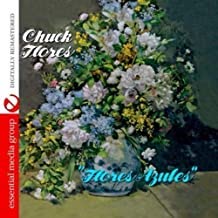
Chuck Flores was born Charles Walter Flores on January 5, 1935 in Orange, California, and grew up in Santa Ana, California. Best known for his work with saxophonist Bud Shank in the 1950s, he also had a two-year stint with Woody Herman from 1954 to 1955.
Throughout his career Chuck performed and recorded with, among others, Carmen McRae, Art Pepper, Maynard Ferguson, Al Cohn, and Shelly Manne. His drum teacher Manne and others considered him an underrated drummer.
In his later years, Flores became a highly sought after and renowned educator who was a longtime faculty member at Musicians Institute in Los Angeles, California.
A few of his students were Danny Seraphine, Chad Wackerman, John Wackerman, Brooks Wackerman, Ray Mehlbaum, Pete Parada, Jamie Wollam, Jose Ruiz and Zack Stewart.
Drummer Chuck Flores, who was one of the relatively small number of musicians associated with West Coast jazz who were actually from the West Coast, transitioned on November 24, 2016.
More Posts: bandleader,drums,educator,history,instrumental,jazz,music
Daily Dose Of Jazz…
David Lee, Jr. born January 4, 1941 in New Orleans, Louisiana played professionally from his early teens. While serving in the U. S. Army, he was a member in several bands. In 1969, he co-founded the New Orleans Jazz Workshop.
In 1969 Dizzy Gillespie brought Lee into his band and soon after he was working with Roy Ayers in 1971 and Sonny Rollins for three years beginning in 1972. The Rollins recordings were hard swinging but included the plethora of tempos of the Seventies.
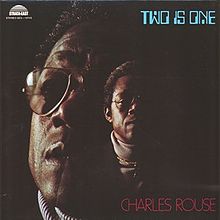
Forming a quartet but never recording as a leader, he continued to work as a sideman. On August 4, 2021, drummer and composer David Lee, who recorded Yoshiaki Masuo, Charlie Rouse, Lonnie Liston Smith and Richard Wyands among others, transitioned at 80 years of age.
More Posts: bandleader,composer,drums,history,instrumental,jazz,music
Daily Dose Of Jazz…
Jane Jarvis, née Louella Jane Nossette on October 31, 1915 in Vincennes, Indiana, to Charles and Luella Nossette. She was recognized as a piano prodigy at the age of five and she studied under a Vincennes University professor as a young girl.
A family move to Gary, Indiana in 1927 soon put her in place to be hired to play the piano at radio station WJKS in Gary. Orphaned at 13 when her parents perished in a train-auto wreck, she returned to Vincennes, graduating from high school in 1932. She continued her studies at the Chicago Conservatory of Music, the Bush Conservatory of Music, Loyola University Chicago and DePaul University.
By 1954, Jane was on television in Milwaukee, hosting a show called Jivin’ with Jarvis while serving as staff pianist and organist. At the time, the Milwaukee Braves had just relocated from Boston and sought her out to be the organist at Milwaukee County Stadium. Jarvis stayed with the Braves for eight seasons and then went to New York City, where she took a position with Muzak Corporation as a staff composer and arranger. She would rise to become a corporate vice-president and its director of recording and programming.
In 1964, she was hired by the New York Mets to play the organ at Shea Stadium, where she is remembered for playing their theme song, Meet The Mets, which debuted in the 1963 season before every home game, followed by the Jarvis composed Let’s Go Mets, as the team took the field.
Leaving Muzak in 1978, the next year she left the Mets to concentrate on her first musical love, jazz piano. She became a fixture at New York City nightclubs, frequently playing alongside bassist Milt Hinton. She became a founding member of the Statesmen of Jazz, a group of jazz musicians aged 65 and older sponsored by the American Federation of Jazz Societies, and was featured on their 1994 album. She performed with this group across the US as well as in Japan and elsewhere.
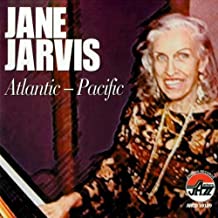
Jarvis released several albums of her jazz piano work, including Jane Jarvis Jams, and Atlantic/Pacific. In addition to Hinton, she often collaborated with trombonist Benny Powell and bassist Earl May. As a member of ASCAP, she also had over three hundred compositions to her credit.
Living in Cocoa Beach, Florida, where she was honored in 2003 by the Space Coast Jazz Society for her lifetime achievement. Back in New York City in 2008, she was displaced when a construction crane collapsed, damaging her building on East 50th Street. Pianist, composer, baseball stadium organist and music industry executive Jane Jarvis spent her final years of her life at the Lillian Booth Actors Home in Englewood, New Jersey until she passed away on January 25, 2010.
More Posts: bandleader,composer,history,instrumental,jazz,music,piano
Daily Dose Of Jazz…
Bobby Jones, born October 30, 1928 in Louisville, Kentucky and played drums as a child, started on clarinet at age 8, and his father encouraged him to explore jazz. He studied with Simeon Bellison, Joe Allard, Charlie Parker, and George Russell.
He played with Ray McKinley from 1949 into the mid-1950s, and then with Hal McIntyre before rejoining McKinley later in the decade. During a stint in the Army he met Nat and Cannonball Adderley as well as Junior Mance. After his discharge he played country music and rock & roll as a studio musician, and did time with Boots Randolph. He worked with Glenn Miller in 1950 before returning to McKinley from 1959 to 1963.
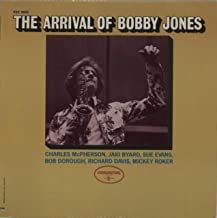
He spent a brief time with Woody Herman and Jack Teagarden in 1963, and after the latter’s death he retired to Louisville and started a local jazz council there in addition to teaching at Kentucky State College. In 1969 he moved to New York City and played with Charles Mingus from 1970 to 1972, touring Europe and Japan with him. He also recorded sessions under his own name in 1972 and 1974.
Late in his life he moved to Germany, where he ceased performing due to emphysema. Saxophonist Bobby Jones passed away on March 6, 1980 in Munich, Germany.
More Posts: bandleader,history,instrumental,jazz,music,saxophone