

Daily Dose Of Jazz…
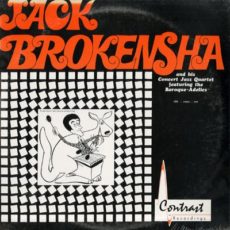
Jack” Brokensha was born John Joseph Brokensha on January 5, 1926 in Nailsworth, South Australia. He studied percussion under his father, and played xylophone in vaudeville shows and on radio. He played with the Australian Symphony Orchestra during the war years from 1942–44, and then joined a band in the Air Force from 1944 to 1946.
Forming his own group, Jack began performing in Melbourne in 1947, moving around Australia and playing in Sydney from 1949 to mid–50, Brisbane later in 1950 and Adelaide in 1951. By 1953 he had moved to Windsor, Ontario, Canada with Australian pianist Bryce Rohde and together they formed the Australian Jazz Quartet/Quintet. They enlisted fellow Australian bassoonist/saxophonist Errol Buddle and American saxophonist/flutist/bassist Dick Healey to complete the ensemble that toured together until 1958 and often grew to quintet /sextet to record.
Leaving Canada for Detroit, Michigan, Brokensha was hired by Berry Gordy of Motown Records as a percussionist, becoming one of the few white members of Motown’s Hitsville U.S.A. recording studio’s house band, The Funk Brothers. He was given the nickname “White Jack”, to distinguish him from Jack Ashford, an African American percussionist nicknamed “Black Jack”.
During the 1970s he ran “Brokensha’s”, a steakhouse high up in a Downtown Building whilst working at Motown. Though relatively small, the club had good food and Jack’s great music, with occasional appearance by his friend and pianist Detroit resident, pianist Bess Bonnier. Following tours of Australia with Sammy Davis, Jr. and Stan Freberg, he founded his own music production company and did a session with Art Mardigan in 1963. Jack then became more active in radio as a disc jockey and writing music for television. He recorded as a leader again in 1980 and continued to lead his own group well into the 1990s. The Australian Jazz Quartet also reunited for tours and recording in 1994, leaving a small collection of some thirteen albums as a leader and member of the quartet.
Vibraphonist Jack Brokensha moved to Sarasota, Florida, where he passed away due to complications from congestive heart failure, at age 84 on October 28, 2010.

#preserving genius
More Posts: drums,vibraphone
Daily Dose Of Jazz…
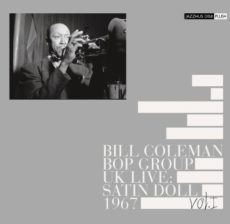
Alan Littlejohn was born Albert John Alan Littlejohns on January 4, 1928 in Highgate, London, England. Taking up the trumpet in 1946, he trained as an accountant after the War but also played semi-professionally with bands such as the Blue Note Swingtet and the Galleon Jazz Band. In 1952 he joined Cy Laurie and then a year later moved to play with Eric Silk. Moving to Manchester for eight months he worked with Ron Simpson and the Saints Jazz band in 1954, but then returned to London to work with Eric Silk again.
1955 saw Littlejohn taking a residency at the Putney Jazz Club and a further residency in Chelsea in 1960. In 1963 he led a quintet with trombonist Tony Milliner, pianist Mat Mathewson, bassist Bucky Cowman and Terry Cox on drums, emulating the style of the Bob Brookmeyer/Clark Terry band. Cox and Cowman were soon replaced by Max Cutlan and Dave Holland, respectively.
Over the course of his career Alan would play with Mal Cutlan, Lew Hooper, Jimmy Hamilton, Matt Methewson, Cat Anderson, Peanuts Hucko, Earl Warren, Sonny Dee, the Georgia Jazz Band and to be the support band for Dave Brubeck at his Festival Hall gig. From 1973 to 1978, he played with Alvin Roy’s Band which had a residency at The Prospect of Whitby in London.
When not in residency at clubs in London Littlejohn toured Spain and Germany, guest appeared with the Merseysippi Jazz Band and during the Eighties played as a full-time professional musician for a short period. From 1990 he worked with Laurie Chescoe’s Good Time Jazz until a month before his death. Trumpeter, flugelhornist and bandleader Alan Littlejohn, most notable for his work with artists such as Ben Webster, Earl Hines, Billy Butterfield and recording with Bill Coleman, passed away on November 12, 1995 in Barnet in Hertfordshire.

Uplift Someone’s World

#preserving genius
More Posts: flugelhorn,trumpet
Daily Dose Of Jazz…
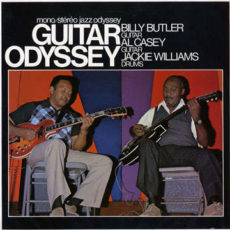
Jackie Williams was born on January 02, 1933 in Harlem, New York City, New York. Growing up in the fertile jazz atmosphere of the city, he also absorbed the dance grooves of rhythm and blues. Citing Papa Joe Jones as one of his greatest influences, by the mid 1950s he was playing for dancers and soon became a first call musician for recording sessions. He is a recipient of Yale University’s Duke Ellington Fellowship Medal
For 18 years Jackie played with Doc Cheatham at Greenwich Village’s Sweet Basil and performed and recorded with Buck Clayton on a U.S. State Department tour of the Middle East and Africa. He has also been a sideman with Bobby Hackett, Illinois Jacquet, Earl Hines, Duke Ellington, Alberta Hunter, Buddy Tate, Billy Butler, Al Casey, Stéphane Grappelli, Johnny Guarnieri, Jimmy Shirley, Buddy Tate, Slam Stewart, Barbara Morrison, Milt Hinton, Dizzy Gillespie, Maxine Sullivan, Vic Dickenson, Jay McShann, Bobby Short, Teddy Wilson and Errol Garner to name a few.
At one time or another during his career Williams was a member of The Cliff Smalls Septet, The Dan Barrett Octet, The Howard Alden / Dan Barrett Quintet, Warren Vaché Quartet, Warren Vaché, Jr. And His All-Stars, Statesmen of Jazz, The Floating Jazz Festival Trio and many others.
Drummer Jackie Williams is currently a member of the Junior Mance Trio.
Sponsored By
Voices From The Community
#preserving genius
More Posts: drums
Daily Dose Of Jazz…
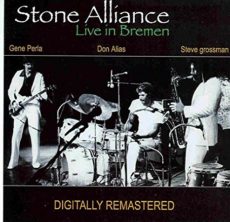
Charles “Don” Alias was born on December 25, 1939 in Harlem, New York City, the son of Caribbean immigrants. Absorbing the lessons of neighborhood Cuban and Puerto Rican hand drummers, while in high school he played conga with the Eartha Kitt Dance Foundation, and in 1957 accompanied the singer at the Newport Jazz Festival.
Mothballing his musical career to study biology at Erie, Pennsylvania’s Cannon College, he followed those studies with a stint at Boston’s Carnegie Institute for Biochemistry. While there Alias regularly moonlighted at local clubs in the company of students of the nearby Berklee School of Music, among them conguero Bill Fitch and bassist Gene Perla, and played bass in a short-lived trio featuring Chick Corea on guitar and Tony Williams on drums.
When Perla landed a gig with Nina Simone, he convinced the singer to hire Alias to assume drumming duties. By the end of his three-year residency he was serving as musical director, and eventually captured the attention of Miles Davis, with whom Simone regularly shared festival bills. He would go on to record four albums with Miles Davis including sitting in to play the drums on the recording of Miles Runs the Voodoo Down on the album Bitches Brew in 1969, when neither Lenny White nor Jack DeJohnette were able to play the marching band-inspired rhythm.
Settling back in New York City in the late Seventies he along with Gene Perla formed the Afro-Cuban fusion group Stone Alliance, which would be resurrected in 1980 with pianist Kenny Kirkland and tenor saxophonist Bob Mintzer. Performing on hundreds of recording sessions, he can be heard playing with Carla Bley, Uri Caine, Jack DeJohnette, Roberta Flack, Joe Farrell, Dan Fogelberg, Bill Frisell, Hal Galper, Kenny Garrett, Herbie Hancock, Elvin Jones, Joe Lovano, David Sanborn, Philip Bailey, Joni Mitchell, Jaco Pastorius, Carlos Santana, John McLaughlin, Lalo Schifrin, Nina Simone, Steve Swallow, the Brecker Brothers, James Taylor, Weather Report, Lou Reed, Blood Sweat & Tears, Pat Metheny, Don Grolnick Group and Jaco Pastorius, on the short list.
Percussionist Don Alias, best known for playing congas and other hand drums, but was also a capable drum kit performer, passed away suddenly in his Manhattan home on March 29, 2006 in New York City.
Give The Gift Of Knowledge
More Posts: drums,percussion
Daily Dose Of Jazz…
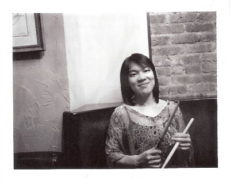
Kaori Yamada was born on December 23, 1971 in Takamatsu, Kagawa Pref., Japan. She started learning to play the piano at the age of 4 and graduated from the School of Music, at Takamatsu Junior College, majoring in classical piano. She began teaching herself to play drums on her own initiative at the age of 14 and was particularly interested in Soul, R&B and Jazz, the music her brother was listening to at the time. It was during this period that she developed a strong desire to become a professional drummer.
From 1991 to 1995, Kaori lived Hiroshima where she gave drum instruction under the R.C.C. Takeshi Inomata Drum School at Yamaha Music Shops. During this period, she volunteered in the community as a musician and performed at charity concerts and events for a local youth group and welfare facility.
Introduced to Japan’s best-known drummer, the late Motohiko Hino, in 1996 Yamada started to train with him and two years later she began her professional drumming career. Since that time she has performed with her bands “Wet” and “Petit Agasa”. She has also worked as a side person for Terumasa Hino, Fumio Karashima, Kosuke Mine and Yosuke Inoue, among other Japanese jazz musicians.
Moving to New York in 2007 she broadened her music horizons playing venues like Showman’s and Dizzy’s Club Coca Cola of Lincoln Center, and more. She plays with Carol Sudhalter, James Zollar, Nabuko Kiryu, Valery Ponomarev, Alvin Walker, Peter Brainin, Cecilia Coleman, Chris Haney, Marco Panascia, Robert Bowen, Steve Millhouse, Miki Hayama, Madame Pat Tandy, Vito Di Modugno, Radam Schwartz, Akiko Tsuruga, Satoshi Inoue, Kayo and more. In 1994 Kaori was awarded the Best Ensemble Award at the Yamaha Music Festival. Drummer Kaori Yamada continues to perform both as a leader and side person, but as yet has not led a recording session.
Sponsored By


More Posts: drums