

Daily Dose Of Jazz…
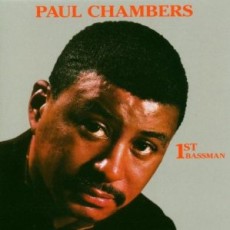
Paul Laurence Dunbar Chambers, Jr. was born in Pittsburgh, Pennsylvania on April 22, 1935 but was raised in Detroit after the death of his mother. He began his music career as a youth playing the baritone horn, then switched to the tuba but by age 14 finally settled on the string bass in 1949. Through high school he trained with a Detroit Symphony Orchestra bassist, played classical music with the Detroit String Band, played with the Cass Technical High School Symphony and various other student groups that often had him playing the baritone saxophone.
Bassist Jimmy Blanton was Paul’s biggest influence but Charlie Parker and Bud Powell were his first influences. He admired Oscar Pettiford and Ray Brown, followed by Percy Heath, Milt Hinton and Wendell Marshall for their rhythm section work. It was Charles Mingus’ and George Duvivier’s technical prowess that gave him an understanding of their broadening of the jazz bass.
Chambers was invited to New York by Paul Quinichette and was soon touring and playing with George Wallington, J.J. Johnson, John Coltrane, Wes Montgomery, Bennie Green, Thad Jones, Barry Harris and Kai Winding. In 1955 he joined the Miles Davis followed by Wynton Kelly and freelanced with many jazz greats throughout his short but impressive career.
Paul Chambers was a prominent figure and one of the most influential jazz bassists of the 1950s and 60s. His importance in the development of jazz bass can be measured by his impeccable time, intonation and virtuosic improvisations. He, along with Slam Stewart was first to perform arco or bowed features.
Over the span of his extremely short career Paul was a member of two of the jazz world’s most famous “rhythm sections”, the first with Red Garland and Philly Jo Jones, the second with Wynton Kelly and Jimmy Cobb. On January 4, 1969 he passed away of tuberculosis at the premature age of 33.

More Posts: bass
Daily Dose Of Jazz…
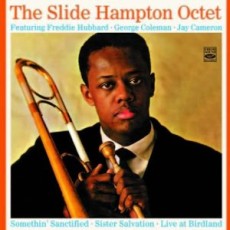
Slide Hampton was born Locksley Wellington Hampton on April 21, 1932 in Jeannette, Pennsylvania, one of twelve children born to Laura and Clarke Hampton, who taught them to play instruments. One of the few left-handed trombonists, not naturally having received a left-handed trombone from his father, by age twelve the Hamptons were living in Indianapolis and Slide was playing in the Duke Hampton Band, led by his father.
Just eight years later Slide was on stage at Carnegie Hall playing with Lionel Hampton in 1952. Throughout the 1950s Slide played with Buddy Johnson, played and arranged for Maynard Ferguson, and recorded with master trombonist Melba Liston. As his reputation grew he began working with Art Blakey, Tadd Dameron, Barry Harris, Thad Jones, Mel Lewis, and Max Roach, contributing both original compositions and arrangements. In the early Sixties he formed an octet with Freddie Hubbard, Booker Little and George Coleman that toured and recorded throughout the U.S. and Europe.
Over the course of fifty plus years Hampton has played with Woody Herman, lived in Europe for ten years, taught at Harvard, University of Massachusetts, DePaul University and Indiana State. He has led a nine trombone 3 rhythm band – World Of Trombones, co-led a quintet with Jimmy Heath called Continuum and freelanced as a writer and player.
This gifted jazz musician has been inducted into the Indianapolis Jazz Hall of Fame, is a two-time Grammy winner, and was honored in 2005 with the NEA Jazz Masters Award. Trombonist, bandleader, educator, master composer, arranger Slide Hampton, who is among the most distinguished assembly of careers in music, passed away on November 18, 2021 in Orange, New Jersey.

More Posts: trombone
Daily Dose Of Jazz…
Paul Smith also known as Paul T. Smith was born on April 17, 1922 in San Diego, California. After playing early on with Johnny Richards in 1941 and spending a couple of years in the military, the pianist played with Les Paul from 1946–1947 and Tommy Dorsey from 1947–1949, them moved to L.A. and became a studio musician.
Smith has recorded frequently as a leader both with his trios and as a soloist. As a sideman he worked with Dizzy Gillespie, Anita O’Day, Buddy DeFranco, Louis Bellson, Steve Allen, Sammy Davis Jr., Rosemary Clooney, Stan Kenton Mel Torme and Ella Fitzgerald, the later with whom he was her conductor and pianist from 1956 to 1978.
Throughout his career Smith has worked in television with Bing Crosby, Red Skelton, Dinah Shore, Nat King Cole, Carol Burnett and many more, has toured around the world and has authored a number of educational books and CDs, most of which focus on explaining his particular approach to jazz piano.
Often praised for his brilliant technique and lyrical playing, he has performed in various genres of jazz, most typically bebop but has delved into cool jazz, swing, and traditional pop. Pianist Paul Smith passed away of heart failure at the age 91 in Torrance, California on June 29, 2013.
More Posts: piano
Daily Dose Of Jazz…
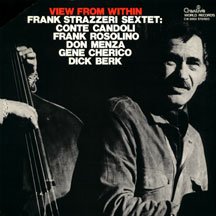
Eugene Valentino Cherico was born on April 15, 1935 in Buffalo, New York. As a child he played drums and pursued a drumming career until he hurt his hand while in a special services band in the Army whereupon he picked up the double bass as therapy. He attended Berklee College of Music where he met Toshiko Akiyoshi with whom he would tour and record intermittently for many years.
Throughout the Fifties and 60s Cherico worked as a sideman with Herb Pomeroy, Maynard Ferguson, Red Norvo, Benny Goodman, George Shearing, Stan Getz, Peter Nero Joe Morello, Paul Desmond and Gary Burton.
Much of the ‘70s Gene made a living as a studio musician siding with Frank Strazzeri, Louis Bellson Peggy Lee, Lew Tabackin, Frank Sinatra, Nancy Wilson Gerry Mulligan, Carmen McRae and Frank Sinatra, who he toured with into the early eighties. In 1984 he retired after being diagnosed with non-Hodgkins lymphoma and after a ten-year battle, double bassist Gene Cherico passed away on August 12, 1994 in Santa Monica, California.
More Posts: bass
Daily Dose Of Jazz…
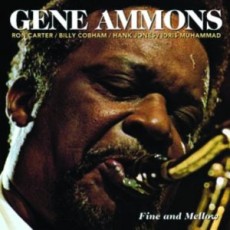
Eugene Ammons was born in Chicago, Illinois on April 14, 1925 to one of the greatest boogie-woogie pianist, Albert Ammons. At the age of 18 he left Chicago to go on the road with King Kolax for a year and in 1944 and ‘49 he worked as a featured soloist with Billy Eckstine and Woody Herman respectively. By 1950 he formed a duet with Sonny Stitt and recorded as a leader from 1947 to 1953 for the Mercury, Aristocrat, Chess, Decca, United and for the rest of his career he was affiliated with Prestige.
Known as “Jug” and “The Boss”, Gene’s playing showed influences from Lester Young and Ben Webster and both helped develop higher levels of expressiveness with from the tenor. Along with Dexter Gordon and Sonny Stitt, he integrated those developments into the emerging vernacular of bebop. His adeptness with technical aspects did not abandon the commercial blues and R&B sounds and he became an important part of the soul jazz movement in the mid-50s combining the tenor with the Hammond B3.
Using a thinner drier tone Ammons exploited a vast textural range that would later influence Stanley Turrentine, Houston Person and Archie Shepp and much later Joshua Redman. Yet he had little interest in the modal jazz of Coltrane, Henderson or Shorter. His ballads are classic, a testament to his sense of intonation, melodic symmetry and lyrical expressiveness.
Along with Von Freeman, they founded the Chicago School of Tenor Saxophone. On August 6, 1974 Gene Ammons passed away after a battle with cancer.
More Posts: saxophone