

Requisites
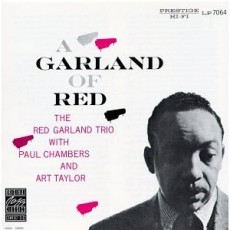
A Garland of Red was Red Garland’s debut release on Prestige, being signed to an exclusive recording contract after his performance in the Miles Davis Quintet brought awareness to his talent. The Dallas-born Philadelphian brought Davis alums to form the recording trio that brings a handful of standards, a blues and some rhythm. As a leader it is Garland’s beginning and an auspicious one at that.
Personnel: Red Garland – piano, Paul Chambers – bass, Arthur Taylor – drums
Supervised by: Bob Weinstock
Record Date: Hackensack, New Jersey, August 17, 1956
Cover: Hannan/Edwards
Songs: A Foggy Day, My Romance, What Is This Thing Called Love, Makin’ Whoopee, September In The Rain, Little Girl Blue, Constellation, Blue Red

More Posts: collectible,piano

Daily Dose Of Jazz…
Martin France was born on February 29, 1964 in Rainham, Kent, England and began performing at the age of twelve backing singers in working men’s clubs with organ trios in and around Manchester. He studied under Geoff Riley, Kenny Clare, Joel Rothman, and principal percussionist Richard Smith of The Hallé, the Manchester orchestra.
In 1983 Martin began his recording career performing as a sideman on several records for ECM Records, toured with several of the labels roster during the 80s and 90s and subsequently led several sessions as a leader.
The turning point in his early career was as a member of the 1980s big band Loose Tubes, where he began working on projects that included film soundtracks, jazz theatre and cross cultural collaborations with other big bands and orchestras.
France formed his own band Spin Marvel, that showcased more electronic and sequence drumming, and would be an integral rhythm backbone on more than 60 albums working with some of the world’s finest musicians including Kenny Wheeler, Elvis Costello, Bob Mintzer, Steve Swallow, Joe Lovano, Lee Konitz, Marc Johnson and Dave Holland to name a few and is currently a regular performer with the NDR Radio Orchestra in Hamburg.

More Posts: drums
Requisites
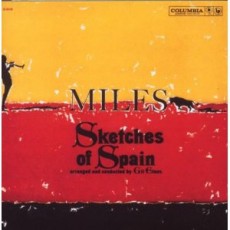
Sketches of Spain: When Miles Davis Went to Andalusia (Without Leaving New York)
What happens when you put Miles Davis‘ trumpet against the backdrop of Spanish classical music and flamenco? You get one of the most daring, gorgeous albums in jazz history.
Sketches of Spain (1960) was the third collaboration between Miles Davis and arranger/conductor Gil Evans, and it remains their most audacious. This isn’t just jazz—it’s a complete reimagining of Spanish music through an American lens, a cultural bridge built in sound. Rolling Stone ranked it #350 on their list of the 500 Greatest Albums of All Time, and once you hear it, you’ll understand why.
Recorded between November 1959 and March 1960 at Columbia’s legendary 30th Street Studio in New York City, the sessions brought together Miles’ core rhythm section—Paul Chambers on bass, Jimmy Cobb on drums, plus the great Elvin Jones adding percussion—with an absolutely massive orchestra. We’re talking French horns, oboes, bassoons, tuba, harp, flutes, and more, featuring stellar musicians like Danny Bank, Bill Barber, Johnny Coles, Bernie Glow, Ernie Royal, and Janet Putnam among many others.
Gil Evans’ arrangements are nothing short of miraculous—lush, evocative, cinematic. He doesn’t just accompany Miles; he creates entire sonic landscapes for that singular trumpet voice to soar over. The album opens with their interpretation of Joaquín Rodrigo’s “Concierto de Aranjuez,” and from the first mournful notes, you’re transported.
Across five tracks—”Concierto de Aranjuez,” “Will O’ the Wisp,” “The Pan Piper,” “Saeta,” and “Solea”—Miles and Gil paint with broader strokes than most jazz albums dare. This is music that breathes, broods, and burns with quiet intensity.
Producers Teo Macero and Irving Townsend captured something timeless when they released this on July 18, 1960. It’s been over six decades, and Sketches of Spain still sounds like nothing else, a masterpiece that proved jazz could go anywhere, be anything, as long as the vision was clear and the artists were fearless.
Put this on, close your eyes, and let Miles take you to Spain.
More Posts: collectible,trumpet
Requisites
It’s the late 1950s and early ’60s in Los Angeles, California and Jazz, that quintessentially American art form, is struggling to find its footing. Gigs are drying up, and even titans like tenor saxophonist Ben Webster are fighting for recognition in their own country. But here’s the beautiful part: when the spotlight dims, sometimes the most honest music emerges.
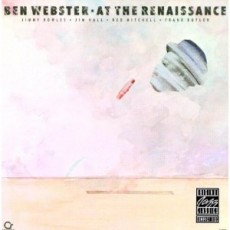
At The Renaissance captures one of those magical nights when Webster and a group of sympathetic, deeply inspired colleagues came together at a Hollywood club and created something essential. This wasn’t about fame or fortune—this was about survival, about keeping the music alive when nobody seemed to be listening.
Recorded live on October 14, 1960, Webster is surrounded by the perfect ensemble: the sensitive touch of pianist Jimmy Rowles, the elegant guitar work of Jim Hall, Red Mitchell’s solid bass foundation, and Frank Butler’s impeccable drumming. Producer Lester Koenig had the wisdom to simply press record and let them do what they do best.
What unfolds across eight tracks—from the haunting “Gone With The Wind” to the classic “Stardust,” from Ellington’s “Caravan” to the blues-soaked originals—is pure empathy translated into sound. Webster’s tone is unmistakable: warm, breathy, deeply human. You can hear everything he’s feeling in every note.
This is the kind of recording that belongs in every collection not because it’s flashy or groundbreaking, but because it reminds us what jazz is really about—musicians speaking truth to each other and to us, even when the world isn’t paying attention.

Give A Gift Of Jazz – Share
More Posts: collectible,saxophone