

Daily Dose Of Jazz…
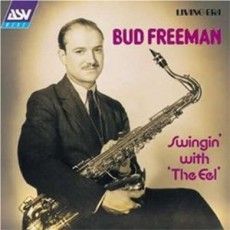
Lawrence “Bud” Freeman was born on April 13, 1906 in Chicago, Illinois and became one of the most influential and important jazz tenor saxophonists of the Big Band era. During high school in 1922 he became one of the original Austin High School Gang playing the C-melody saxophone alongside Jimmy McPartland and Frank Teschemacher. Two years later he switched to tenor and influenced by the New Orleans Rhythm Kings and Louis Armstrong the Gang would formulate their own style that would become part of the emerging Chicago jazz sound.
In 1927 Freeman moved to New York and worked as a session player and band member with Red Nichols, Roger Wolfe Kahn, Ben Pollack Joe Venuti and Eddie Condon in 1933 producing one of his most notable performances on the recording of “The Eel” which would later become Bud’s nickname for his long snake-like improvisations.
Bud’s smooth and full-tenor sax style with a heavy robust swing was the signature that got him gigs with the Tommy Dorsey and Benny Goodman orchestras along with leading his own Summa Cum Laude Orchestra. During WWII he joined the Army and led the band in the Aleutian Islands. Returning to New York after his discharge, for the next couple of decades he led his own groups, worked with Eddie Condon, Buck Clayton, ruby Braff, Vic Dickerson and Jo Jones. He was a member of the World’s Greatest Jazz Band off and on, moved to England in 1974, performing, touring and recording throughout Europe. He returned to Chicago and continued to work well into his eighties.
Tenor saxophonist, clarinetist, composer and bandleader Bud Freeman passed away on March 15, 1991 in his hometown of Chicago. He was posthumously inducted into the Big Band and Jazz Hall Of Fame in 1992.

Daily Dose Of Jazz…
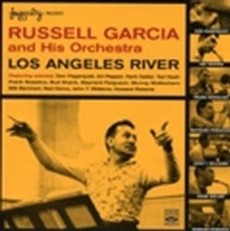
Russell Garcia was born April 12 1916 in Oakland, California but for most of his life has resided in New Zealand. The self-taught musician with only a few lessons in high school could read music from a very young age. He began his career at age five when one of his brothers bought him a $5 cornet. In school he started up a jazz band so he could play his horn and it became an outlet for his compositions and arrangements.
When Garcia was eleven the Oakland Symphony Orchestra performed his arrangement of Stardust and by high school was playing five nights a week. After a year at San Francisco State University he dropped out and went on the road with several big bands. Finding no satisfaction in his progress he went to Hollywood and studied composition, harmony, orchestration, counterpoint and form with the best teachers and took lessons on every instrument so he could write for each with a deeper awareness. During that time while still in his twenties he conducted the West Hollywood Symphony Orchestra, preparing him for things to come.
Russell’s big break came in 1939 when he took the job of composer/conductor for “This Is Our America” and impressed then director Ronald Reagan, who in turn, recommended him to NBC. From that point on worked poured in. He worked with Henry Mancini on the Glenn Miller Story, Charlie Chaplin, Universal Studios, arranged and conducted Louis Armstrong and Ella Fitzgerald’s “Porgy & Bess”, then followed up with three more albums with Armstrong.
Always the innovator Garcia left Hollywood for jazz and using experimental frameworks assembled his groundbreaking four-trombone band with famed brass players Frank Rosolino, Tommy Pederson, Maynard Ferguson and Herbie Harper and Marty Paich. He recorded over sixty albums under his own name, as well as composing for Stan Kenton’s cutting edge Neophonic Orchestra. He collaborated with Frances Faye, Anita O’Day, Mel Torme, Andy Williams, Judy Garland, Orson Welles, Julie London and Oscar Peterson.
In 1966 he walked away from his success in music to advocate world peace, a promise he made to himself after surviving World War II’s Battle of the Bulge. He continues to lecture and record around the globe and has authored what is considered the definitive textbooks on composition, “The Professional Arranger Composer Books I and II” used in universities and conservatories worldwide. Composer and arranger Russell Garcia passed away on November 19, 2011.

Daily Dose Of Jazz…
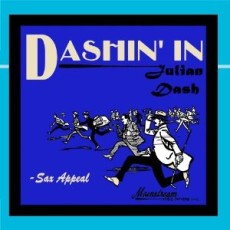
Tenor saxophonist Julian Dash was born on April 9, 1916 in Charleston, South Carolina. He first played the alto saxophone and made his debut in the Charleston Nighthawks in 1935, then switched to tenor that year playing with the Revellers and the Bama State Collegians at Alabama State Teachers College from 1935-36 followed with a move to New York to study embalming.
Dash headed his own group from 1936 to 38 then replaced Paul Bascomb in the Erskine Hawkins Orchestra, an association that lasted into the 50’s. After the group disbanded Julian became a part-time player, worked with Buck Clayton in 1953, worked with Marlowe Morris in the sixties, led his own quintet in 1970-71 prior to retiring in 1971. Julian Dash, tenor saxophonist who was based in swing music and co-wrote the classic hit Tuxedo Junction, passed away on February 25, 1974.

More Posts: saxophone
Daily Dose OF Jazz…
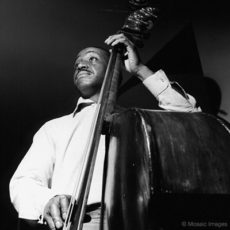
Gene Ramey, born April 4, 1913 in Austin, Texas, began playing trumpet in college but switched to the sousaphone when he played with George Corley’s Royal Aces, The Moonlight Serenaders and Terence Holder. It wasn’t until his move to Kansas City in 1932 that he took up the bass, studying with Walter Page.
Becoming a fixture in the Kansas City jazz scene, the double bassist played with Jay McShann’s orchestra from 1938 to 1943. Never a leader but a most sought after sideman, especially once he moved to New York, Ramey played with the who’s who of jazz including but not limited to Lester Young, Coleman Hawkins, Charlie Parker, Count Basie, Ben Webster, Hot Lips Page, Horace Silver, Thelonious Monk and Miles Davis.
His transition into bebop was easily accomplished due to the countless hours of daily practice with his friend Bird. They developed their style without drums, piano or other horns and Ramey was soon the first bassist to play the whole harmony chord while Bird ran his changes. Ramey is credited with stating that long before the jazz world started calling it bop he and Bird had created this pattern.
Ramey had a prolific career as a bassist for over three decades, never losing touch with Dixieland or swing as witnessed in his solos on recording sessions. Returning to Austin in 1976 his short-lived retirement led to lessons to local bassists, then to live performances and full-time musicianship until a heart attack caused his death on December 8, 1984.
More Posts: bass
Daily Dose Of Jazz…
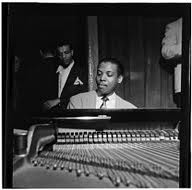
Kenny Kersey was born on April 3, 1916 in Harrow, Ontario into a musical family and studied piano and trumpet while attending the Detroit Institute of Musical Arts. In 1936, Kersey moved to New York City where he played with Lucky Millinder, Billy Hicks, Frankie Newton, Billie Holiday, Roy Eldridge, Red Allen and Cootie Williams.
In 1942 he replaced Mary Lou Williams as Andy Kirk’s pianist and Kirk recorded his composition “Boogie Woogie Cocktail”. He joined the Army from 1943 to 1945, where he occasionally played trumpet in military bands, then played from 1946 to 1949 with the Jazz at the Philharmonic touring ensembles. He continued to play with noted musicians through the 1950s, including Eldridge and Allen again, as well as Buck Clayton, Edmond Hall, Sol Yaged, and Charlie Shavers.
Kersey retired from music late in the 1950s after being diagnosed with a bone ailment. He recorded twelve tunes as a bandleader – four for Savoy in 1946, two for Clef in 1949, two for Circle in 1950, and four for Foxy in 1951 which featured Hot Lips Page and Paul Quinichette and as sidemen. Kenny Kersey passed away on April 1, 1983 in New York City.
More Posts: piano