

Daily Dose Of Jazz…
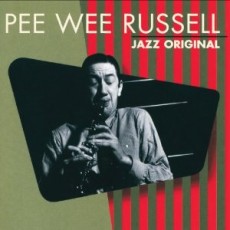
Charles Ellsworth Russell, much better known by his nickname Pee Wee Russell was born on March 27, 1906 in Maplewood, Missouri but grew up in Muskogee, Oklahoma. He began music studying the violin, followed by the piano and then drums. While none of these satisfied his musical acumen he became attracted to the clarinet when his father snuck him into an Elks Club dance and he witnessed the five-piece band. He bought an Albert-system instrument and took lessons from Charlie Merrill, a clarinetist in the pit band at the Broadway Theatre.
His family moved to St. Louis in 1920 and while in school at the Western Military Academy, Pee Wee played with various dance and jazz bands. By 1922 he was traveling and performing professionally with tent shows and riverboats but two years later settled in Chicago playing with notables as Bix Beiderbecke and Frankie Trumbauer.
Over the next two decades Russell built a career with his distinctive style that was somewhat unorthodox to his contemporaries and often was accused of playing out of tune. Yet he played with the likes of Coleman Hawkins, Louis Prima, Red Nichols, Art Hodes freelanced recording sessions and took up residence at “Nick’s” in Greenwich Village.
By 1940 Pee Wee’s health began to deteriorate exacerbated by his bout with alcoholism. In and out of hospitals and a breakdown was coupled with had periods when he could not play. In his latter years he played jazz festivals and international tours organized by George Wein including Newport in 1963 with Thelonious Monk. Playing Richard Nixon’s inaugural was his last gig with George Wein.
Clarinetist Pee Wee Russell died in an Alexandria, Virginia hospital just three weeks later on February 15, 1969. His greatly imaginative improvisations remain inspiration to clarinetists and in 1987 he was inducted into the Big Band and Jazz Hall of Fame.

More Posts: clarinet

Daily Dose Of Jazz…
Johnny Guarnieri, born March 23, 1917 in New York City was a virtuoso jazz and stride pianist best known for his stints with the big bands of Benny Goodman and Artie Shaw in the 1940s. Guarnieri is also noted for his embellishment and juxtaposition of jazz with classical piano, such as Scarlatti and Beethoven.
Throughout the 1940s Guarnieri was a busy sideman, recording with artists such as Charlie Christian, Cozy Cole, Ike Quebec, Charlie Kennedy, Hank D’Amico and Ben Webster. He also led his own group called the “Johnny Guarnieri Swing Men” and recorded with them on the Savoy label, a group that included Lester Young, Hank D’Amico, Billy Butterfield and Cozy Cole. He also led a trio in the 1940s composed of himself, Slam Stewart and Sammy Weiss.
In 1949 Guarnieri recorded an album with June Christy and recorded with numerous other artists over his career. In his later years he shifted more toward jazz education. In commemoration of his reputation as a teacher, Guarnieri’s students financed a label for him called “Taz Jazz Records” and in the ‘70s he recorded numerous albums on his new label, and until 1982 worked the “Tail of the Cock” nightclub in Studio City, California.
Pianist Johnny Guarnieri died doing what he loved to do, play jazz, onstage during a performance with Dick Sudhalter on January 7, 1985.

More Posts: piano
Daily Dose Of Jazz…
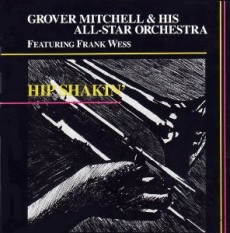
Trombonist and bandleader Grover Curry Mitchell was born on March 17, 1930 in Whatley, Alabama. By age eight he was living in Pittsburgh where jazz took hold of him. During his teen years after an initial desire to play trumpet, the school took note of his long arms and trained him to play the trombone.
After high school he enlisted playing in the U.S. Marine Band, then went on to play with Lionel Hampton and Duke Ellington. But his best-known association was with Count Basie from 1962 to 1978, when he founded his own band, the Jazz Chronicles.
In the seventies he started writing music for television and film including the 1972 Lady Sings The Blues. returned to the Count Basie Band in 1980 and continued to lead the band and served as the director from ’95 until his death, winning a Grammy for the Best Large Jazz Ensemble Album twice.
The mellow-toned trombonist lost a quiet battle with cancer on August 6, 2003 in New York City’s Sloan Kettering Hospital. Grover Mitchell was inducted posthumously into the Alabama Jazz Hall of Fame in 2008.

More Posts: trombone
Daily Dose Of Jazz…
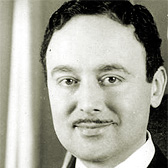
Peter DeRose was born on March 10, 1900 in New York City and as a boy exhibited a gift for music. His older sister taught him to play piano but composing was his true love and by 18 had published his first song. After high school he worked as a music store stock clerk but his successful 1920 composition “When You’re Gone, I Won’t Forget” led him to a job with Italian music publisher G. Ricordi & Company.
In 1923 he met his soon to be wife May Singhi Breen and the duet of piano and ukulele became popular entertainment on NBC’s musical radio show “Sweethearts of the Air” which ran for sixteen years. The show also offered a spotlight for DeRose to introduce many of his compositions.
Collaborating with lyricists Charles Tobias, Al Stillman, Carl Sigman and Billy Hill some of his best known works were “Somebody Loves Me”, Wagon Wheels, Rain, Lamp Is Low, On A Little Street In Singapore and Deep Purple. His songs have been performed by the likes of Bing Crosby, Paul Robeson, Ella Fitzgerald, Frank Sinatra, Johnny Mathis, Sarah Vaughan and Duke Ellington among others.
He wrote religious sheet music; composed for the 1941 Ice Capades show and ventured into Hollywood scoring music for several motion pictures. In 1970 he was inducted into the Songwriters Hall Of Fame.
The Hall of Fame composer of jazz and pop during the Tin Pan Alley era, composer Peter DeRose passed away on April 23, 1953 in his hometown of New York City.
More Posts: composer
Daily Dose Of Jazz…
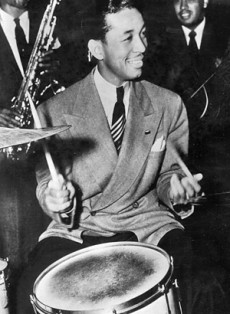
Drummer and singer Lee Young was born on March 7, 1914 as Leonidas Raymond Young in New Orleans, Louisiana to parents who were both musicians and teachers. The younger brother of tenorist Lester Young, his father drilled music into his children long before they started school, preparing them for the carnival and vaudeville road. The family finally settled in Los Angeles.
Steeped in the roots deep in New Orleans jazz, Lee played and recorded with Fats Waller in the thirties, and helped forge a burgeoning and vibrant jazz scene in Los Angeles in the ‘40s, and in 1944 he was drumming with Les Paul, J. J. Johnson, and Illinois Jacquet at Norman Granz’s first Jazz At The Philharmonic. In the Fifties he conducted and drummed for Nat King Cole.
Young was the first Black musician to be a regular studio musician in Hollywood and taught Mickey Rooney to play drums for a movie. By the 60’s he was a successful A&R man and record producer for Vee-Jay and Motown with a reputation for predicting what would sell.
Young is considered one of the most significant figures in jazz who directly connected the world to the early glories of jazz: the birth of jazz in New Orleans, the jazz age, the swing era and bebop. He led an integrated band at a time when it was not fashionable. He worked with Duke Ellington, Count Basie, Benny Goodman, Lionel Hampton and Les Hite. Lee Young passed away at the age of 94 on July 31, 2008.
Lee Young: 1914-2008 / Drums
More Posts: drums