

Daily Dose Of Jazz…
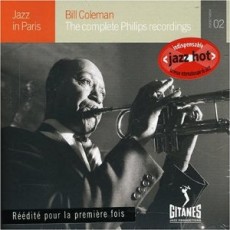
Bill Coleman was born William Johnson Coleman on August 4, 1904 in Paris, Kentucky. In 1909 his family moved from Kentucky to Cincinnati and his first musical explorations were on clarinet and C melody saxophone, but he eventually settled on trumpet. He studied with Cincinnati trumpeter Theodore Carpenter and played in an amateur band led by trombonist J.C. Higginbotham. He began professional work in Cincinnati with bands led by Clarence Paige, Wesley Helvey and then Lloyd and Cecil Scott.
In 1927 he traveled to New York City and played with the Scott brothers to New York City, and continued to work with them until 1929, when he joined the orchestra of pianist Luis Russell. His first recording session was with Russell and he soloed on the tune “Feelin’ the Spirit”. Over the next couple of years he floated between Russell and Scott participating in recording sessions with each of them. By 1933 Bill was on his first European tour with Lucky Millinder, then in October returned to New York, worked with the bands of Benny Carter and Teddy Hill and sat in on a recording session with Fats Waller and laying down a number of memorable sides.
Coleman returned to Europe, played a residency in Paris with entertainer and vocalist Freddy Taylor, recorded with guitarist Django Reinhardt and made several freelance sessions under his own name. In late 1936 he traveled to Bombay, India playing with Leon Abbey’s Orchestra, then back to Paris to join saxophonist William T. Lewis. Returning to the States found him playing with Benny Carter, Teddy Wilson, Andy Kirk, Ellis Larkins, Mary Lou Williams, Sy Oliver, John Kirby, Lester Young, Billie Holiday and Coleman Hawkins.
Due to racial segregation Bill Coleman returned to France in 1948 and lived out his days there touring and performing in clubs and concert halls all over Europe. In 1974 he received the Ordre National du Merite and in 1978, he performed at the first Jazz in Marciac festival (along with tenor saxophonist Guy Lafitte, later becoming an honorary president of the festival organization.
Jazz trumpeter Bill Coleman passed away in Toulouse, France on August 24, 1981. His sound and phrasing were immediately recognizable with a style of the swing era musicians.

Dose A Day – Blues Away
More Posts: trumpet
Daily Dose Of Jazz…
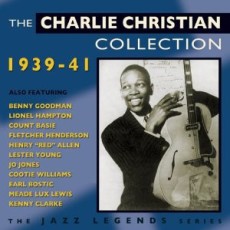
Charlie Christian was born Charles Henry Christian on July 29, 1916 in Bonham, Texas but his family moved to Oklahoma City, Oklahoma when he was a small child. He started performing as a dancer with his father and brothers as buskers to make ends meet. His father would later teach him to play guitar and inherit all his instruments by age 12. Attending Douglass School he was further encouraged in music but a disagreement in instrument led him to leave music and excel in baseball.
By 1936 he was playing electric guitar and had become a regional attraction. He jammed with many of the big name performers traveling through Oklahoma City including Teddy Wilson, Art Tatum and Mary Lou Williams who turned him on to record producer John Hammond. This led to an audition, recommendation to Benny Goodman, subsequently gaining national exposure with the Benny Goodman Sextet and Orchestra from August 1939 to June 1941. By 1940 Christian dominated the jazz and swing guitar polls and was elected to the Metronome All Stars.
Christian was an important early performer on the electric guitar, and is cited as a key figure in the development of bebop and cool jazz. One of the best improvisational talents of the swing era, his single-string technique combined with amplification helped bring the guitar out of the rhythm section and into the forefront as a solo instrument.
Christian’s influence reached beyond jazz and swing, and in 1966, 24 years after his death, Christian was inducted into the Down Beat Hall of Fame. In 1990 he was inducted into the Rock and Roll Hall of Fame and in 2006 Oklahoma City renamed a street in its Bricktown entertainment district Charlie Christian Avenue. On March 2, 1942, Charlie Christian passed away at age 25.
Take A Dose On The Road
More Posts: guitar
Daily Dose Of Jazz…
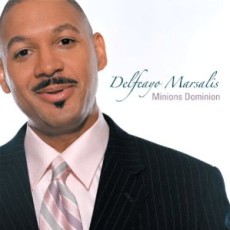
Delfeayo Marsalis was born July 28, 1965 in New Orleans, Louisiana into the musical family in which father and three brothers are musicians. Lying under the piano as a child while his father played, he eventually tried the bass and the drums but by the sixth grade gravitated to the trombone. His early influences were J.J. Johnson, Curtis Fuller, Al Grey, Tyree Glenn and Tommy Dorsey.
He went on to attend the New Orleans Center for Creative Arts high school and was classically trained at the Eastern Music Festival and Tanglewood Institute. He graduated from Berklee School of Music and the University of Louisville with degrees in performance and audio production.
While a gifted trombonist, Delfeayo has recorded only five albums as a leader and is more prolific and better known for his work as a producer of over 100 acoustic jazz recordings. Since the age of 17 he has produced such artists as Harry Connick Jr., Marcus Roberts, Spike Lee, Terence Blanchard, Nicholas Payton, Marcus Roberts, the Preservation Hall Jazz Band and his family members – Ellis, Branford and Wynton.
Along with Tonight Show engineer Patrick Smith, he coined “to obtain more wood sound from the bass recorded without usage of the dreaded bass direct”, a phrase that became the single sentence to define the recorded quality of many acoustic jazz recordings since the late ’80s.
Forming Uptown Music Theatre in 2000, the organization has trained over 300 youth and staged 8 original musicals, all of which are based upon the mission of “community unity.” Marsalis has toured with internationally renowned bandleaders Art Blakey, Slide Hampton, Max Roach, Elvin Jones and Abdullah Ibrahim. In addition he has performed and toured with the Lincoln Center Jazz Orchestra, was a part of the Ken Burns documentary Jazz and is an integral part of Marsalis Family: A Jazz Celebration DVD.
Delfeayo Marsalis, along with his father and brothers, are group recipients of the 2011 NEA Jazz Masters Award. He continues to perform, record, tour and produce.
Dose A Day – Blues Away
Daily Dose Of Jazz…
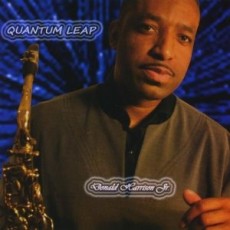
Donald Harrison, Jr. was born June 23, 1960 in New Orleans, Louisiana. He studied at the New Orleans Center for Creative Arts, and then went on to study at Berklee College of Music. In the 80s he became a Jazz Messenger, played with Roy Haynes, Jack McDuff, Terence Blanchard and Don Pullen, and was part of the re-formed Headhunters band in the Nineties.
By1991 Don had recorded “Indian Blues” capturing the sound and culture of New Orleans’ Congo Square in a jazz context and by mid-decade created the “Nouveau Swing” jazz style, merging the swing beat with many of today’s popular dance styles of music as well as those prominent from his cultural experiences in his hometown.
Harrison has performed in the smooth jazz arena, is a producer, singer and rapper in the traditional Afro-New Orleans Culture and hip-hop genres with his group, The New Sounds of Mardi Gras and is the Big Chief of the Congo Nation Afro-New Orleans Cultural Group that keeps alive the traditions of Congo Square.
Not limited by his music crossing genres in his compositions and playing, Don has created large orchestral pieces, was featured in Spike Lee’s HBO documentary “When The Levees Broke”, directed the New Jazz School for the Isidore Newman School, is the director of Tipitina’s Intern Program and has nurtured a number of young musicians including his nephew and Grammy-nominated trumpeter Christian Scott, Mark Whitfield, Cyrus Chestnut, Christian McBride and the Notorious B.I.G.
Give The Gift Of Knowledge
More Posts: saxophone
Daily Dose Of Jazz…
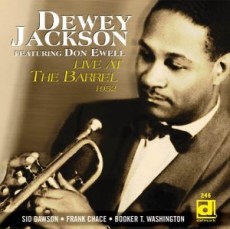
Dewey Jackson was born on June 21, 1900. A trumpeter and cornetist, he began playing professionally at an early age, with the Odd Fellows Boys’ Band in 1912, then Tommy Evans from 1916-17 and George Reynold’s Keystone Band.
He played the riverboats with Charlie Creath and then led his own Golden Melody Band from 1920 to 1923. He continued to be a regular performer on riverboats into the early 1940s, heading his own groups and working as a sideman for Creath and Fate Marable. His only major stint off boats during this time was in 1926, when he played for four months with Andrew Preer at the Cotton Club in New York City.
Jackson played little in the 1940s but returned to work in the 1950s with Singleton Palmer and Don Ewell. He recorded only four sides as a leader in 1926. Among his sidemen were Pops Foster, Willie Humphrey, Don Stovall, Morris White and Clark Terry.
Dewey Jackson passed away on January 1, 1994.
Dose A Day – Blues Away