

Daily Dose Of Jazz…
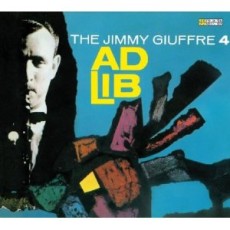
James Peter Giuffre was born on April 26, 1921 in Dallas, Texas. A graduate of Dallas Technical High School and North Texas Teachers College, he first became known as an arranger for Woody Herman. He would become a central figure in West Coast jazz and cool jazz, and was a member of Shorty Roger’s groups before going solo. Giuffre played clarinet, as well as tenor and baritone saxophones, but eventually focused on clarinet.
His first trio in 1957 consisted of Giuffre, guitarist Jim Hall and double bassist Ralph Pena, later replace by Jim Atlas. With minor hit with Giuffre’s “The Train and the River” featured on a television special The Sound of Jazz, he was matched with Pee Wee Russell for a leisurely jam session. When Atlas left the trio, Jimmy replaced him with valve trombonist Bob Brookmeyer. By 1961, Giuffre formed a new trio with Paul Bley and Steve Swallow and exploring free jazz hushed and quiet focus more resembling chamber music. The trio’s early ‘60s explorations of melody, harmony and rhythm are still as striking and radical as any in jazz.
Throughout the ‘60s Giuffre, Bley and Swallow eventually explored wholly improvised music, several years ahead of the free improvisation boom in Europe. By the early 1970s, Giuffre formed a new trio and utilized different instrumentation configurations as he ventured into electric and synthesizers. During this decade he headed the jazz ensemble at New York University, taught private lessons in saxophone and music composition. This continued through the ‘90s at the New England Conservatory of Music.
Jimmy Giuffre, who continually wrote creative and unusual arrangements and who was most notable for his development of forms of jazz which allowed for free interplay between the musicians, anticipating forms of free improvisation, passed away in Pittsfield, Massachusetts on April 24, 2008 of pneumonia, just two days shy of his 87th birthday.

Give A Gift Of Jazz – Share
Daily Dose Of Jazz…
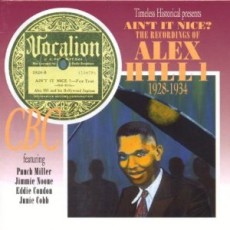
Alex Hill was born on April 19, 1906 in Little Rock, Arkansas to a minister father and pianist mother who taught her child prodigy to play. Defying his father’s wishes the young pianist delved into secular music and while studying at Shorter College met Alphonse Trent and began arranging for him. After graduating in 1922 he worked with several territory bands including Fats Waller and Terence Holder.
From 1924 to 1926 Alex led his own ensemble, then played with Speed Webb, and in 1927 he spent time with Mutt Carey’s Jeffersonians and Paul Howard’s Quality Serenaders. Later that same year Hill relocated to Chicago and held a job as an arranger for the Melrose Music Publishing Company, while simultaneously arranging for the Carroll Dickerson Orchestra. He began recording as a leader and a sideman in 1928 and continued through 1934.
By 1930, prior to a move to New York City, Alex had played with Jimmy Wade, Jimmie Noone and Sammy Stewart. During his time in New York he arranged for Paul Whiteman, Benny Carter, Claude Hopkins, Andy Kirk, Eddie Condon and Duke Ellington among others. Additionally, he became staff arranger for the Mills Music Company. Reuniting with Fats Waller the two did a show together in New York called “Hello 1931”, and accompanied Adelaide Hall.
Hill again put together his own group in 1935, but after playing the Savoy Ballroom he disbanded the ensemble due to his battle with tuberculosis. Moving back to Little Rock, pianist and arranger Alex Hill passed away in February 1937 at the age of 30.
Give A Gift Of Jazz – Share
Daily Dose Of Jazz…
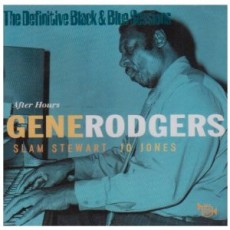
Gene Rodgers was born on March 5, 1910 in New York City. He worked professionally as a pianist from the mid-1920s and over the next few years made recordings with Clarence Williams and King Oliver while also playing with Chick Webb and Teddy Hill.
Rodgers started his own variety show in the 1930s, doing tours of Australia and England recording with Benny Carter in 1936 while in the latter. Upon his return to the States in ‘39 he played with Coleman Hawkins, Zutty Singleton and Erskine Hawkins into the early 40s. During the Forties he worked in Hollywood appearing in the film Sensations of 1945 with Cab Calloway and Dorothy Donegan. After this he worked mainly in New York, leading a trio for many years.
Rodgers appears, with opening title credits, in the 1947 film “Shoot To Kill”, and appearing in the film are two of his compositions “Ballad of the Bayou” and later is “Rajah’s Blues”.
Rodgers recorded sparingly as a leader; he did two sides for Vocalion in 1936, four in a session for Joe Davis in 1945, and albums as a trio leader for EmArcy, Black & Blue Records and 88 Up Right. He played with the Harlem Blues and Jazz Band in 1981-82.
Gene Rodgers, pianist and arranger, best known for his contributions on Coleman Hawkins’ 1939 recording of “Body and Soul”, passed away on October 23, 1987 in New York City.
More Posts: piano
Daily Dose Of Jazz…
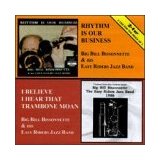
Big Bill Bissonnette was born February 5, 1937 in Bridgeport, Connecticut who became a jazz trombonist and producer. A strong advocate of New Orleans jazz played by Black musicians in the Sixties he led his group The Easy Riders Jazz Band.
During that period Bill also established his own Jazz Crusade label and organized northern tours for such veterans as Kid Thomas Valentine, George Lewis and Jim Robinson. After a period off the jazz scene, Bill successfully published of his 1992 memoirs, “The Jazz Crusade” that told many stories about New Orleans’ musicians.
Bissonnette reactivated his label and began to play trombone again. He has produced and recorded over 100 jazz sessions for his Jazz Crusade label, appearing as trombonist or drummer on over 50 recording sessions of New Orleans jazz.
He has spent much of the 1990s documenting the British jazz scene with his “Best of the Brits” CD series. He published a newsletter several times a year. Trombonist, drummer, producer, bandleader and writer retired from music and now resides in Concord, North Carolina in 2006.
More Posts: bandleader,drums,writer
Daily Dose Of Jazz…
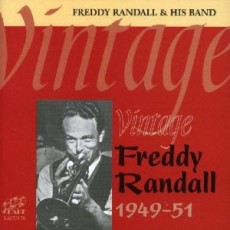
Freddy Randall was born Frederick James Randall on May 6, 1921 in Clapton, East London, England. Becoming interested in music in school the self-taught musician took up the trumpet at 16, never learned to read music but still achieved a high degree of technical proficiency with a flair and exuberance which marked him out. He began playing in local bands including Albert Bale’s Darktown Strutters and Will De Barr’s Band.
Randall’s heroes were the so-called Dixieland players out of Chicago like Wild Bill Davison and Muggsy Spanier and his own playing reflected their influence as he led the St. Louis Four in 1939. After military service he played Freddy Mirfield and John Dankworth before leading his own Dixieland groups in the late forties that featured many well-known English trad jazz stars of the era.
By 1958 Freddy left music due to lung problems, not resurfacing until ’63 playing with Dave Shepherd and recording for Black Lion Records. Over the course of his career Randall played with visiting American jazz musicians Sidney Bechet, Bud Freeman, Wild Bill Davison, Pee Wee Russell, Bill Coleman and Teddy Wilson.
Freddy Randall, trumpeter and bandleader, died on May 18, 1999 in Teignmouth, Devon at age 78.

More Posts: trumpet