

Daily Dose OF Jazz…
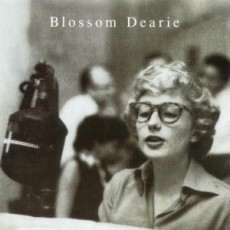
Blossom Dearie was born April 28, 1924 in East Durham, New York and as a child she studied Western classical piano but switched to jazz in her teens. After high school Dearie moved to New York City to pursue a music career and began to sing in groups such as the Blue Flames with the Woody Herman Orchestra and the Alvino Rey’s Blue Reys before starting her solo career.
She moved to Paris in 1952 and formed a vocal group, the Blue Stars of Paris, which included Michel Legrand’s sister Christine and Bob Dorough. In 1954 the group had a hit in France with a French version of “Lullaby of Birdland”. The Blue Stars would later evolve into the Swingle Sisters. Interestingly, on her first solo album released two years later, she plays the piano but does not sing.
After returning to the U.S. Blossom, Dearie made her first six American albums as a solo singer and pianist for Verve Records in the late 1950s and early 1960s, mostly in a small trio or quartet setting. In 1962, she recorded a radio commercial for Hires Root Beer. Through the Sixties she recorded with orchestra, performed in supper clubs around New York, appeared at Ronnie Scott’s in London and recorded four albums in the UK.
After a period of inactivity, by the ‘’70s she established her own label, Daffodil Records, lent her voice to “Mother Necessity” and “Figure Eight” on “Schoolhouse Rock!” and she collaborated with Johnny Mercer on one of his final songs “My New Celebrity Is You”. Her voice and songs have been featured in such films as Kissing Jessica Stein, The Squid and the Whale, My Life Without Me and The Adventures of Felix.
Blossom Dearie, vocalist, pianist and one of the last remaining supper-club performers, continued to perform in clubs until shortly before she passed away on February 7, 2006 at age 84 in Greenwich Village, New York.

Dose A Day-Blues Away
From Broadway To 52nd Street
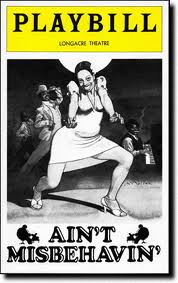
Ain’t Misbehavin’ opened at the Longacre Theatre on May 8, 1978 and ran for 1604 performances, establishing it as one of the blockbuster musicals of Broadway. Thomas “Fats” Waller who left an indelible imprint on the music by the time of his death at age 41 composed the music that included jazz favorites “Ain’t Misbehavin”, “Honeysuckle Rose” and “I’m Gonna Sit Right Down And Right Myself A Letter”. Richard Maltby directed Nell Carter, Andre Deshields, Armelia Mcqueen and Ken Page.
The Story: Began performance at the Manhattan Theatre Club, this musical retrospective of the life of Fats Waller, master of the stride piano, comedian, last of the great Black minstrel showmen, uses his songs written with various lyrics. In spirit, Ain’t Misbehavin’ evokes the late days of Prohibition when “vipers” smoked “reefers” and bootleg booze could be the worst or the best depending on the source of supply. Title song first sung in the 1929 revue “Hot Chocolates”. The musical won a Grammy in 1978 for Best Cast Show Album.
Broadway History: By the Seventies Broadway is a disheveled cornucopia of porn shows, strip clubs, drug dealers, pimps, prostitutes, runaways, hustlers and street people. The American Musical was not dissuaded by this environment as it morphed into a cultural consciousness during the Seventies to become an instrument of social commentary bringing plays with mixed casts like Hair, Jesus Christ Superstar, Godspell, Two Gentlemen From Verona and the longest running play on the avenue A Chorus Line. Though the country was still reeling from Vietnam, plays like Company gave audiences an opportunity to view middle-class morality and their problems. Black audiences got to see shows like Bubbling Brown Sugar, Timbuktu, Eubie and Purlie opening up the stage for more Black actors and musicals to shine on the Great White Way.
Sponsored By

www.whatissuitetabu.com

From Broadway To 52nd Street
A Little Night Music brings up the curtain of the Shubert Theatre on February 2, 1973. Stephen Sondheim composed the music that spawned the jazz classic Send In The Clowns. Glynis Johns, Len Cariou, Victoria Mallory, Laurence Guittard, Hermione Gingold and Mark Lambert. Though it only ran for 600 performances it went on to get a movie made in 1978, directed by Harold Prince and starring Elizabeth Taylor, Lesley-Anne Down and Diana Rigg.
The Story: Based on the Ingmar Bergman comedy about sexual liaisons at a country mansion. Frederick falls in love with his former mistress Desiree’ and would dissolve his marriage to his child bride. Count Carl, Desiree’s lover, attempts to cool the romance. However at a dinner party given by Desiree’s mother, Frederick’s son, Henrik, runs off with his young mother-in-law, the Count returns to his wife and Frederick and Desiree’ are free to pursue their romance.
Jazz History: It’s the 1970s and jazz is in an evolutionary mode as the old guard makes way for a new sound. The jazz world has witnessed the release of fusion albums from Weather Report, Chick Corea and Return To Forever and the Mahavishnu Orchestra. Herbie Hancock records the classic jazz/funk album Head Hunters that includes “Chameleon” and “Watermelon Man” as does drummer Billy Cobham with his recording “Spectrum” with Tony Bolin, Jan Hammer, Lee Sklar, Joe Farrell, Jimmy Owens, John Tropea, Ron Carter and Ray Barretto. In 1973 swing and bop saxophonist Ben Webster passes away on September 20th as does stride piano pioneer Willie “The Lion” Smith on October 8th. Fortunately for the many young men who haven’t been called upon, the United States is almost completely out of Vietnam.
Sponsored By
www.whatissuitetabu.com
From Broadway To 52nd Street
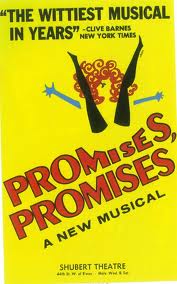
Promises, Promises opened at the Shubert Theatre on December 1, 1968 and ran for 1281 performances, ushering it into the blockbuster hall of fame. Composers Burt Bachrach & Hal David scored the music that rendered I’ll Never Fall In Love Again that went on to become a jazz standard. Jerry Orbach, Ken Howard and Jill O’hara star.
The Story: In this adaptation of the Jack Lemmon movie vehicle “The Apartment”, a young man (Jerry Orbach) attempts to get ahead in the world of business, climbing the corporate ladder by lending his apartment to various executives.
Broadway History: A reluctant success of Broadway is the fact that many of the plays had been turned into movies by the Hollywood film industry. When the movie studios began implementing sound technology for film screenings, musicals were some of the first productions released on the silver screen. Not only did the scripts migrate from the stage to the screen, but many actors and actresses did as well. To this day, many well-known film actors began their career on Broadway.
Sponsored By
www.whatissuitetabu.com
Daily Dose Of Jazz…
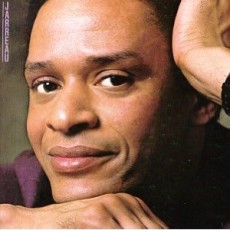
Alwin Lopez Jarreau was born March 12, 1940 in Milwaukee, Wisconsin to a minister/singer father and church pianist mother. He started out sing church concerts and benefits with his family and PTA meetings with his mother. He attended Ripon College where he sang with a group called the Indigos but graduated in 1962 with a Bachelor of Science degree in Psychology and went on to earn his Masters in Vocational Rehabilitation from the University of Iowa. He then worked as a Rehabilitation Counselor in San Francisco and moonlighted with a jazz trio led by George Duke.
By 1967, Al found success with acoustic guitarist Julio Martinez and the duo became the star attraction at Gatsby’s, a small Sausalito nightclub, which ultimately guided his decision to make singing his profession. Heading south the duo hit the L.A. hotspots, appeared on Johnny Carson, Merv Griffin, Mike Douglas and David Frost shows, and sang at The Improv between rising star comics like Bette Midler, Jimmie Walker and John Belushi.
Jarreau made jazz his primary occupation and in 1975 he signed with Warner Brothers dropping his critically acclaimed debut album, “We Got By”, that catapulted him to international fame and was soon followed by his second release “Glow”. He wrote and performed the Grammy-nominated theme to the 1980s television show “Moonlighting” and is also well known for his scat singing and the ability to imitate conventional guitar, bass, and percussive instrumentation.
Al was a featured vocalist on USA for Africa’s “We Are The World”, toured extensively, got his symphony program under way, performed on the Broadway production of “Grease” and signed with Verve. He has toured and performed with Joe Sample, Kathleen Battle, Miles Davis, David Sanborn, Rick Braun and George Benson among others. The seven-time Grammy winner in jazz, pop and R&B categories received a star on the Hollywood Walk of Fame. Al Jarreau continued to tour, perform and record until February 12, 2017, when he passed away of respiratory failure, at the age of 76, just two days after announcing his retirement, and one month before his 77th birthday.
\>
Give A Gift Of Jazz – Share
More Posts: vocal