

Daily Dose Of Jazz…
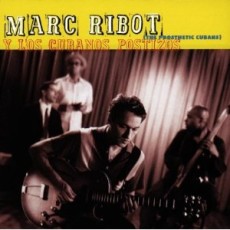
Marc Ribot was born on May 21, 1954 in Newark, New Jersey and worked extensively as a session musician. His early sessions with Tom Waits helped define Waits new musical direction in 1985.
His own work has touched on many styles, including n wave, free jazz and Cuban music. Ribot’s first two albums featured The Rootless Cosmopolitans, followed by an album of works by Frantz Casseus and Arsenio Rodriguez. Further releases found him working in a variety of band and solo contexts including two albums with his self-described “dance band”, Marc Ribot y Los Cubanos Postizos.
His relatively limited technical facility is due to learning to play right-handed despite being left-handed. He currently performs and records with his group Marc Ribot’s Ceramic Dog. Marc’s studio work involves several tracks accompanying the legendary pianist McCoy Tyner’s “Guitars” project. He has performed and recorded with Jack McDuff, John Scofield, Wilson Pickett, Cibo Matto, Bela Fleck, Derek Trucks, Madeline Peyroux, Medeski Martin & Wood, Elton John and many others.
He has toured Europe with his band Sun Ship, had a biographical documentary film called the The Lost String and has also judged the 8th Annual Independent Music Awards to support indie careers in music. He has twenty-one albums as a leader, a filmography that includes five and a biographical documentary about him titled The Lost String. Guitarist Marc Ribot also plays banjo, trumpet, cornet and sings and continues to perform, record and tour.

Dose A Day-Blues Away
From Broadway To 52nd Street
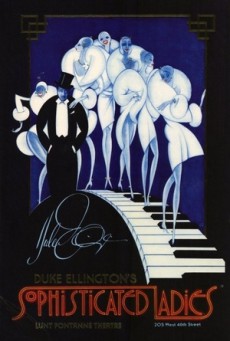
Sophisticated Ladies had a preview run of 15 shows beginning February 16th prior to its official opening at the Lunt Fontanne Theatre on March 1, 1981 and ran for 767 performances. Duke Ellington composed the music for the revue with a cast that included Gregory Hines, Judith Jamison, Phyllis Hyman, Hinton Battle, Gregg Burge and Mercer Ellington. Hines’ older brother Maurice joined the cast later in the run.
The score includes classic jazz tunes “Mood Indigo,” “Take The “A” Train, I’m Beginning To See The Light, Hit Me With A Hot Note and See Me Bounce, It Don’t Mean A Thing (If It Ain’t Got That Swing), I Let A Song Go Out Of My Heart, Old Man Blues, In A Sentimental Mood, Sophisticated Lady, Don’t Get Around Much Anymore, Satin Doll and I Got It Bad And That Ain’t Good among numerous others.
Jazz History: In the 1980s the jazz community shrank dramatically and split. A mainly older audience retained an interest in traditional and straight-ahead jazz styles. Wynton Marsalis strove to create music within what he believed was the tradition, creating extensions of small and large forms initially pioneered by such artists as Louis Armstrong and Duke Ellington. In the early part of the decade, a commercial form of jazz fusion called pop fusion or smooth jazz became successful and garnered significant radio airplay.
Smooth jazz received frequent airplay with more straight-ahead jazz in “Quiet Storm” time slots (a format begun at Howard University’s WHUR by host Melvin Lindsay) at radio stations in urban markets across the United States. This helped to establish or bolster the careers of Grover Washington, Jr., Kenny G, Kirk Whalum, Boney James and David Sanborn and vocalists including Al Jarreau, Anita Baker, Chaka Khan and Sade.
In this same time period “Echoes of an Era” was released by the sextet comprised of Chaka Khan (vocal), Joe Henderson (saxophone), Freddie Hubbard (trumpet), Chick Corea (piano), Stanley Clarke (bass) and Lenny White (drums). The quintet released another “Echoes” enlisting the vocal talents of Nancy Wilson. The quintet would also release two albums titled “The Griffith Park Collection”.
Sponsored By

www.whatissuitetabu.com

From Broadway To 52nd Street…
Evita opened at the Broadway Theatre on September 25, 1979 and ran 1,567 performances. The musical starred Patti Lupone, Mandy Patinkin, Bob Gunton, Mark Syers, Jane Ohringer singing music composed by Andrew Lloyd Webber with lyrics by Tim Rice. The show began as a rock opera concept album released in 1976. Its success led to productions in London’s West End in 1978, and on Broadway a year later, both of which enjoyed considerable success. A major 1996 film of the musical was made, starring Madonna and Antonio Banderas. The musical was revived in London in 2006. Evita has had numerous professional tours and worldwide productions, and numerous cast albums have been recorded, and won a 1980 Grammy. “Don’t Cry For Me Argentina” has become an entry into the catalogue of jazz standards.
The Story: Evita is a musical that concentrates on the life of Argentine political leader Eva Peron, the second wife of Argentinian President Juan Peron. The story follows Evita’s early life, rise to power, charity work, and eventual death.
Broadway History: The Booth Theatre was given its name in recognition of one of the great contributors to American theatre. However, the current Booth Theatre does not get its name from an accomplished actor, playwright, or producer. It comes instead from the original Booth Theatre, which was originally located on 23rd Street and 6th Avenue. The original Booth Theatre, which opened on February 3, 1869 with a production of Romeo and Juliet, derived its name from Edwin Booth, an accomplished Shakespearean actor, who unfortunately happens to be the brother of infamous actor/assassin John Wilkes Booth. Although demolished only fourteen years later in 1883, the theatre revolutionized American drama by incorporating hydraulic ramps to change scenery, an electric device that allowed changes in lighting, and a sprinkler system. Fun fact, the top floor of the original theatre’s adjoining shop and rehearsal space was reserved as Edwin’s personal apartment.
Sponsored By
www.whatissuitetabu.com

Daily Dose Of Jazz…
Teresa Brewer was born Theresa Veronica Breuer on May 7, 1931 in Toledo, Ohio and at the age of two her mother took her to audition for a radio program, “Uncle August’s Kiddie Show” on Toledo’s WSPD, performing for cookies and cupcakes. Although she never took singing lessons, she took tap dancing lessons and from age five to twelve, she sang and danced on the “Major Bowes Amateur Hour,” then a popular touring radio show.
At the age of 12, Theresa returned to Toledo, ceased touring, went back to school and continued to perform on local radio. By 1948 at 16 she won a local competition, went to New York, won a number of talent shows and played New York nightclubs including the Latin Quarter.
Discovered by agent, Richie Lisella she signed with London Records and in 1949 recorded her first session that sold over a million copies and “Music! Music! Music!” became her signature song.
In 1951 she switched labels, going to Coral Records and had a string of hits. Since she never learned to read music, she had demos sent to her to learn the melodies of the songs she would record. During those years she continued to play nightclubs in New York, Chicago, Las Vegas and elsewhere. In the mid-50s, she did a number of covers of rhythm and blues and country songs, and co-wrote “I Love Mickey” for Yankees center fielder Mickey Mantle, appeared in the musical “Those Redheads From Seattle” stealing the show fro veterans Rhonda Fleming, Agnes Moorehead and Guy Mitchell.
By 1962 she switched to Philips Records, recorded many singles and albums over a five-year period, also re-recorded her earlier material with new arrangements and instrumentation. In 1977 Teresa guest starred on The Muppet Show and Sha Na Na.
Throughout the ‘80s and ‘90s she re-emerged as a jazz singer paying tribute to Bessie Smith, Louis Armstrong, Fats Waller and Irving Berlin. She recorded with Count Basie, Duke Ellington, Earl “Fatha” Hines and Bobby Hackett.She recorded nearly 600 song titles, received a star on the Hollywood Walk of Fame and inducted into the Hit Parade Hall of Fame.
Singer Teresa Brewer passed away on October 17, 2007 in New Rochelle, New York of Progressive Supranuclear Palsy, a rare degenerative brain disease at 76.
Dose A Day-Blues Away
More Posts: vocal
From Broadway To 52nd Street
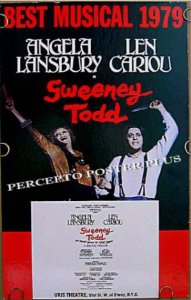
Sweeney Todd opened at the Uris Theatre on March 1, 1979 and ran for 557 performances. The musical starred Angela Landsbury and Len Cariou with music composed by Stephen Sondheim from which came the song Pretty Women that entered into the jazz pantheon. The show would also win Best Musical for that year.
The Story: The Demon Barber of Fleet Street was set in the 19th century London. Todd is a barber who dispatches his victims by pulling a lever as they sit in his barber chair. Todd “polishes them off”, slitting their throats with his straight razor before dispatching them into the basement via the revolving trapdoor. After Todd has robbed his dead victims of their goods, Mrs. Lovett, his partner in crime assists him in disposing of the bodies by baking their flesh into meat pies and selling them to the unsuspecting customers of her pie shop. Todd’s barbershop is situated at 186 Fleet Street and is connected to Mrs. Lovett’s pie shop by means of an underground passage.
Jazz History: The end of the 70s decade saw trumpet virtuoso Wynton Marsalis in New York and a hard bop revival was soon underway. Bassist and composer Charles Mingus dies in Mexico at the age of 56. Vocalese singer Eddie Jefferson dies on May 9 in Detroit, Michigan. A jam session at the Brecker brothers’ club will produce the group Steps Ahead. Gil Scott Heron is experimenting with a new form of music which involves spoken poetry set to music, similar to what will later be known as hip hop and rap; the first Sony Walkman (model TPS-L2) hits the market and two years later the word “Walkman” enters the dictionary, and the product changes listening habits forever.
Sponsored By
www.whatissuitetabu.com