

Daily Dose Of Jazz…
Zilner Trenton Randolph was born in Dermott, Arkansas on January 28, 1899 and matriculated at Biddle University, the Kreuger Conservatory, and the Wisconsin Conservatory of Music.
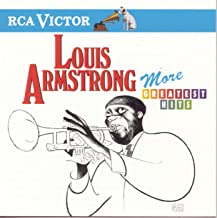
Randolph played in St. Louis, Missouri in the early 1920s, then in Bernie Young’s band in Milwaukee, Wisconsin from 1927 to 1930. A move to Chicago, Illinois in 1931 and was a trumpeter and arranger with Louis Armstrong until 1932 and again in 1933 and 1935.
He played trumpet on a number of Armstrong’s recordings and composed the tune Old Man Mose. In 1934 he played with Carroll Dickerson and Dave Peyton, and led his own Chicago band later in the decade. He arranged for bandleaders Earl Hines, Woody Herman, Fletcher Henderson, and Duke Ellington, and led a quartet in the 1940s.
From the 1940s Zilner devoted himself mainly to teaching, but recorded as a pianist in 1951. Trumpeter, arranger, composer and music educator Zilner Randolph, whose children Hattie and Lucious were part of Sun Ra’s band in the Fifties, transitioned on February 2, 1994.
More Posts: arranger,bandleader,composer,educator,history,instrumental,jazz,music,trumpet
Daily Dose Of Jazz…
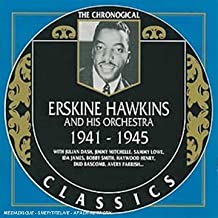
James Avery Parrish was born on January 24, 1917 in Birmingham, Alabama. Graduating from Parker High School he went on to matriculate Alabama State Teachers College, where he played in the Bama State Collegians, an ensemble led by Erskine Hawkins. He remained in Hawkins’s employ performing and arranging until 1942 and recorded with him extensively. Composing the music to After Hours, a 1940 recording of the tune with Hawkins’s orchestra resulted in its becoming a jazz standard.
Driving to gigs between Pittsburgh and Chattanooga in 1942 he was injured in an overturned car crash that killed Hawkin’s trumpeter Marcellus Green, one of the five men in the vehicle. Avery left Hawkins later that year and moved to California, where hebecame a commercially successful solo pianist. Hit in the head by a bar stool during a bar fight in 1943l put him in hospital for a few months. His injuries left him partly paralyzed, thus ending his career and ability to play music for the rest of his life.
Pianist, composer and arranger Avery Parrish transitioned of unknown causes on December 10, 1959. He was posthumously inducted twenty years later into the Alabama Jazz Hall of Fame.
More Posts: arranger,composer,history,instrumental,jazz,music,piano
Daily Dose Of Jazz…
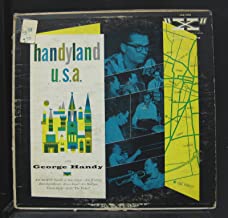
George Handy, born George Joseph Hendleman on January 17, 1920 in New York City, where his musical beginnings were fostered under the tutelage of composer Aaron Copland.
He first worked professionally as a swing pianist for Michael Loring in 1938. Soon afterward George was drafted into the United States Army in 1940. Post WWII, from 1944 to 1946 he became a member of the Boyd Raeburn Orchestra, composing and performing on piano. This was during a time when many big bands were transforming their musical tendencies toward bebop. Leaving the orchestra briefly to work for Paramount Studios, he returned to Raeburn quickly. During this period he entered one of his most creative periods, doing arrangements of older standards with a distinctly bebop quality.
A rift between him and Raeburn, just as he was entering his prime, forced him to depart the group. Handy continued to arrange for other musicians in his later career.
Pianist, arranger and composer George Handy, best remembered in retrospect for his bebop arrangements, transitioned in Harris, New York, on January 8, 1997 at the age of 76, from heart disease.
More Posts: arranger,composer,history,instrumental,jazz,music,piano

Daily Dose Of Jazz…
Alain Mion was born of French extraction on January 14, 1947 in Casablanca, Morocco but was raised in Paris, France.Influenced by Bobby Timmons, Ray Charles and Les McCann, his style varies between jazz, soul jazz and funky music. By the time he was 19 he formed his own trio and performed at the Blue Note. This subsequently led to him gigging at various festivals with Hank Mobley and Philly Joe Jones.
1974 Alain created the jazz funk group Cortex and recorded a dozen albums before embarking upon a career under his own name in 1982, recording to date eleven albums, such as Pheno-Men, Alain Mion in New York recorded with David Binney and Marc Johnson, and Some Soul Food recorded in Stockholm, Sweden with Patrik Boman and Ronnie Gardiner.
In 2008, he emerged with a new group, Alain Mion FunKey Combo with drums, bass and a saxophone section consisting of Italian and French musicians. He reinvented his new group Alain Mion & The New Cortex with the singer Adeline de Lépinay reprising the role originally performed by Mireille Dalbray on the Troupeau Bleu album.
In the United States, Alain Mion and Cortex’s songs have been sampled by several hip-hop artists including but not limited to Madlib, Fat Joe, DJ Day, MF DOOM, Wiz Khalifa, Curren$y, Mellowhype, Tyler The Creator, Rick Ross, and Lupe Fiasco.
Pianist, composer, arranger, and vocalist Alain Mion continues his exploration of the jazz idiom.
More Posts: arranger,bandleader,composer,history,instrumental,jazz,music,piano,vocal
Daily Dose Of Jazz…
Bud Scott was born Arthur Budd Scott on January 11, 1890 in New Orleans, Louisiana. He played guitar and violin as a child and performed professionally from an early age. His first job was with New Orleans dance band leader John Robichaux in 1904 and as a teenager he played with Buddy Bolden. In 1911 he was playing guitar with Freddie Keppard’s Olympia Orchestra. In 1912 he left New Orleans with a large travelling show.
As a violinist he performed with James Reese Europe’s Clef Club Orchestra at a historic 1912 concert at Carnegie Hall, and the following year worked with Europe’s ensemble on the first jazz recordings on the Victor label.He would go on to play on a number of Victor Talking Machine Company ragtime recordings with James Reese Europe’s Society Orchestra in 1913.
A graduate of the Peabody School of Music, he was a notable rhythm guitarist in Chicago, Illinois’s Jazz Age nightclubs of the 1920s. Moving there in 1923, he became a member of King Oliver’s Creole Jazz Band, originating the now traditional shout, Oh, play that thing!, on Oliver’s recording of Dippermouth Blues. He also worked with Johnny Dodds and Jimmy Blythe, Erskine Tate, Jelly Roll Morton’s Red Hot Peppers and Richard M. Jones’ Jazz Wizards.
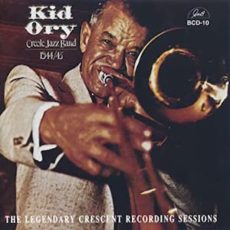
Scott was the first person to use a guitar in a modern dance orchestra, in Dave Peyton’s group accompanying Ethel Waters at Chicago’s Cafe de Paris. After performing and recording with Jimmie Noone’s Apex Club Orchestra in 1928 he moved to California. Making a living as a professional musician through the 1930s, when traditional jazz was eclipsed by big-band swing music, he formed his own trio. In 1944 Scott joined an all-star combination that evolved into Kid Ory’s Creole Jazz Band. This was an important force in reviving interest in New Orleans-style jazz in the 1940s, and he wrote the majority of the band’s arrangements.
In 1944 Bud joined an all-star traditional New Orleans band that was a leader of the West Coast revival, put together for the CBS Radio series The Orson Welles Almanac. He arranged most of the songs for Kid Ory’s band, of which he was a part. His talent for arranging earned him the title of The Master.
A stroke in 1948 forced his retireent from music. Guitarist, banjoist, violinist and vocalist Bud Scott, whose obituary ran on the front page of the Los Angeles Sentinel, transitioned in Los Angeles, California on July 2, 1949, aged 59.
More Posts: arranger,banjo,buitar,history,instrumental,jazz,music,violin,vocal