


Daily Dose Of Jazz…
Sonny Phillips was born on December 7, 1936 in Mobile, Alabama. Phillips began playing jazz organ after hearing Jimmy Smith in his twenties. He studied under Ahmad Jamal, and played in the 1960s and 1970s with Lou Donaldson, Nicky Hill, Eddie Harris, Houston Person, and Gene Ammons.
His debut album Sure ‘Nuff was released on the Prestige Records label in 1969. He released several records as a leader in the Seventies before suffering a long illness in 1980. He also recorded twenty-three albums as a sideman with Harris, Person, Ammons, Rusty Bryant, Billy Butler, Willis Jackson, Etta Jones, Boogaloo Joe Jones and Bernard Purdie.
Electric organist and pianist Sonny Phillips went into semi-retirement after suffering a long illness. He moved to Los Angeles, California and has since performed and taught occasionally.

More Posts: bandleader,history,instrumental,jazz,music,organ,piano

Daily Dose Of Jazz…
Ulysses Owens Jr. was born December 6, 1982 in Jacksonville, Florida and began playing the drums at the age of 3. He played many types of music in his younger years, centering on his experience in the church. By the time he was in his early teens, he realized that he would become a jazz musician and received a full scholarship to study at the Juilliard School, in its inaugural jazz program.
After graduating from Juilliard in 2006, Ulysses traveled the world as a jazz drummer. After hearing about Jacksonville’s high dropout rate and other problems with struggling youths, he and his family designed a program to help suspended youths stay in school.
Owens was vocalist Kurt Elling’s drummer on Dedicated to You: Kurt Elling Sings the Music of Coltrane and Hartman, and on bassist Christian McBride’s The Good Feeling, both of which won Grammy Award. He has also played and recorded with pianist Joey Alexander, Gregory Porter and Matthew Whitaker. His composition The Simplicity of Life was commissioned by the string quartet ETHEL for their multimedia show ETHEL’s Documerica.
Drummer and percussionist Ulysses Owens Jr., who is co-founder and artistic director of the charity, Don’t Miss A Beat, continues to perform and compose.
More Posts: bandleader,drums,history,instrumental,jazz,music

Daily Dose Of Jazz…
Kansas Fields was born Carl Donnell Fields on December 5, 1915 in Chapman, Kansas and first played in Chicago, Illinois from the late Twenties and worked with King Kolax and Jimmie Noone in the 1930s. In 1940 he joined Roy Eldridge’s group for a year and returned to play with Eldridge again later in the decade.
He briefly led his own ensemble and played with Ella Fitzgerald and Benny Carter before joining the Marines during World War II. After the war, Kansas played with Cab Calloway, Claude Hopkins, Sidney Bechet, Dizzy Gillespie, and Eldridge again before the close of the decade.
Forming another group early in the 1950s, he then played with Mezz Mezzrow in Europe in 1953. Fields stayed in Europe for more than a decade, relocating to France where he worked as a sideman. In 1965, he returned to Chicago, working once more with Gillespie and doing studio work.
Drummer and bandleader Kansas Fields transitioned on March 7, 1995 in Chicago.
More Posts: bandleader,drums,history,instrumental,jazz,music

Daily Dose Of Jazz…
Denis Alphonso Charles was born December 4, 1933 in St. Croix, Virgin Islands and first played bongos at age seven with local ensembles. 1945 saw him moving to New York City, and gigging frequently around town. Nine years later he was working with Cecil Taylor and the pair collaborated until 1958. Following this he played with Steve Lacy, Gil Evans, and Jimmy Giuffre. Befriending Ed Blackwell, the two influenced each other.
He went on to record with Sonny Rollins on a calypso-tinged set, and then returned to Lacy, with whom he played until 1964. He worked with Archie Shepp and Don Cherry in 1967, but heroin addiction saw him leave the record industry until 1971. In the 1970s and 1980s, he played regularly on the New York jazz scene with Frank Lowe, David Murray, Charles Tyler, Billy Bang, and others. He also played funk, rock, and traditional Caribbean music. He released three discs as a leader between 1989 and 1992. , and died of pneumonia in his sleep in New York in 1998.
Drummer Denis Charles, who released three albums as a leader, thirty-four as a sideman and several with the BMC Trio, transitioned four days after a five week European tour on March 26, 1998 from pneumonia.
More Posts: bandleader,drums,history,instrumental,jazz,music
Daily Dose Of Jazz…
Melissa Aldana was born on December 3, 1988 in Santiago, Chile and began playing the saxophone when she was six under the influence and tuition of her father Marcos Aldana, also a professional saxophonist. She began with alto, influenced by Charlie Parker, Cannonball Adderley and Michael Brecker. However, upon first hearing the music of Sonny Rollins, she switched to tenor, picking up her grandfather’s Selmer Mark VI.
Performing around hometown jazz clubs while in her early teens, in 2005 she was invited by pianist Danilo Pérez to play at the Panama Jazz Festival as well as auditions at music schools in the USA. This resulted in Melissa attending the Berklee College of Music in Boston, Massachusetts studying under Joe Lovano, George Garzone, Frank Tiberi, Greg Osby, Hal Crook, Bill Pierce, and Ralph Peterson. After graduating she relocated to New York City to study with George Coleman.
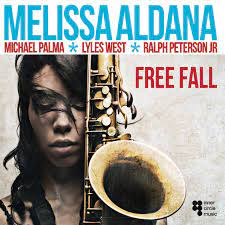
Aldana recorded her debut album, Free Fall, released in 2010 on Greg Osby’s Inner Circle Music label. Two years later she released her sophomore project, Second Cycle, and by age 24, she was the first female and South American musician to win the Thelonious Monk International Jazz Saxophone Competition, in which her father had been a semi-finalist in 1991. The prize was a $25,000 scholarship, and a recording contract with Concord Jazz.
Aldana has been awarded the Altazor National Arts Award of Chile, and the Lincoln Center’s Martin E. Segal Award. She has played concerts alongside artists such as Peter Bernstein, Kevin Hays, Christian McBride, Jeff “Tain” Watts, Jimmy Heath and Wynton Marsalis.
She has formed the group, Melissa Aldana & Crash Trio, with Cuban drummer Francisco Mela and Chilean bassist Pablo Menares, and in addition her most recent configuration in 2017, the Melissa Aldana Quartet includes Aldana on tenor saxophone, pianist Sam Harris or guitarist Lage Lund, bassist Pablo Menares and drummer Kush Abadey.
Tenor saxophonist Melissa Aldana continues to explore and expand her vocabulary as she performs and records.
More Posts: bandleader,history,instrumental,jazz,music,saxophone