

Daily Dose Of Jazz…
Christopher Brubeck was born on March 19, 1952 in Los Angeles, California to pianist and composer Dave Brubeck. By the age of twenty he was joining his father and brothers Darius and Daniel in The New Brubeck Quartet.
Having toured for about 30 years in a group called Triple Play, he joined with guitarist Joel Brown and singer and harmonica virtuoso Peter Madcat Ruth, and swung jazz Louisiana style. He was a member of New Heavenly Blue, Chris also participated and recorded as a keyboardist/trombonist/guitarist in 1970’s Educated Homegrown.
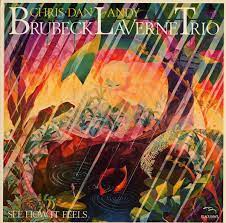
In 1999, Chris and his brother Daniel joined with other musicians to form The Brubeck Brothers Quartet, having previously partnered with Andy LaVerne and released a 1972 album, The Brubeck-LaVerne Trio. He has performed with Mike DeMicco and Chuck Lamb.
In 2003, Chris played his first Concerto for Bass Trombone and Orchestra with the Czech national Symphony Orchestra in Prague, Czech Republic. A year later, he composed his own concerto titled, The Prague Concerto for Bass Trombone and Orchestra. Many of his classical compositions still contain strong hints of the jazz influence of his father.
Grammy nominated electric bassist, bass trombonist and pianist Chris Brubeck continues to pursue his musical explorations.
More Posts: bandleader,bass,history,instrumental,jazz,music,piano,trombone
The Quarantined Jazz Voyager
Remaining hesitant to be in crowds of people without a mask, more and more people are unmasking while we are still in the pandemic. Legislators are speaking unmask rhetoric and otherwise responsible people are listening. This Jazz Voyager is listening to my conscience and protecting myself and those around me.
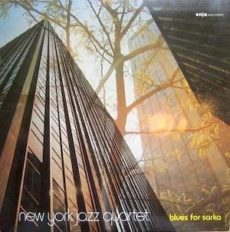
This week I have chosen another quartet recording by the New York Jazz Quartet, founded by pianist Roland Hanna. The first iteration of the group consisted of flautist Hubert Laws, bassist Ron Carter, and drummer Billy Cobham. In 1974 the lineup changed to Frank Wess, bassist George Mraz, and drummer Ben Riley. Drummers Richie Pratt and Grady Tate also were enlisted to contribute their talents to the group at different times through the decade the band was together. The group recorded for the Inner City, Enja, Salvation and Sonet Records from 1972 to 1982
This album is the group’s fourth release, Blues For Sarka, recorded live on May 17, 1978 at The Domicile in Munich, West Germany. It was produced by Horst Weber and Matthias Winckelmann, recorded by Carlos Albrecht and released the same year on Enja Records. The cover photography was taken by Josef Werkmeister and the cover design was by Weber & Winckelmann
Track List | 45:11 All compositions by Roland Hanna except as indicated- All Blues (Miles Davis) ~ 15:29
- Rodney Round Robin ~ 5:44
- I’ll Tell You Tonite (George Mraz) ~ 7:14
- Blues for Sarka (George Mraz) ~ 7:11
- Smelly Jelly Belly ~ 9:33
- Frank Wess ~ flute, tenor saxophone
- Roland Hanna ~ piano
- George Mraz ~ bass
- Grady Tate ~ drums
More Posts: adventure,album,bass,club,drums,flute,genius,jazz,museum,music,piano,preserving,restaurant,saxophone,travel
Daily Dose Of Jazz…
Robert Sherwood Haggart was born March 13, 1914 in New York City, New York. He became a member of the Bob Crosby Band in 1935 and composed and arranged Big Noise from Winnetka, My Inspiration, What’s New?, and South Rampart Street Parade. He remained with the band until its 1942 dissolution. He went on to work as a session musician, with much of his time spent at Decca Records.
He recorded with Billie Holiday, Duke Ellington, Benny Goodman, and Ella Fitzgerald and his arrangements can be heard on Fitzgerald’s album Lullabies of Birdland. Haggart also starred in several commercials for L&M cigarettes on the radio program Gunsmoke.
He and Yank Lawson formed the Lawson~Haggart Band, and together led the World’s Greatest Jazz Band from 1968 until 1978. Over the next two decades he appeared at jazz festivals. Double bassist, composer and arranger Bob Haggart, who was associated with dixieland and swing, transitioned on December 2, 1998 in Venice, Florida.
More Posts: bandleader,bass,history,instrumental,jazz,music
Daily Dose Of Jazz…
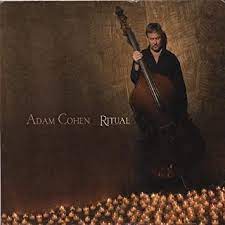
Adam Cohen was born on March 12, 1963 in Queens, New York but would soon find Los Angeles, California home when his parents moved to the West Coast. His musical foundation was built upon the piano lessons introduced to him at the age of six by his father Irwin, an accomplished pianist & composer. However, it would be the sounds of Earth, Wind & Fire, The Beatles, Chicago, Tower of Power, and Stanley Clarke that lured him to the low end. Add the influences of Ray Brown, Charles Mingus, Paul Chambers, and Dave Holland and lessons on both the upright and electric bass commenced.
Playing both acoustic & electric bass, Cohen has led him to work with Ernie Watts, Ray Charles, The New York Voices, Phil Upchurch, Taylor Dayne, Engelbert Humperdinck, David Benoit, Maxine Nightingale, Eric Benet, and Mark Isham, among others.
Having found his voice, he has become a ubiquitous presence on the Los Angeles scene and a leader in his own right with two albums, Gig Bag and Ritual, along with many compositions to his credit. Bassist Adam Cohen continues to move forward and reach upward, teaching privately and fueling his desire to make a positive impact on the musical situation at hand.
More Posts: bandleader,bass,history,instrumental,jazz,music
The Quarantined Jazz Voyager
It is amazing but not surprising how people want to get back to the same old routine they were in before the pandemic instead of inventing themselves anew. As I move around my city I see more and more people not wearing masks in enclosed spaces. I am not surprised by the robotic sense of normalcy by society.
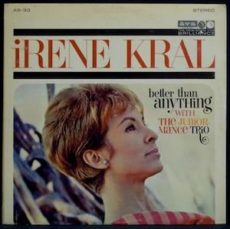
This week I have selected an album by the underrated and often unappreciated vocalist Irene Kral. The younger sister of pianist Roy Kral, I discovered her towards the end of her career in 1977 when I heard her album Where Is Love. I was enamored by her voice and the quiet understatement of her singing. Unfortunately I never had the opportunity to hear her live as she transitioned the followin year in August.
The album I present today is her third studio session, Better Than Anything, recorded on June 17 & 18, 1963 at the World Pacific Studios in Los Angeles, California. It was produced by Joe Burnett, engineered by Richard Bock and released the same year on Äva Records and distributed by MGM. Making up the quartet with Irene is the Junior Mance Trio.
The cover design was by Richter & Mracky Design Associates, the photography by Fred Seligo and the liner notes were written by Tommy Wolf.
Track List | 29:24
- Better Than Anything (David “Buck” Wheat, Bill Loughborough) ~ 2:21
- The Touch Of Your Lips (Ray Noble) ~ 2:22
- The Meaning of the Blues (Bobby Troup, Leah Worth) ~ 3:11
- Rock Me To Sleep (Benny Carter, Paul Vandervoort II) ~ 2:20
- No More (Tutti Camarata, Bob Russell) ~ 3:10
- Passing By (Laurent Hess, Charles Trenet, Jack Lawrence) ~ 1:54
- It’s a Wonderful World (Jan Savitt, Harold Adamson, Johnny Watson) ~ 2:34
- This Is Always (Mack Gordon, Harry Warren) ~ 3:23
- Just Friends (John Klenner, Sam M. Lewis) ~ 2:40
- Guess I’ll Hang My Tears Out to Dry (Jule Styne, Sammy Cahn) ~ 3:35
- Nobody Else But Me (Jerome Kern, Oscar Hammerstein II) ~ 1:54
- Irene Kral ~ vocals
- Junior Mance ~ piano
- Bob Cranshaw ~ bass
- Mickey Roker ~ drums
More Posts: adventure,album,bass,club,drums,genius,jazz,museum,music,piano,preserving,restaurant,travel,vocal