

Daily Dose Of Jazz…
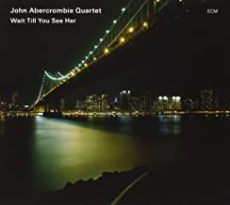
John Laird Abercrombie was born in Port Chester, New York on December 16, 1944. Growing up in the 1950s in Greenwich, Connecticut he was attracted to the rock and roll of Chuck Berry, Elvis Presley, Fats Domino, and Bill Haley and the Comets. He also liked the sound of jazz guitarist Mickey Baker of the vocal duo Mickey and Silvia. He had two friends who were musicians with a large jazz collection and they listened to albums by Dave Brubeck and Miles Davis.
The first jazz guitar album he heard was by Barney Kessel, and taking guitar lessons at the age of ten, asked his teacher to show him what Kessel was playing. After high school, John went to Berklee College of Music and while there he was drawn to the music of Jim Hall, Sonny Rollins, and Wes Montgomery. He cites George Benson and Pat Martino as inspirations. His playing around Boston, Massachusetts led to his meeting the Brecker Brothers and organist Johnny Hammond Smith, who invited him to go on tour.
From Berklee in 1967 to North Texas State University to a move to New York City in 1969 where he became a popular session musician. He joined the Brecker Brothers in the jazz-rock fusion band Dreams, followed by recordings with Gato Barbieri, Barry Miles, and Gil Evans. He continued to play fusion in Billy Cobham’s band until an invitation from drummer Jack DeJohnette led to the fulfillment of Abercrombie’s desire to play in a jazz-oriented ensemble.
Around the same time, record producer Manfred Eicher, founder and president of ECM Records, invited him to record an album. He recorded his first solo album, Timeless, with DeJohnette and keyboardist Jan Hammer. who had been his roommate in the 1960s. In 1975 he formed the band Gateway with DeJohnette and bassist Dave Holland.
Between 1984 and 1990, Abercrombie experimented with a guitar synthesizer. Free jaz became a mainstay for him in the 1990s and 2000s as he formed many new associations. Drummer Adam Nussbaum, and Hammond organist Jeff Palmer became his trio and made a free-jazz album, then replaced Palmer with organist Dan Wall and released three albums between 1992 and 1997. Adding trumpeter Kenny Wheeler, violinist Mark Feldman and saxophonist Joe Lovano to the trio he recorded Open Land in 1999.).
He continued to tour and record until the end of his life. who recorded 59 as a leader, 4 with Gateway, 6 with Andy LaVerne and 93 as a sideman for the who’s who in jazz. Guitarist John Abercrombie, whose work explored jazz fusion, free jazz, and avant-garde jazz, passed away of heart failure in Cortlandt Manor, New York, at the age of 72 on August 22, 2017.

More Posts: bandleader,composer,guitar,history,instrumental,jazz,music
Daily Dose Of Jazz…
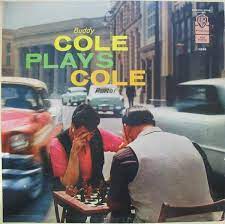
Buddy Cole was born Edwin LeMar Cole on December 15, 1916 in Irving, Illinois. He started his musical career in the theater, playing between movies and by age 19 he was recruited to be part of the Gil Evans band.
Moving to Hollywood, California in the second half of the 1930s, Buddy played in dance bands, including those led by Alvino Rey and Frankie Trumbauer. From the 1940s, his main work was as a studio musician, utilizing piano, electric organ, celeste, harpsichord and Novachord.
Cole worked with Henry Mancini, who used his Hammond organ for the soundtrack to the TV series Mr. Lucky. He also played most of the piano parts in the 1951 film Young Man with a Horn, subbing for Hoagy Carmichael, who appeared on screen. He also wrote the music for the television game show Truth or Consequences.
He performed on Bing Crosby’s hits In a Little Spanish Town and Ol’ Man River, and on the albums Some Fine Old Chestnuts and New Tricks. Buddy also played on Rosemary Clooney’s radio program and some recordings from the show were released on the album Swing Around Rosie.
Pianist, organist, orchestra leader, and composer Buddy Cole, who recorded several organ albums as a leader for Warner Brothers, Columbia, Alshi and Doric, passed away on November 5, 1964 in Hollywood, California.
More Posts: bandleader,composer,history,instrumental,jazz,music,organ,piano
Daily Dose Of Jazz…
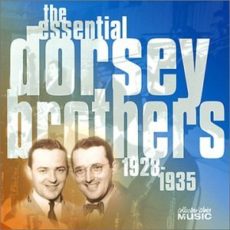
Fulton “Fidgy” McGrath was born in Superior, Wisconsin on December 6, 1907. He played with Red Nichols early in the 1930s, then joined the band of the Dorsey boys and worked on their studio recordings and radio broadcasts.. Additionally he worked extensively as a studio musician and in radio orchestras.
From 1935-37 McGrath played in Lennie Hayton’s radio ensemble, before playing later in the decade with Bunny Berigan, Joe Venuti, and Chauncey Morehouse. After spending time in an NBC orchestra, he moved to the West Coast around 1943, where he became a first-call studio musician who worked on film soundtracks in Hollywood.
His compositions include Shim Sham Shimmy and Mandy Is Two, the latter of which was recorded by Billie Holiday.
Pianist and songwriter Fidgy McGrath passed away at the age of 51 on January 1, 1958 in Los Angeles, California.
Daily Dose Of Jazz…
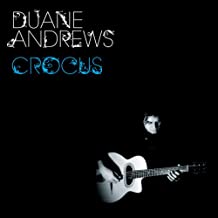
Duane Andrews was born November 30, 1972 in Carbonear, Newfoundland and Labrador and grew up exposed to the island’s mélange of cultural influences and his development as a guitarist reflects that. After graduating from the Jazz Studies program at St. Francis Xavier University with honours, he spent several years studying contemporary music composition at the Conservatoire International de Paris and at the Conservatoire National de Region in Marseille, France.
He combines traditional Newfoundland folk music with jazz similar to the way that guitarist Django Reinhardt infused jazz with Manouche influences. He is a composer for film and television, and has recorded thirteen albums as he continues to compose and explore music.
More Posts: bandleader,composer,guitar,history,instrumental,jazz,music
Daily Dose Of Jazz…
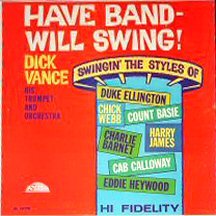
Dick Vance was born on November 28, 1915 in Mayfield, Kentucky, and raised in Cleveland, Ohio. He learned violin before concentrating on trumpet and by 1932 was playing with J. Frank Terry before joining Lil Armstrong’s band in 1934.
He moved to New York City and played with Willie Bryant, Kaiser Marshall, and Fletcher Henderson between 1936 to 1938. In Henderson’s band he was lead trumpeter and occasionally sang. By 1939 he joined Chick Webb’s orchestra, remaining in the group when Ella Fitzgerald took over leadership. His next move had him becoming the staff arranger for Glen Grey’s band and, in 1942, joined the Lucky Millinder Orchestra.
From 1944–45 he worked with Charlie Barnet, Don Redman, Eddie Heywood and Ben Webster. From 1944 to 1947 he studied at Juilliard, and moonlighted as a pit orchestra musician and an arranger for Harry James, Cab Calloway, Earl Hines and Duke Ellington. During this time Dick played on notable Broadway productions including Pal Joey, Beggar’s Holiday, and in the off-stage band for Streetcar Named Desire.
In 1950, Vance reunited with Fletcher Henderson, playing in his New York sextet. 1951 to 1952 saw him as a member of Duke Ellington’s trumpet section where he arranged most of the items for the album Ellington ‘55. In 1958 he co-composed Jazz Festival Suite with Ellington for performance at the Newport Jazz Festival. He led Sonny Stitt’s trumpet section on the 1962 album Sonny Stitt & The Top Brass. He toured abroad with his own band in 1969, which later appeared in the film L’aventure du jazz.
He toured with Redman in 1953 and was a regular at the Savoy Ballroom throughout the 1950s. He released two albums in the 1960s and toured with Eddie Barefield in 1969. He appears briefly in episode 9 of the music documentary series All You Need Is Love: The Story of Popular Music. In 1979, he composed for the documentary film No Maps On My Taps, starring Lionel Hampton and Howard Sims.
Trumpeter, vocalist, composer and arranger Dick Vance passed away on July 31, 1985 in New York City at the age of 69.
More Posts: arranger,bandleader,composer,history,instrumental,jazz,music,trumpet,vocal