

Daily Dose Of Jazz…
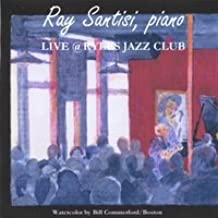
Ray Santisi was born on February 1, 1933 in Boston, Massachusetts and grew up in Jamaica Plain. He won an honors scholarship to attend Schillinger House and by the time he graduated it had been renamed Berklee School of Music, and later became Berklee College of Music..
He played as featured soloist with Charlie Parker, Stan Getz, Dexter Gordon, Mel Torme, Irene Kral, Herb Pomeroy and Natalie Cole to name a few. He performed with Buddy DeFranco, Joe Williams, Gabor Szabo, Milt Jackson, Zoot Sims & Al Cohn, Carole Sloane, Clark Terry and Bob Brookmeyer. As a leader he performed with his own ensemble, The Real Thing and in the 1960s performed with the Benny Golson Quartet.
As an educator, in 1957 Ray became a professor of piano and harmony at Berklee College of Music. His students include many notable jazz musicians, including Diana Krall, Makoto Ozone, Joe Zawinul, Keith Jarrett, Jane Ira Bloom, Jan Hammer, Alan Broadbent, Arif Mardin, Gary Burton, John Hicks, Danilo Perez and Hiromi. Fourteen of his students received Grammy awards.
He was awarded grants from the National Endowment for the Arts in composition and performance. He taught at Stan Kenton’s summer jazz clinics throughout the United States, performed in Europe, Scandinavia, and Asia. He performed at the first Jazz Workshop, and in 2008 was nominated to IAJE Jazz Education Hall of Fame.
He authored two books, Berklee Jazz Piano, and his instructional book, Jazz Originals for Piano. His trio played the first Sunday of each month for eleven years at Ryles Jazz Club until the month of his death. Pianist, composer, arranger, and educator Ray Santisi passed away on October 28, 2014 in his hometown.

More Posts: arranger,bandeader,composer,educator,history,instrumental,jazz,music,piano
Daily Dose Of Jazz…
Charlie Holmes was born on January 27, 1910 near Boston, Massachusetts and began playing alto saxophone at age 16 and emulated the style of his childhood friend, Johnny Hodges.
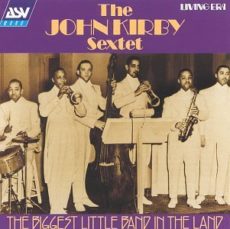
Beginning his professional career a week later, after moving to New York City Charlie worked for a variety of groups, including Luis Russell in 1928. Between 1929 and 1930 he recorded with Red Allen. He would work with Russell again a few times and in 1932 joined the Mills Blue Rhythm Band. He was in John Kirby’s Sextet, Cootie Williams’ Orchestra, and Louis Armstrong’s band for much of the next two decades.
Leaving music in 1951, Holmes did not return for twenty years then worked in Clyde Bernhardt’s Harlem Blues & Jazz Band. He later played for the Swedish band Kustbandet. He never acted as a leader in any recording or group.
Alto saxophonist Charlie Holmes, best known for composing Sugar Hill Function, not only performed during the swing era but also played clarinet and oboe for the Boston Civic Symphony Orchestra, passed away on September 19, 1985 in Stoughton, Massachusetts.
More Posts: composer,history,instrumental,jazz,music,saxophone

Daily Dose Of Jazz…
James Otis Wyble was born on January 25, 1922 in Port Arthur, Texas and in his early years worked for a radio station in Houston. He and guitarist Cameron Hill played Western swing, an outgrowth of jazz, in a band led by Burt “Foreman” Phillips. The sound of two guitars attracted Bob Wills, another fan of Western swing, and he hired both men for his band, the Texas Playboys.
His career interrupted by World War II, he served in the Army from 1942 to 1946, but returned to music after he came home. Jimmy continued to play in Western swing bands, but his interest in jazz surfaced on his 1953 debut album, The Jimmy Wyble Quintet. He would soon work with Barney Kessel and Benny Goodman, and then played with Red Norvo for eight years, including on a tour of Australia accompanying Frank Sinatra.
During the 1960s Wyble took a job as a studio musician in Los Angeles, California working as a guitarist for movies and television, playing on movie soundtracks, including The Wild Bunch, Ocean’s Eleven, Everything You Always Wanted to Know About Sex and Kings Go Forth, and played on TV shows such as The Flip Wilson Show and Kraft Music Hall.
He became an educator after taking classical guitar lessons from Laurindo Almeida, teaching guitar to Larry Koonse, Howard Roberts, Howard Alden and Steve Lukather among others. The 1970s saw Jimmy developing a two-line contrapuntal approach to guitar and composed numerous etudes in this style, publishing Classical/Country, The Art of Two-Line Improvisation, and Concepts for the Classical and Jazz Guitar.
During the 1980s, he left the music business, returning to performance in 2005. Larry Koonse, his former student, issued the album What’s in the Box with compositions by Wyble based on his book of etudes.
Guitarist, composer, and educator Jimmy Wyble continued to perform, record and teach until his death on January 16, 2010.
More Posts: composer,educator,guitar,history,instrumental,jazz,music
Daily Dose Of Jazz…
Igor Grigoriev was born on January 24, 1955 in Moscow, Russia and taught himself to play the guitar as a young child, and later obtained his master’s degree from a music institution in Russia. As a young boy in the late sixties, he was interested in the latest music of the time, rock and started his career, gaining fame by playing and touring around the world.
Becoming a band leader of the trio, Roof, with trumpeter Andrew Solovyov, and percussionist Michael Zhukov they recorded on Melodia Records and Leo Records. His group, Asphalt also gained tremendous popularity despite its short life span.
As he developed musically, Grigoriev became interested in Charlie Parker’s work, but in later years the influence of classical composers became evident in his music. Permanently migrating to the United States in 1989 he continued his career, as a classical and jazz musician, but later he became more and more interested in Avant-garde music.
Better known for his 1990s work, he rapidly assimilated the American avant-garde and forged his own, instantly identifiable style. His music of the 1970s and 1980s saw transition from rock to classical to jazz and to avant-garde music. Igor developed methods of simultaneously improvising bass lines, harmony and melodic lines. In his later years, his playing became less predictable and formulaic.
He has recorded a number of solo albums, as well as recording or performing with Stan Getz, Red Callender, Larry Gales, Milcho Leviev, Ira Schulman, Rod Oakes, and many others. Igor and Rod founded OGOGO in 1996, which is one of the most important organizations to perform improvised music. His central focus was free improvisation, though he occasionally appeared in more conventional jazz and classical contexts, such as big band, various ensembles, and string orchestra.
He composed and arranged for a wide range of music genres, did orchestra work for a Russian circus, and arranged music for theatrical plays. As an educator he taught guitar, music history, jazz history, ensembles, and improvisation at Los Angeles Harbor College and Cerritos College in Los Angeles, California. Guitarist, composer, arranger, band leader and educator Igor Grigoriev passed away on September 25, 2010.
More Posts: arranger,composer,guitar,history,instrumental,jazz,music
Daily Dose Of Jazz…
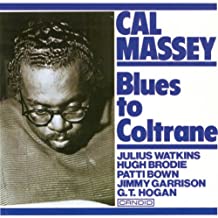
Calvin “Cal” Massey was born in Philadelphia, Pennsylvania on January 11, 1928 and studied trumpet under Freddie Webster. Following his studies, he played in the big bands of Jay McShann, Jimmy Heath, and Billie Holiday.
In the late 1950s Cal headed an ensemble with Jimmy Garrison, McCoy Tyner, and Tootie Heath. Occasionally John Coltrane and Donald Byrd would play with Massey’s group and in the 1950s he gradually receded from active performance and concentrated on composition.
His works were recorded by Coltrane, Tyner, Freddie Hubbard, Jackie McLean, Lee Morgan, Philly Joe Jones, Horace Tapscott and Archie Shepp. Massey played and toured with Shepp from 1969 until 1972 and also performed in The Romas Orchestra with Romulus Franceschini.
Massey’s political standpoint was radical and his work was strongly connected with the Civil Rights Movement of the 1960s and ’70s. The Black Panther Party was an inspiration for The Black Liberation Movement Suite which he created with Franceschini and was performed three times at Black Panther benefit concerts. His ideology resulted in him getting whitelisted from major recording companies and only one album was recorded under his name.
Trumpeter and composer Cal Massey passed away from a heart attack on October 25, 1972 at the age of 44 in New York City, New York.