

Daily Dose Of Jazz…
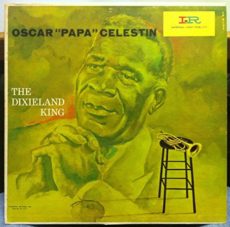
Oscar “Papa” Celestin was born on January 1, 1884 in Napoleonville, Louisiana to a Creole family. As a youth he worked on rural Louisiana plantations but eager for a better life, he worked as a cook for the Texas & Pacific Railroad, saved up money and bought used musical instruments. He played guitar and trombone before deciding on cornet as his main instrument. He took music lessons from Claiborne Williams, who traveled down the Bayou Lafourche from Donaldsonville.
Celestin played with the Algiers Brass Band by the early 1900s, and with various small town bands before moving to New Orleans in 1904, at age 20. There he played with the Imperial, Indiana, Henry Allen senior’s Olympia Brass Band, and Jack Carey’s dance band. Early in his career he was sometimes known as Sonny Celestin. Around 1910 he landed a job as leader of the house band at the Tuxedo Dance Hall on North Franklin St. at the edge of Storyville.
Keeping the name Tuxedo as the band’s name after the Dance Hall closed, they dressed in tuxedos and became one of the most popular bands hired for society functions, both black and white. He co-led the Tuxedo Band with trombonist William Ridgely and made their first recordings during the Okeh Records field trip to New Orleans in 1925. Following a fallout with Ridgely, the two led competing Tuxedo bands for about five years. Celestin’s Original Tuxedo Orchestra had Louis Armstrong, Bill Mathews, Octave Crosby, Christopher Goldston, Joe Oliver, Mutt Carey, Alphonse Picou and Ricard Alexis as a members over the years and made an additional series of recordings for Columbia Records through the 1920s. He also led the Tuxedo Brass Band, one of the top brass bands in the city.
Forced out of the business by depression economics, Papa worked in a shipyard until putting together another band after the World War II. The new Tuxedo Brass Band was tremendously popular and became a New Orleans tourist attraction. By 1953 he appeared in the travelogue Cinerama Holiday, became a regular feature at the Paddock Lounge on Bourbon Street and gave a command performance for President Eisenhower at the White House. He made regular radio broadcasts, television appearance, and more recordings with his last recording was singing on Marie LaVeau in 1954.
Bandleader, trumpeter, cornetist and vocalist Papa Celestin passed away in New Orleans, Louisiana on December 15, 1954, amassing 4000 people who marched in his funeral parade. The Jazz Foundation of New Orleans had a bust made and donated to the Delgado Museum in New Orleans, in honor of his contributions to the genre. #preserving genius

Give A Gift Of Jazz – Share

Daily Dose Of Jazz…
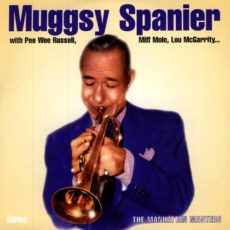
Muggsy Spanier was born Francis Joseph Julian Spanier on November 9, 1906 in Chicago, Illinois. He borrowed the nickname from the manager of the NY Giants, John “Muggsy” McGraw. In the early 1920s, he was playing cornet with The Bucktown Five in Chicago.
He led several traditional hot jazz bands, most notably Muggsy Spanier and His Ragtime Band, that actually played Dixieland. This band set the style for all later attempts to play traditional jazz with a swing rhythm section of key members George Brunies on trombone and vocals, clarinetist Rod Cless, pianists George Zack or Joe Bushkin, Ray McKinstry, Nick Ciazza or Bernie Billings playing tenor saxophone, and Bob Casey on bass.
Muggsy’s theme song was Relaxin’ at the Touro, named for the infirmary in the New Orleans, Louisiana hospital where Spanier was treated for a perforated ulcer in 1938. Saved by Dr. Alton Ochsner he homaged a song titled Oh Doctor Ochsner.
Spanier made numerous Dixieland recordings, co-led a quartet, the Big Four, with Sidney Bechet in 1940 and co-led a traditional band with pianist Earl Hines at the Club Hangover in San Francisco, California in the 1950s. He followed this engagement up playing with the Bob Crosby band. Winding down his career in the late 1950’s and early 1960’s by 1959 he was leading a small band at the College Inn in the Sherman Hotel, then appeared in the Blue Note, Jazz Ltd. and in the Empire Room of the Palmer House, all in Chicago. His last appearance was at the Newport Rhode Island Jazz Festival in 1964.
Cornetist, composer and bandleader Muggsy Spanier passed away on February 12, 1967.
Jazz Is Global – Share
More Posts: cornet
Daily Dose Of Jazz…
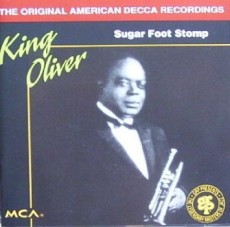
King Oliver was born Joseph Nathan Oliver on May 11, 1885 in Aben, Louisiana. He was also known as Joe Oliver and moved to New Orleans in his youth. He first studied the trombone and then changed to cornet. From 1908 to 1917 he played cornet in New Orleans brass and dance bands, and also in the city’s red-light district known as Storyville.
Oliver co-led a band with trombonist Kid Ory that was considered to be New Orleans’ hottest and best in the late 1910s. He gained great popularity in New Orleans across economic and racial lines, and was in demand for music jobs from rough working-class black dance halls to white society debutante parties.
With the closing of Storyville, Joe packed up his wife and child and moved to Chicago, Illinois in 1918. There he found work with clarinetist Lawrence Duhé, bassist Bill Johnson, trombonist Roy Palmer and drummer Paul Barbarin, eventually becoming the leader. By 1922 he was billing himself as King Oliver and his Creole Jazz Band at the Royal Gardens cabaret. His band included Louis Armstrong, Baby Dodds, Johnny Dodds, Lil Hardin, Honoré Dutrey and William Manuel Johnson. The following year they recorded for Gennett, Okeh, Paramount and Columbia record labels, bringing Dixieland to the attention of a much wider audience.
The mid-Twenties saw King enlarging his band to nine musicians, began performing more written arrangements with jazz solos, disbanding to do more freelance work in New York, Over the course of his career Oliver pioneered the use of mutes, including the rubber plumber’s plunger, derby hat, bottles and cups but his favorite mute was a small metal mute made by the C.G. Conn Instrument Company. He performed mostly on cornet, but like many cornet players he switched to trumpet in the late 1920s.
Oliver was also a talented composer, and wrote many tunes that are still regularly played, including Dippermouth Blues, Sweet Like This, Canal Street Blues, and Doctor Jazz. His recording Wa Wa Wa with the Dixie Syncopators can be credited with giving the name wah-wah to such techniques.
As an educator he influenced young New Orleans and Chicago players like Tommy Ladnier, Paul Mares, Muggsy Spanier, Johnny Wiggs Frank Guarente, Louis Panico and Louis Armstrong. The latter he taught, gave him his job in Kid Ory’s band and then summoned him to Chicago to play in his band.
As a businessman his acumen was often less than his musical ability losing jobs at the Savoy Ballroom and the Cotton Club by holding out for moe money than they were willing to pay. Ellington took the Cotton Club job and catapulted to fame
Oliver’s managers stole money from him and then the Great Depression hit losing his life savings to a failed Chicago bank, and bookings became lean.Oliver also had health problems, suffering from the gum disease pyorrhea, caused by his love of sugar sandwiches. He began employing younger musicians to play solos like up-and-coming trumpeter Henry “Red” Allen. Coupled with health problems suffering from periodontitis and his diminished capacity to play left him no choice but to stop playing by 1937.
Cornetist and bandleader King Oliver died in poverty of arteriosclerosis in a Savannah rooming house on April 10, 1938 at age 52, too broke to afford treatment. His sister spent her rent money to have his body brought to New York, where he was buried at Woodlawn Cemetery in the Bronx. In attendance were his friends Louis Armstrong, Clarence Williams, Coleman Hawkins, Lionel Hampton, W.C. Handy, Milt Jackson, and Max Roach. In 2007 he was inducted as a charter member of the Gennett Records Walk of Fame in Richmond, Indiana.
Jazz Is Global – Share

Daily Dose Of Jazz…
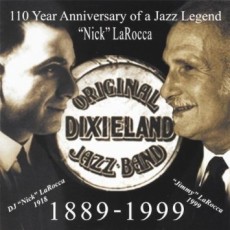
Nick LaRocca was born Dominic James LaRocca on April 11, 1889 in New Orleans, Louisiana to poor Sicilian immigrants. Attracted to the music of the brass bands in New Orleans as a child, he covertly taught himself to play the cornet against the wishes of his father who hoped his son would go into a more prestigious profession. From around 1910 through 1916 he was a regular member of Papa Jack Laine’s bands. A solid lead player with a strong lip allowed him to play long parades without let up or to play several gigs in a row on the same day.
In 1916 he joined Johnny Stein’s band to play a job in Chicago, Illinois, that subsequently became the Original Dixieland Jass Band and made their first commercially issued jazz recordings in New York City in 1917 that were hits, making them into celebrities. LaRocca led tours of England and the United States into the early 1920s, suffered a nervous breakdown. H retired from music until 1936 reuniting the ODJB for a successful tour and more recordings. He proclaimed that he and his band were the inventors of the now nationally popular swing music. Personality conflicts broke up the band again in 1937, and he again retired from music.
In the 1950s he wrote numerous vehement letters to newspapers, radio, and television shows, stating that he was the true and sole inventor of jazz music, damaging his credibility and provoking a backlash against him, his reputation and career. He donated his large collection of papers related to the O.D.J.B. to Tulane University in 1958 and worked with writer H.O. Brunn on the book The Story of the Original Dixieland Jass Band. Written during the Jim Crow era, he is acknowledge as an important figure, much in his own mind because he could not live with the thought that Negroes invented the music, in taking jazz from a regional style to international popularity, the leader of the most influential jazz band of the period from 1917 to 1921, and a good player in a very early jazz style on records.
Nick’s playing and recordings were an important early influence on such later jazz trumpeters as Red Nichols, Bix Beiderbecke and Phil Napoleon. His 1917 composition Tiger Rag is one of the most important and influential jazz standards of the twentieth century having some 136 cover versions by 1942 alone. It was covered by Louis Armstrong in several different versions throughout his career, while Duke Ellington, Art Tatum, Charlie Parker, The Mills Brothers, Frank Sinatra, Benny Goodman, Les Paul and Kid Ory also recorded important and influential cover versions of the jazz standard.
In 2006, his 1917 recording of Darktown Strutters Ball with the Original Dixieland Jass Band was inducted into the Grammy Hall of Fame. Cornetist Nick LaRocca, who was part of what is generally regarded as the first recorded jazz band, releasing the first jazz recording Livery Stable Blues in 1917, passed away on February 22, 1961 in New Orleans.
Give The Gift Of Knowledge
More Posts: cornet
Daily Dose Of Jazz…
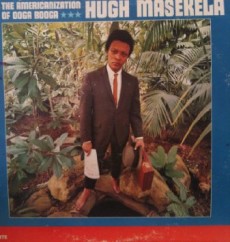
Hugh Ramopolo Masekela was born on April 4, 1939 in Kwa-Guqa Township of Witbank, South Africa. He began singing and playing piano as a child. At the age of 14, after seeing Kirk Douglas in the film Young Man With A Horn he took up playing the trumpet. He was given his first trumpet was given to him by anti-apartheid Archbishop Trevor Huddleston at St. Peter’s Secondary School.
Quickly mastering the instrument under the tutelage of Uncle Sauda of Johannesburg’s Native Municipal Brass Band, Masekela along with some of his schoolmates formed the Huddleston Jazz Band, South Africa’s first youth orchestra. By 1956, after leading other ensembles, he joined Alfred Hebrert’s African Jazz Revue.
In 1958 he wound up in the orchestra of South Africa’s first musical blockbuster King Kong, followed by touring the country for a sold-out year with Miriam Makeba and the Manhattan Brothers’ Nathan Mdledle in the lead. By the end of 1959 Hugh along with Dollar Brand, Kippie Moeketsi, Makhaya Ntshoko and Johnny Gertze formed the Jazz Epistles. They became the first African jazz group to record an album and perform to record-breaking audiences in Johannesburg and Cape Town.
Following the 1960 Sharpeville Massacre of 69 peacefully protesting Africans he left the country with the help of Huddleston, Yehudi Menuhin and John Dankworth for London’s Guildhall School of Music. Befriended by Harry Belafonte on a visit to the U.S. he gained admission to Manhattan School of Music studying classical trumpet.
By the late Sixties he had hits with Up, Up & Away and Grazing In The Grass, appeared at the Monterey Pop Festival, and was featured in the film Monterey Pop. In 1974, Masekela and friend Stewart Levine organized the Zaire 74 music festival around the Rumble In The Jungle boxing match.
He has played primarily in jazz ensembles, with guest appearances on recordings by The Byrds and Paul Simon. Since 1954 Hugh’s music protested about apartheid, slavery, government and the hardships individuals were living but also vividly portrayed the struggles and sorrows, as well as the joys and passions of his country. In 1987, he had a hit single with Bring Him Back Home, which became an anthem for the movement to free Nelson Mandela.
Trumpeter Hugh Masekela also plays the flugelhorn, cornet, and trombone and is a composer and singer. He has some four dozen albums to date in his catalogue, has won two Grammy Awards with seven nominations, received two honorary doctorates, and serves as a director on the board of The Lunchbox Fund, a non-profit organization that provides a daily meal to students of township schools in Soweto. He continues to perform, record and tour.
Take A Dose On The Road
More Posts: cornet,flugelhorn,trombone,trumpet