

The Quarantined Jazz Voyager
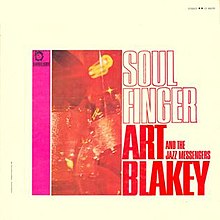
The pandemic has given me time to indulge in listening to a variety of music but for this post, Soul Finger is the album I’ve chosen for this week’s edition of The Quarantined Jazz Voyager. The album was recorded by drummer Art Blakey And The Jazz Messengers recorded on May 12 & 13, 1965 in New York City and its original release date was in August of the same year on the Limelight label. The sessions were produced by Jack Tracy.
On the 2009 CD edition, Gary Bartz, whose recording debut this was, was left off the credits – he is the alto saxophonist for 5 of the 6 cuts. Lucky Thompson is only on one cut, playing soprano saxophone on Spot Session with the quartet of Blakey, John Hicks, and Victor Sproles.
A sixth cut from the Bartz sessions was used on the later Hold On, I’m Coming album. This recording was trumpeter Lee Morgan’s last recording with Art Blakey after a seven-year association; Freddie Hubbard would return to tour with Blakey’s group again in the 1980s.
Track Listing | 36:42
- Soul Finger (Freddie Hubbard, Lee Morgan) ~ 3:17
- Buh’s Bossa (Morgan) ~ 5:33
- Spot Session (Lucky Thompson) ~ 7:21
- Freedom Monday (Art Blakey) ~ 6:15
- A Quiet Thing (Fred Ebb, John Kander) ~ 6:56
- The Hub (Hubbard) ~ 7:20
- Art Blakey ~ drums
- Freddie Hubbard, Lee Morgan ~ trumpet (except on “Spot Session”)
- Gary Bartz – alto saxophone (except on “Spot Session”)
- Lucky Thompson – soprano sax (on “Spot Session”)
- John Hicks – piano
- Victor Sproles – bass
As you listen I hope you enjoy this great addition to the jazz catalog. Continue your vigilance of social distancing, wear your masks, and stay healthy. During this sabbatical from flying and investigating jazz around the globe, this Quarantined Jazz Voyager is looking forward to listening to this lineup of talented musicians and enjoy the listen and know that the world and I will be back.
More Posts: adventure,club,drums,genius,jazz,museum,music,preserving,restaurant,travel,voyager
Daily Dose Of Jazz…
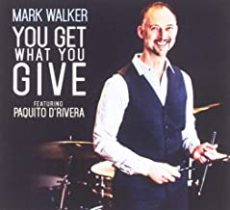
Mark Walker was born on October 16, 1961 in Chicago, Illinois and began playing drums at age ten. He played his first professional club, concert, and recording gigs barely out of high school. After studying with Roy C. Knapp, he gained valuable experience performing a wide range of styles in the Chicago, area and later became a first-call session drummer and percussionist, playing on film scores, jingles, and record dates.
Moving to New York in 1995, he easily entered the jazz culture and performed and recorded extensively with Michel Camilo, Dave Samuels, Andy Narell, WDR Big Band, NDR Big Band, Grace Kelly, Eliane Elias, Lyle Mays, Dave Liebman, Regina Carter, Joao Bosco, Dianne Reeves, Cesar Camargo Mariano, and Rosa Passos, among numerous others. He has been earned several Grammy nominations and in 2008 he was nominated for a Grammy for Best Instrumental Composition.
Walker has worked on Grammy~winning albums with Oregon, Donato Poveda, Paquito D’Rivera, the Caribbean Jazz Project and has also earned Indy and Jazz awards. He appeared on Late Night with David Letterman, The Rosie O’Donnell Show, PBS Presents, BET On Jazz, and with Paquito D’Rivera in Fernando Trueba’s Latin jazz documentary Calle 54.
As an educator, Mark is a professor in the Percussion Department at Berklee College of Music where he has taught drummers, percussionists, and ensembles since 2001. He has served on the faculty at New York City’s Drummers Collective and has conducted master classes, clinics, and workshops in South America, North America, and Europe. He has published two books, World Jazz Drumming and Killer Grooves, an instructional drum set book.
Grammy Award-winning drummer, percussionist, author, and educator Mark Walker continues to tour with Oregon and Paquito D’Rivera. He writes for and leads Rhythm of the Américas, a jazz octet incorporating Caribbean and South American rhythms.

More Posts: bandleader,composer,drums,history,instrumental,jazz,music
Conversations About Jazz & Other Distractions
Conversations About Jazz
Spotlights The Young Guns on October 15
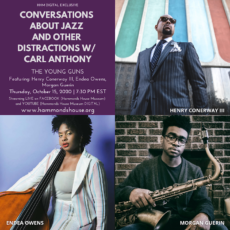
Hammonds House Digital invites you to join us for Conversations about Jazz & Other Distractions hosted by former jazz radio host and founder of Notorious Jazz, Carl Anthony. Every other Thursday, Carl takes audiences on a unique journey through the world of jazz music with artist talks, workshops, and listening sessions.
On October 15 at 7:30 pm (EST), Conversations about Jazz features some of today’s Young Guns. Carl’s guests will be bassist Endea Owens; and multi-instrumentalist, producer, composer, and engineer Morgan Guerin. This program is for the jazz novice and jazz head alike. It is free and will stream live on Hammonds House Museum’s Facebook and YouTube.
Lincoln Center’s Emerging Artist of 2019, recent graduate of the Julliard School, and Detroit native Endea Owens, is a vibrant up and coming bassist. She has been mentored by the likes of Marcus Belgrave, Rodney Whitaker, and Ron Carter. She has toured and performed with Jennifer Holliday, Rhonda and Diana Ross, Jazzmeia Horn, Dee Dee Bridgewater, Steve Turre, and Lea DeLaria from the Netflix Original Series “Orange is The New Black.’ Endea has performed around the globe including from Europe to India and Australia. She is the house bassist for The Late Show with Stephen Colbert.
New York City-based and New Orleans native multi-instrumentalist, producer, composer, and engineer Morgan Guerin has achieved much in his young, burgeoning career. Dubbed a “wunderkind saxophonist and multi-instrumentalist” by The New York Times, Guerin is skilled in bass, saxophones, electronic wind instrument (EWI), drums, and keys. In 2016, the Huffington Post named his debut album, “The Saga,” one of the best Jazz albums of the year. In 2017, Stereogum highlighted his sophomore album, “The Saga II,” as one of the best new albums. He was featured on Terri Lyne Carrington & Social Science’s award-winning album, “Waiting Game.” He was a songwriter and co-producer of Esperanza Spalding’s 2019 Grammy-winning record, “12 Little Spells.” His third album, “The Saga III,” was released on September 18, 2020.
Hammonds House Museum is generously supported by the Fulton County Board of Commissioners, Fulton County Arts and Culture, the City of Atlanta Mayor’s Office of Cultural Affairs, AT&T and WarnerMedia.
Hammonds House Museum’s mission is to celebrate and share the cultural diversity and important legacy of artists of African descent. The museum is the former residence of the late Dr. Otis Thrash Hammonds, a prominent Atlanta physician and a passionate arts patron. A 501(c)3 organization which opened in 1988, Hammonds House Museum boasts a permanent collection of more than 450 works including art by Romare Bearden, Robert S. Duncanson, Benny Andrews, Elizabeth Catlett, Jacob Lawrence, Hale Woodruff, Amalia Amaki, Radcliffe Bailey and Kojo Griffin. In addition to featuring art from their collection, the museum offers new exhibitions, artist talks, workshops, concerts, poetry readings, arts education programs, and other cultural events throughout the year.
Located in a beautiful Victorian home in Atlanta’s historic West End, Hammonds House Museum is a cultural treasure and a unique venue. During the COVID-19 pandemic, they continue to observe CDC guidelines, but look forward to welcoming in-person visitors soon! For more information about upcoming virtual events, and to see how you can support their mission, visit their website: hammondshouse.org. MEDIA: For more information, contact Karen Hatchett at Hatchett PR, karen@hatchettpr.com
More Posts: bass,conversations,drums,history,instrumental,jazz,musicians,saxophone
Daily Dose Of Jazz…
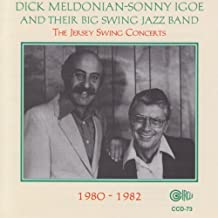
Owen Joseph “Sonny” Igoe was born on October 8, 1923 in Jersey City, New Jersey and grew up in Ridgewood, New Jersey. He attended Ridgewood High School when he got his start after winning a Gene Krupa drumming contest. His playing was initially influenced by Krupa, but he soon drew upon elements of Max Roach and others, which eventually developed into an exuberant and individual style.
From the mid-1940s to 1988, Sonny performed on over 79 recordings with bands and artists, including The Buddy Stewart Quintet, Benny Goodman and His Orchestra, Woody Herman and His Orchestra, Frances Wayne with Neal Hefti and His Orchestra, Rita Moss with the George Williams Orchestra, Charlie Ventura, Tony Bennett, Billy Maxted and His Manhattan Jazz Band, The Chuck Wayne Quintet, The Don Elliott Quintet, Joe Wilder, Phil Napoleon and His Original Memphis Five, Sammy Spear, Pee Wee Erwin, Joe Williams, Marlene Ver Planck, Savina Hartwell, Dick Meldonian, and Doctor Billy Dodd.
In the 1960s, Igoe was a member of the NBC Television Orchestra and then the CBS Television Orchestra, where his credits included The Ed Sullivan Show and The Jackie Gleason Show.
Drummer Sonny Igoe, who toured with the orchestras of Tommy Reed, Les Elgart, Ina Ray Hutton, Benny Goodman, and Woody Herman, passed away on March 28, 2012 in Emerson, New Jersey where he was a longtime resident.
More Posts: bandleader,drums,history,instrumental,jazz,music
Three Wishes
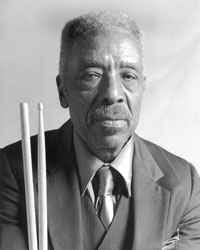
The Baroness inquired of the three wishes that Edgar Bateman would desire and he responded with:
- “To create all the time, master drums, and to make a contribution to drums and music.”
- “To have a loving and truthful wife whom I love.”
- “For everyone to be at peace and be happy.”
*Excerpt from Three Wishes: An Intimate Look at Jazz Greats ~ Compiled and Photographed by Pannonica de Koenigswarter

More Posts: baroness,drums,history,instrumental,jazz,music,pannonica,three,wishes