

Daily Dose Of Jazz…
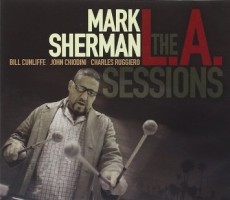
Mark Sherman was born April 17, 1957 in Manhattan, New York City to a Juillliard trained soprano mother who performed with the Cleveland and Boston symphonies, so it was natural that he studied classical piano as a child.
Sherman graduated from The High School of Music and in 1975, then went on to study classical percussion at Juilliard. He performed in ensembles under the direction of Leonard Bernstein, Sir George Solti, Zubin Mehta and Herbert Von Karajan. While there he would jam regularly with Wynton Marsalis. During the course of his career, Sherman also studied with Elvin Jones, Rohland Kohloff, Justin Diccocco, Roland Hanna and Jackie Byard among others.
While still in his teens, Mark played drums in a trio with pianist Kenny Kirkland who he introduced to Wynton. At 21, he began working on Broadway and in New York’s active studio scene, playing percussion, piano, drums and vibraphone. In 1980 he released his first album Fulcrum Point on Unisphere records. The decade saw him in studio working on commercial jingles.
Sherman spent a lot of his time in the studio in the 1980s, working on commercial jingles. Pianist Mike Renzi took him under his wing, connecting him with Peggy Lee and other singers performing with Lee, Tony Bennett, Mel Torme, Lena Horne and Ruth Brown. In 1986 he signed with Columbia Records and released his major label debut, A New Balance.
He continued to perform with Peggy Lee in the early 1990s, began a seven-year playing relationship with Larry Coryell, became an active studio musician, and played on numerous films and Broadway soundtracks. Reemerging as a leader playing vibraphone, he also continued his active career as a sideman, recording with Capathia Jenkins, Jennifer Holiday, Ann Hampton Callaway, Liz Minnelli and others.
Sherman continued to release his own albums on Miles High Records, won the Rising Star (Vibes) category in the Down Beat Critics Poll in 2007, 2008, 2009 and 2010 and has been a Jazz Ambassador for the U.S. State Department and Jazz at Lincoln Center.
Vibraphonist, pianist and drummer Mark Sherman is currently on the faculty of Juilliard jazz program, New Jersey City University and the New York Jazz Workshop.

Inspire A Young Mind
More Posts: drums,piano,vibraphone
Daily Dose Of Jazz…
Rusty Jones was born Isham Russell Jones II on April 13, 1942 in Cedar Rapids, Iowa and began playing drums at the age of thirteen and continued on throughout his college years choosing traditional and modern jazz as his preferred mode of music.
He went “on the road” after graduating college in 1965 from the University of Iowa with a degree in history and political science, to “get it out of his system”, but he never stopped his pursuit of a musical vocation. He moved to the Chicago area in 1967.
Jones appeared with Chicago musician Judy Roberts from 1968 to 1972, soon after becoming a member of George Shearing, then accompanied pianist Marian McPartland, then free-lanced throughout Chicago with several bands, touring the United States and Europe. He has worked with Patricia Barber, Adam Makowitz, Larry Novak, Ike Cole, Clifford Jordan, Danny Long, Johnny Gabor, Frank D’Rone, Art Hodes, Buddy DeFranco, Mark Murphy, Eddie Higgins, Red Holloway, Anita O’Day Stephane Grappelli, Ira Sullivan and J. R. Monterose, and the list goes on.
Between 1958 and 2004 this consummate sideman has been a part of nearly four-dozen recording sessions, all while performing and touring the U.S. and the world. Drummer Rusty Jones currently, appears quite regularly around the Chicago area with the Johnny Gabor Trio featuring vocalist Connie Marshall.
Dose A Day – Blues Away
More Posts: drums
Daily Dose Of Jazz…
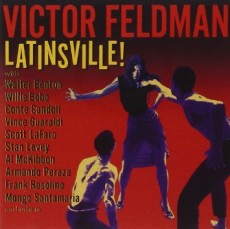
Victor Stanley Feldman was born on April 7, 1934 in Edgware, London, England and caused a sensation as a musical prodigy when he was discovered at aged seven. His family members were all musical and his father founded the Feldman Swing Club in 1942 to showcase his talented sons. His first professional appearance was playing drums at No. 1 Rhythm Club as a member of the Feldman Trio with brothers Robert on clarinet and Monty on piano accordion.
At eight years old the drummer was featured in the films King Arthur Was A Gentleman and Theatre Royal, in 1944 he was featured as “Kid Krupa” at a Glenn Miller AAAF band concert when he was 10, and went on to play vibraphone for Ralph Sharon Sextet and the Roy Fox band. Victor eventually made piano his instrument of choice and became best known.
Feldman recorded with Ronnie Scott’s orchestra and quintet from 1954 to 1955, and then in 1955 came to the U.S. He first worked with Woody Herman, then with Buddy Defranco. He recorded some thirty albums as a leader and recorded with Benny Goodman, George Shearing, Milt Jackson, Blue Mitchell, Lalo Schifrin, John Klemmer Sam Jones, Cannonball Adderley and others, as well as, Miles Davis on Seven Steps To Heaven, having composed the title track. He was a part of the 5-LP recording of Shelly Manne Black Hawk sessions in 1959.
Feldman settled in Los Angeles permanently and specialized in the lucrative session work for the film and recording industry. He also branched out to work with a variety of musicians outside of jazz, working with artists such as Frank Zappa, Steely Dan, Joni Mitchell, Tom Waits and Joe Walsh through the Seventies and Eighties.
Vibraphonist, drummer, percussionist, pianist and composer Victor Feldman died on May 12, 1987 at his home in Woodland Hills, California at age 53, following a heart attack. In 2009, he was inducted into the Musicians Hall of Fame and Museum in Nashville, Tennessee.
Give A Gift Of Jazz – Share
More Posts: drums,percussion,piano,vibraphone
Daily Dose Of Jazz…
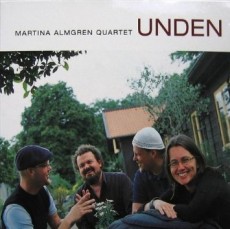
Martina Almgren was born on March 20, 1962 in Sweden and was surrounded by music as a child. She started playing the piano, then soon followed with the flute. In her late teens she was caught entirely by the drums, that became her primary instrument, along with the freedom in jazz and improvised music. It was some years later that she began composing her own music.
A colorful addition on the contemporary Swedish jazz scene, Almgren is passionate about playful improvisation, enticing rhythms and expressive melodies. This is reflective in her drumming as well as her compositions. She heads her own band, Martina Almgren Quartet, and has released four albums since 1999.
Martina together with Owe Almgren lead the Oh Yeah Orchestra comprised of ten of the top jazz musicians on the Swedish scene. In 2009 she was commissioned to compose for Swedish Jazz Celebration for Oh Yeah Orchestra. The album with the music “Freedom of Movement” was released in 2011. She expanded her performing on the European scene in 2007 when she teamed up with Scottish saxophonist Laura Macdonald on their album Open Book in 2008 followed by another in 2012.
She has been a part of Tom Bancroft´s Band of Eden, Nikki Iles Quintet and MOZ Trio that released their debut album “Sparkling Water, Please” released on the new Swedish label Oh Yeah Records in 2013. Drummer and composer Martina Almgren teaches improvisation classes at the Academy of Music and Drama at the University in Gothenburg, performs, records and tours.
Take A Dose On The Road
More Posts: drums
Daily Dose Of Jazz…
Roy Haynes was born in Boston, Massachusetts on March 13, 1925, and was keenly interested in jazz ever since he can remember. Primarily self-taught, he began to work locally in 1942 with musicians like guitarist Tom Brown, bandleader Sabby Lewis, and Kansas City blues-shout alto saxophonist Pete Brown. In the summer of 1945 he got a call to join bandleader Luis Russell to play for the dancers at New York’s Savoy Ballroom. When not traveling with Russell, the young drummer spent much time on Manhattan’s 52nd Street and uptown in Minton’s, the incubator of bebop.
From 1947 to 1949 Haynes was Lester Young’s drummer, worked with Bud Powell and Miles Davis in ’49, became Charlie Parker’s drummer of choice from 1949 to 1953, toured the world with Sarah Vaughan from 1954 to 1959, did numerous extended gigs with Thelonious Monk in 1959-60. Through the Sixties he performed and recorded with Eric Dolphy, Stan Getz, John Coltrane, has collaborated with Chick Corea since 1968, and with Pat Metheny during the ’90s. He’s been an active bandleader from the late ’50s to the present, featuring on his recordings Phineas Newborn, Booker Ervin, Roland Kirk, George Adams, Hannibal Marvin Peterson, Ralph Moore and Donald Harrison to name a few.
A perpetual top three drummer in the Downbeat Readers Poll Awards, he won the Best Drummer honors in 1996 (and many years since), and in that year received the prestigious French Chevalier des l’Ordres Artes et des Lettres and in 2002 his album “Birds Od A Feather” was nominated for a Grammy. Roy Haynes, percussionist, composer and bandleader nicknamed Snap Crackle, continues to compose, performer, record and tour.
Dose A Day – Blues Away
More Posts: drums,percussion