

Daily Dose Of Jazz…
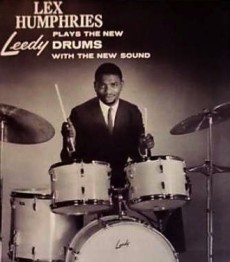
Lex Humphries was born on August 22, 1936 in New York City and passed away on July 11, 1994 in his hometown. A jazz drummer, he worked with two musicians known for mixing world music with jazz: Sun Ra and Yusef Lateef. As a member of Sun Ra’s “Arkestra” he appeared in the film Space Is The Place.
Humphries played on the Giant Steps sessions with John Coltrane. The renditions he and Cedar Walton recorded with Coltrane were released as alternative tracks in 1974. He was also the first drummer in the Art Farmer and Benny Golson Jazztet, appearing on their first album titled Meet The Jazztet in 1960.
Between 1959 and 1973 Lex also played and recorded albums with Donald Byrd, John Coltrane including The Heavyweight Champion: The Complete Atlantic Recordings, Dizzy Gillespie, Yusef Lateef, Wes Montgomery, Duke Pearson, Sonny Red, Chet Baker, Junior Mance, Sonny Stitt, McCoy Tyner and Doug Watkins among numerous others.
The understated drummer and solid bebopper cited Philly Joe Jones as his only influence. He was also a member of the band that accompanied Leon Thomas, and amassed a catalogue of over 70 sessions and was a steady collaborator. Though his reputation was firmly established, Lex Humphries, however, only rated a mere five lines in Leonard Feather’s Encyclopedia of Jazz.

Jazz Is Global – Share
More Posts: drums
Daily Dose Of Jazz…
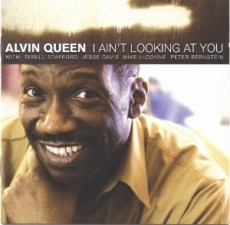
Alvin Queen was born in the Bronx, New York on August 16, 1950. He studied drums as a child and at 16 played for Ruth Brown, Don Benny Green and guitarist Tiny Grimes in 1969. He was asked to replace Billy Cobham and started his tenure in the Horace Silver Quintet.
He has played with the George Benson Quartet and worked with Charles Tolliver on several occasions, rejoining him in 1971. During the Seventies, he lived in Canada, before settling in Switzerland in 1979 and creating the label Nilva, an anagram of his first name.
Over the course of his career he has played with the likes of Michael Brecker, Kenny Drew, Bennie Wallace, Johnny Griffin, Eddie Lockjaw Davis, Pharaoh Sanders, John Patton and George Coleman among others. His who’s who list continues with Ray Drummond, John Hicks, Billy Saxton, Dusko Goykovich and James Spaulding as well as a host of European players in recent years.
Drummer, composer and bandleader Alvin Queen continues to perform and record, to date having nine albums under his belt as a leader.
Inspire A Young Mind
More Posts: drums
Daily Dose Of Jazz…
John Anthony Pompeo, better known as Johnny Rae or John Rae was born on August 11, 1934 in Saugus, Massachusetts and grew up in music, as his mother played piano in night clubs in the Boston area. His area of musical study in jazz led him to become a drummer and vibraphonist. Graduating from East Boston High School in 1952, he went on to study piano at the New England Conservatory and timpani at Berklee College of Music.
Johnny joined Herb Lee’s R&B band right out of high school, gigged with Slim Gaillard and Milt Buckner, played drums and vibes with Al Vega and Jay Migliori. Upon the recommendation of MJQ’s John Lewis, he teamed up with to play with George Shearing, alongside Toots Thielemans, Al McKibbon on bass and three Latin percussionists that included conguero Armando Peraza. It was during this period that Peraza taught him to play timbales.
He played with Johnny Smith, Ralph Sharon, Cozy Cole and Herbie Mann throughout the Fifties. The next couple of decades were equally commanding of his talents by Cal Tjader, Stan Getz, Gabor Szabo, Charlie Byrd, Earl Hines, Art Van Damme, Anita O’Day and Barney Kessel among many others. Though mainly concentrating in the context modern jazz, he never wandered far from Latin music and the Latin jazz percussion he played.
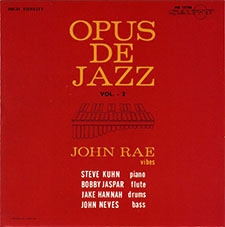
Though he was on more than three-dozen recording sessions, Johnny only recorded one as a leader, “Opus De Jazz, Volume 2” in 1960 for Savoy. A second release under his name was in actuality him fronting Herbie Mann’s band for contractual reasons.
Since the 1980s Rae has worked in music education, has authored several instruction books and was a disc jockey in San Francisco for many years. He assembled a tribute band to Tjader called Radcliff (Tjader’s middle name) and led the band until his death. Johnny Rae, drummer and vibraphonist passed away in 1993 in San Francisco, California.
Dose A Day – Blues Away
More Posts: drums,percussion,timbales,vibraphone
Daily Dose Of Jazz…
Kendrick Scott was born July 8, 1980 in Houston. His initial encounter with the drums was in church, where his family was involved in the music ministry. Attending Houston’s High School for the Performing and Visual Arts, garnering several awards, most notably the IAJE Clifford Brown/Stan Getz Fellowship.
Upon graduation from high school in 1998, Kendrick matriculated through Berklee College of Music under scholarship. Since graduating in 2002,Scott has performed with the Jazz Crusaders, Pat Metheny, Joe Lovano, Kenny Garrett, Dianne Reeves, Lizz Wright and Terence Blanchard among others. He also was a member of the Berklee-Monterey Quartet from 1999 to 2007.
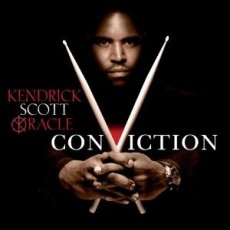
Scott’s debut recording with his group Oracle recorded The Source in 2006, including pianists Aaron Parks and Robert Glasper, guitarist Lionel Loueke, vocalist Gretchen Parlato and others. He also performed with the Terence Blanchard Quintet on the twice Grammy nominated album A Tale of God’s Will (A Requiem for Katrina) in 2007, celebrated the Monterey Jazz Festival’s 50th anniversary and embarked on a 22-state tour with the 50th Anniversary MJF All-Star Band features the leaders of the past, present and future with Blanchard, James Moody, Benny Green, Derrick Hodge and Nnenna Freelon. In 2010 he released his sophomore leader project “Reverence” and in 2013 “Conviction”. He continues to perform, record and tour.
Put A Dose In Your Pocket
More Posts: bandleader,drums
Daily Dose Of Jazz…
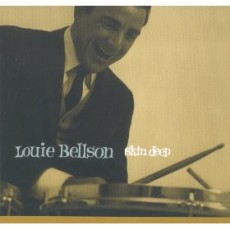
Louie Bellson was born Luigi Paulino Alfredo Francesco Antonio Balassoni on July 6, 1924 in Rock Falls, Illinois. He started playing drums at three years of age and at 15 pioneered the double-bass drum set-up. By 17 he triumphed over 40,000 drummers to win the Slingerland National Gene Krupa contest and graduated from high school in 1939.
1943 saw Bellson performing with Benny Goodman and Peggy Lee in the film “The Powers Girl” followed two more by the decade’s end. Between 1943 and 1952, he performed with Benny Goodman, Tommy Dorsey, Harry James and Duke Ellington, for whom he composed “Skin Deep” and “The Hawk Talks”. In 1952 he married Pearl Bailey, leaving Ellington to be her musical director, a union that lasted 38 years until her death in 1990.
Through the 1950s and 1960s, Louie performed with Jazz At The Philharmonic or J.A.T.P., Tommy and Jimmy Dorsey, Count Basie, again with Duke Ellington and Harry James, as well as appearing on several Ella Fitzgerald studio albums.
Equally adept as a big band or small group drummer, Bellson recorded extensively and led his own big and small bands, occasionally maintaining separate bands on each coast. His sidemen have included Blue Mitchell, Don Menza, Larry Novak, John Heard, Clark Terry, Pete and Conte Candoli and Snooky Young.
Louie Bellson, composer, arranger, bandleader and jazz educator passed away from Parkinson’ s disease on February 14, 2009.
Take A Dose On The Road
More Posts: arranger,composer,drums,educator,musical director