

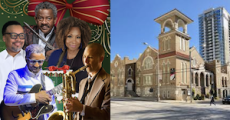
HOLIDAY JAZZ VESPERS
Come celebrate the holiday season with the timeless sounds of jazz at the 2025 Holiday Jazz Vespers at historic First Congregational Church in downtown Atlanta. The Holiday Jazz Vespers has become a highly anticipated treat and an annual favorite among jazz enthusiasts.
All Proceeds benefit the Education and Outreach Programs of the First Church CDC.
Featured Guest Artists:
Kathleen Bertrand ~ Vocal
Doc Powell ~ Guitar
Will Scruggs ~ Bariton Saxophone
Phil Davis ~ Piano
Dwight Andrews ~ Flute
Atlanta Jazz Chamber Chorus
Tickets: $28.52
More Posts: adventure,bandleader,flute,genius,guitar,instrumental,jazz,music,piano,preserving,saxophone,travel,vocal
Daily Dose Of Jazz…
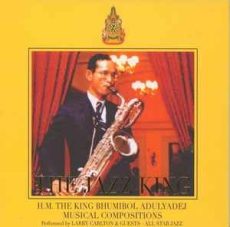
Bhumibol Adulyadej was born on December 5, 1927 in Cambridge, Massachusetts, however, the family moved to Bangkok, Thailand where she briefly attended Mater Dei school. In 1933 his mother took the family to Switzerland, where he continued his education at the École nouvelle de la Suisse romande in Lausanne. In 1934 he was given his first camera, which ignited his lifelong enthusiasm for photography.
Before he became King of Thailand, titled Rama IX, in 1942, Bhumibol became a jazz enthusiast, and started to play the saxophone, a passion that he kept throughout his life. He received his high-school diploma with a major in French literature, Latin, and Greek from the Gymnase Classique Cantonal de Lausanne, and by 1945 had begun studying sciences at the University of Lausanne, when World War II ended and the family was able to return to Thailand.
Adulyadej became an accomplished jazz baritone saxophone player and composer, playing Dixieland and New Orleans jazz. He also played the clarinet, trumpet, guitar, and piano. It is widely believed that his father may have inspired his passion for artistic pursuits at an early age. Initially focusing on classical music exclusively for two years but eventually switched to jazz since it allowed him to improvise more freely. It was during this time that he decided to specialize in wind instruments, especially the saxophone and clarinet. By 18 he started composing his own music with the first being Candlelight Blues.
He continued to compose even during his reign following his coronation in 1946. Bhumibol performed with Preservation Hall Jazz Band, Benny Goodman, Stan Getz, Lionel Hampton, and Benny Carter. Throughout his life, Bhumibol wrote a total of 49 compositions, much of it is jazz swing but he also composed marches, waltzes, and Thai patriotic songs.
He initially received general music training privately while he was studying in Switzerland, but his older brother, then King Ananda Mahidol, who had bought a saxophone, sent Bhumibol in his place. King Ananda would later join him on the clarinet. On his permanent return to Thailand in 1950, he started a jazz band, Lay Kram, whom he performed with on a radio station he started at his palace. The band grew, being renamed the Au Sau Wan Suk Band and he performed with them live on Friday evenings, occasionally taking telephoned requests.
Many bands such as Les Brown and His Band of Renown, Claude Bolling Big Band, and Preservation Hall Jazz Band recorded some of his compositions and can still be heard in Thailand. A 1996 documentary, Gitarajan, was made about his music. Adulyadej still played music with his Au Sau Wan Suk Band in later years, but was rarely heard in public. In 1964, Bhumibol became the 23rd person to receive the Certificate of Bestowal of Honorary Membership on behalf of Vienna’s University of Music and Performing Arts.
Baritone saxophonist, clarinetist, trumpeter, guitarist, pianist and composer and King Bhumibol Adulyadej, who reigned for 70 years and 126 days and is the longest of any Thai monarch, died on October 13, 2016 in Bangkok, Thailand.

More Posts: bandleader,clarinet,composer,guitar,history,instrumental,jazz,music,piano,saxophone,trumpet
Daily Dose Of Jazz…
Alan Plachta was born on November 30, 1981 and raised in Buenos Aires, Argentina. Recently recorded in NYC his last album “Un viaje” in collaboration with Richard Nant, featuring Luis Perdomo on piano, Sam Sadigursky on reeds, Satoshi Takeishi on drums and Matt Pavolka on bass.
As a composer, arranger and conductor he has worked with the Boris Big Band, Orquesta Sudamericana, Kai de Raiz, and Orquesta de Cuerdas Elvino Vardado in collaboration with Juan Pollo Raffo.
Alan has played and/or recorded with numerous South American musicians such as Roberto Taufic, Hugo Fattoruso, Urbano Moraes, Daniel Maza, Robert Vincs, Alex & Nilusha, Alexandre Ribeiro, Ana Luiza and Luis Felipe Gama, Nicolás Ospina, Celeste Carballo, Ligia Piro, Liliana Herrero, and Cecilia Pahl among others.
A leader or co-leader, he has recorded five albums, the first in 2005. A prolific arranger and producer Nussbaum has collaborated as guitarist and guest arranger for Cambrio de Estacion, Roma, Soy Una Tarada, Desmesura, Este Tiempo, Ensamble Real Book Argentina, and Y De Amor No Supe Nada.
As a guitarist he has recorded ninetten albums and his compositions are included in Real Book Argentina. His educator role has Adam teaching ear training, arrangement, harmony and guitar. He is in charge of the Musical Language´s Technichs at the Tecnólogo en Jazz y Música Creativa career at UTEC.
Guitarist, composer, arranger and educator Alan Plachta continues to explore his music and his teaching.

More Posts: arranger,bandleader,composer,educator,guitar,history,instrumental,jazz,music
Daily Dose Of Jazz…
DANIEL DIAZ 11.22.25
Daniel Díaz Fernández was born on November 22, 1963 in Lanús, Argentina. Living in Paris, France since 1997, he has collaborated with Juan Carlos Cáceres, on the single Tango Negro, and on the album Toca Tango. In 1993 he recorded his first album The Years Alone released by Green Linnet/Xenophile Records. The variety of styles in this album was mentioned by critics. He played most of the parts fretted and fretless basses, keyboards, acoustic and electric guitars, percussion, and more.
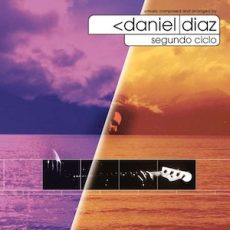
He continued this solo career with Segundo Ciclo, recorded in 1997, released by Dutch jazz label Timeless Records in 2002, and Swan Song, released in 2015, always with guest players from around the world. Both albums featured the cosmopolitan jazz-fusion style of the first one.
Since 2005 Diaz has been composing and recording for films, TV and documentaries. He works for French publisher and music library Cezame Music Agency for whom he composed and recorded more than 250 tracks and released 5 albums alone or in collaboration.
Since 2010 his music has been used on many TV documentaries and films. In 2022 his track “Club Recoleta” from the album Elec’ Tango was used on Tom McCarthy’s feature film Stillwater
Bassist, multi-instrumentalist, arranger, composer, Raúl Diaz whose last collaboration in 2023 with Raúl Barboza was on the album Souvenirs Panamericanos, continues to perform and compose.

More Posts: arranger,bandleader,bass,composer,guitar,history,instrumental,jazz,keyboard,music
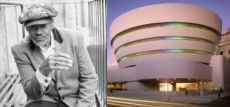
ALLAN HARRIS
Vocalist, songwriter and guiatarist Allan Harris takes the Rotunda Stage to perform for jazz lovers The Poetry of Jazz.
Hailing from Harlem, New York, he has been described as having a “formidable baritone with husky edges and deep resonant low notes. He has been called a protean talent and is known for both his albums and his live performances.
General Admissions gains you entrance to the museumto the show |. $19.00~$30.00
More Posts: adventure,bandleader,composer,genius,guitar,instrumental,jazz,music,preserving,travel,vocal