

Daily Dose Of Jazz…
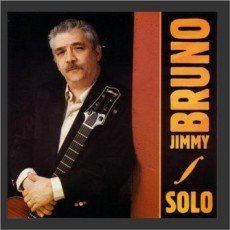
Jimmy Bruno was born in Philadelphia, Pennsylvania on July 22, 1953 to a father who played guitar and a mother who was a gifted singer. He began playing guitar at the age of 7, playing eight to ten hours a day. He studied jazz improvisation with Philly bassist Al Stauffer and to develop technique, taught himself to play the rigorous and exacting classical violin etudes of Wohlfahrt and Paganini. Although he briefly considered leveraging his perfect SAT scores into medical school, a summer guitar gig in Wildwood, New Jersey changed the direction of his life. He began his professional career at the age of 19, touring with Buddy Rich.
Jimmy went on to play guitar in orchestras for Anthony Newley, Doc Severinsen, Lena Horne, and many more music icons. A move to Los Angeles, California saw him as a session musician for many years working with Tommy Tedesco. By his mid-thirties he was ready to pursue jazz and he moved back East. Back in his hometown he played small clubs and venues during the 1980s, met Concord Records founder Carl Jefferson and landed a multi-CD deal that has elicited 13 critically acclaimed sessions.
Bruno has shared the stage with Joe Beck, Bobby Watson, Jack Wilkins, Tal Farlow, Howard Alden, Christian McBride, Kurt Elling and many more. Among his many credits, Bruno is the only guitarist to have ever led Fank Sinatra’s band. He counts Johnny Smith, Hank Garland, Joe Pass, Tal Farlow, Wes Montgomery, Howard Roberts, Jim Hall and Pat Martino among his influences.
As an educator, in 2007, Jimmy and Affiliated Artists opened the Jimmy Bruno Guitar Institute (JBGI) bringing his method and approach to jazz improvisation to eager guitar students around the world. In 2011 Jimmy opened up Jimmy Bruno’s Guitar Workshop, a website that allows students to learn directly from him through video lessons. He continues to perform and record as well.

Take A Dose On The Road
More Posts: guitar
Daily Dose Of Jazz…
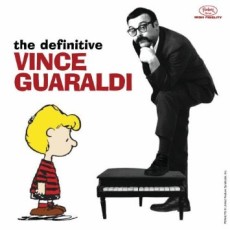
Vince Guaraldi was born Vincent Anthony Dellaglio on July 17, 1928 in San Francisco, California. Growing up in the North Beach area, taking the name of his stepfather Tony Guaraldi after being adopted and being around his maternal uncle was a musician, singer and whistle all became an important influence on his blossoming musical career. He attended Lincoln High School, went on to San Francisco State University and then enlisted and served as an Army cook during the Korean War.
His first recording was a self-titled LP recorded in 1953 with the Cal Tjader Trio and released early the following year. By 1955, Guaraldi had his own trio with Eddie Duran and and Dean Reilly. Reuniting with Tjader in 1956 he became an integral part of two bands that the vibraphonist assembled, the first band played mainly straight jazz with Al Torre on drums and Eugene Wright on bass and Luis Kant playing congas and bongos. The second band included Al McKibbon, Mongo Santamaria, Willie Bob, Paul Horn and Jose “Chombo” Silva. He made a big splash with his performance with Tjader at the 1958 Monterey Jazz Festival.
Vince left the group early in 1959 to pursue his own projects full-time. He probably would have remained a well-respected but minor jazz figure had he not written an original number to fill out his covers of Antonio Carlos Jobim/Luis Bonfá tunes on his 1962 album, Jazz Impressions of Black Orpheus. His label, Fantasy Records released the single Samba de Orpheus with his original Cast Your Fate To The Wind on the B-side trying to catch the building bossa nova wave. As providence would have radio DJs began flipping it over and playing the B-side and the gentle, likeable tune stood out from everything else on the airwaves and became a grassroots hit and won the Grammy for Best Original Jazz Composition.
Guaraldi would go on to record with Brazilian guitarist Bola Sete, began experimenting with electric piano and then composed a series of Latin influenced waltz tempos and jazz standards for the Eucharist chorus at the San Francisco Grace Cathedral. Through contact with Peanuts television producer Lee Mendelson, he was commissioned to score the upcoming Christmas special and played what would become Linus and Lucy over the phone two weeks later. The Vince Guaraldi Trio with drummer Jerry Granelli and bassist Fred Marshall recorded the soundtrack and he would go on to compose scores for seventeen Peanuts television specials, plus the feature film A Boy Called Charlie Brown.
Pianist and composer Vince Guaraldi passed away at age 47 on February 6, 1976. The evening before, he had dined at Peanuts producer Lee Mendelson’s home and was reportedly not feeling well, complaining of indigestion-like chest discomfort that his doctor had told him was nothing to worry about. The following evening, after concluding the first set at Butterfield’s Nightclub in Menlo Park, California with his interpretation of the Beatles’ Eleanor Rigby, Guaraldi and drummer Jim Zimmerman returned to the room they were staying in that weekend at the adjacent Red Cottage Inn, to relax before the next set. Walking across the room he just collapsed. That was it. The cause of death has been variously described as a heart attack or an aortic aneurysm. He had just finished recording the soundtrack for It’s Arbor Day, Charlie Brown earlier that afternoon. He left us a modest catalogue of some 32 albums as a leader or co-leader, 14 notable appearances as a sideman and another eleven showcasing or featuring his music.
Give A Gift Of Jazz – Share
Daily Dose Of jazz…
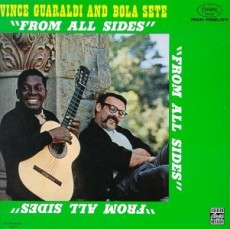
Bola Sete was born Djalma de Andrade on July 16, 1923 in Rio de Janiero, Brazil. His name translates to Seven Ball and in Brazilian billiards the seven ball is the black ball on the table. He got this nickname when he was the only black member of a small jazz group. He studied guitar at the Conservatory of Rio and started performing with his own sextet and local samba groups while he was still a student. His early influences were guitarists Django Reinhardt, Charlie Christian, Barney Kessell and Oscar Moore, as well as the big band sounds of Dizzy Gillespie, Tommy Dorsey and Woody Herman that toured South America.
His career began in 1952 playing various clubs and hotels around Italy for four years. Then returning to Brazil while touring South America he was spotted by the manager of the Sheraton hotels who brought him to the States to play in New York’s Park Sheraton and San Francisco’s Sheraton Palace. Dizzy Gillespie was staying there at the time and listening to Bola Sete playing every day. When Gillespie decided to bring his pianist Lalo Schifrin to the hotel, he discovered that Lalo and Bola had already met and played together in Argentina. This meeting was the beginning of Bola’s success in the US. In the fall of 1962, Gillespie took the guitarist to the 9th Annual Monterey Jazz Festival. Enjoying huge success he toured for a while with Gillespie then returned to San Francisco and joined the Vince Guaraldi Trio.
Bola was already well known in the US, and his partnership with Guaraldi yielded several well-received recordings. After staying for a couple of years Bola formed his own trio with his fellow Brazilians, bassist Sebastian Neto and drummer Paulinho da Costa. In the 1970s, he became friends with guitarist John Fahey, who had been an admirer of Sete’s. In 1975, Fahey used his Takoma label to release Ocean, which is now seen as one of Sete’s greatest accomplishments.
During the eighties, Sete suffered from lung cancer and though he attempted to counter with yoga and meditation, on February 14, 1987 guitarist Bola Sete passed away at Marin General Hospital in Greenbrae, California from complications caused by pneumonia and cancer.
Inspire A Young Mind
More Posts: guitar

Daily Dose Of Jazz…
Tisziji Muñoz was born July 15, 1946 in Brooklyn, New York. He learned to play guitar as a child using a single-line playing style, due to a childhood wrist injury. Spirit-taught, the avant-garde jazz virtuoso and extreme guitarist is best known for his uniquely original guitar sound and playing style, likened to that of a spiritual tornado.
Tisziji became interested in jazz in 1968 when he was introduced to the music of John Coltrane while enlisted in the US Army 440th General’s Band. Upon discharge he pursued his musical interests in Canada and took a lead role in the development of Toronto’s underground music scene, where he began a long lasting working relationship with pianist Paul Shaffer and performed as guitarist in the musicals Hair and Godspell.
In the mid-70’s, Muñoz returned to New York City and began collaborating and performing with saxophonist Pharoah Sanders followed by projects and releases with Ravi Coltrane, Dave Liebman, Marilyn Crispell, Paul Shaffer, Steve Kuhn, Lam Sobo John Medeski, Bernie Senensky, Chris Caswell, Henry Kaiser, Ra Kalam Bob Moses, Don Pate, John Lockwood, David Finck and the late greats Rashied Ali, Lew Soloff, John Hicks, Nick Brignola and Hilton Ruiz.
Tisziji has performed at the Montreal Jazz Festival, appeared on The late Show with David Letterman, played Carnegie Hall, The Village Vanguard and Gate, Iridium, Dizzy Club coca Cola and Jazz at Lincoln Center among other venues.
An accomplished author, Tisziji has independently published numerous written works encompassing his own Heart-Fire Sound realization and embracing the subjects of spirituality, genius, creativity and time mastery. His books and music have radically transformed the manner in which musicians think and play music, validating the spirit of the genuine creative artist – from the inside out. Avant-garde jazz guitarist continues to compose, record and perform.
Dose A Day – Blues Away
More Posts: guitar
Daily Dose Of Jazz…
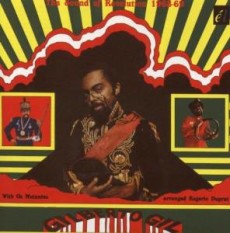
Gilberto Passos Gil Moreira was born June 26, 1942 in Salvador do Bahia, Brazil though he spent much of his childhood in the countryside of Ituaca. The offspring of a doctor and a schoolteacher, he attended the Marist Brothers school until he was nine and then returned to Salvador for secondary school.
Gil’s interest in music began when he was two and grew up listening to the forro music and the street performers of Salvador. Early on, he began to play the drums and the trumpet, and then took up the accordion before attending music school. He first played classical music, but grew more interested in the folk and popular music of Brazil, influenced by accordionist Luiz Gonzaga. He discovered the samba music of Dorival Caymmi, American big band jazz and tango.
In 1950 while still in high school he joined his first band, Os Desafinados (The Out of Tunes), playing accordion and vibraphone and singing. Soon afterwards he settled on the guitar as his instrument after hearing Joao Gilberto and started playing bossa nova. Gil met guitarist and singer Caetano Veloso at the Universidade Federal da Bahia in 1963 and immediately they began collaborating and performing together, releasing a single and EP soon afterwards. Along with Maria Bethania, Gal Costa and Tom Ze, they opened the Vila Velha Theatre with a night of bossa nova and traditional Brazilian songs in 1964.
Gilberto would go on to become musical director of the theatre’s concert series, sold bananas, composed jingles for tv ads and work for Unilever before moving to Sao Paulo in in 1965. Though he had a hit single with Louvação that was later recorded by Elis Regina, his first solo hit was the 1969 song Aquele Abraco. Arrested with Veloso he spent seven months in jail and house arrest and then instructed to leave the country. After a concert in Salvador in ’69 they left for Portugal, Paris and London where he listened to Bob Marley, Jimmy Cliff and Burning Spear. He performed with Yes, Pink Floyd and the Incredible String Band. It was in London that he recorded Gilberto Gil Nega and attended Miles Davis and Sun Ra concerts.
Over the course of his career he participated in the Aids benefit album Red, Hot + Rio, win Grammy awards, receive the Legion d’honneur from France, and was the first Latin American recipient of the Polar Music Prize in Stockholm. In between performances he turned to politics becoming the Salvador Secretary of Culture, founded the environmental protection organization Onda Azul (Blue Wave), was a Good will Ambassador for the Food and Agriculture Organization of the United Nations, became Brazil’s Minister of Culture and then retired due to a vocal cord polyp.
Tenor, baritone and falsetto vocalist, guitarist, lyricist and composer Gilberto Gil who is one of the pioneers of tropicália, and became increasing interested in the welfare of Black culture and focused on Afro-Brazilian culture. He continues to transcend the eras of dance and music trends emerging on the other side with a blend of music styles that stay true to his traditional Bahian roots while engaging with commercial markets.
Inspire A Young Mind