

Daily Dose Of Jazz…
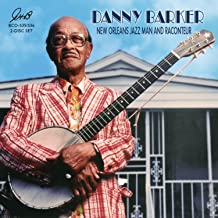
Daniel Moses Barker was born on January 13, 1909 in New Orleans, Louisiana to a family of musicians, the grandson of bandleader Isidore Barbarin and nephew of drummers Paul Barbarin and Louis Barbarin. He took up the clarinet and drums before switching to a ukulele that his aunt got him, and then to banjo. One of Barker’s earliest teachers in New Orleans was fellow banjoist Emanuel Sayles, with whom he would record.
Barker began his career as a musician in his youth with his streetband, the Boozan Kings, and toured Mississippi with Little Brother Montgomery. 1930 saw him moving to New York City where he switched to the guitar. Through the decade he played with Fess Williams, Billy Fowler and the White Brothers, Buddy Harris, Albert Nicholas, Lucky Millinder, and Benny Carter in 1938. During his time in New York, he frequently played with West Indian musicians, who often mistook him for one of them due to his Creole style of playing.
From 1939 to 1946 he frequently recorded with Cab Calloway, and started his own group featuring his wife Blue Lu Barker after leaving Calloway. In 1945 he recorded with pianist Sir Charles Thompson, and saxophonists Dexter Gordon and Charlie Parker. In 1947 he was back with Lucky Millinder and Bunk Johnson. He returned to working with Al Nicholas in 1948 and in 1949 rejoined efforts with his wife in a group.
During the 1950s Danny was primarily a freelance musician, but did work with his uncle Paul Barbarin from 1954 to 1955. In the mid-1950s he went to California to record again with Albert Nicholas; performed at the 1960 Newport Jazz Festival with Eubie Blake. In 1963 he was working with Cliff Jackson, and then in 1964 appeared at the World Fair leading his own group. Sometime in the early 1960s he formed a group he called Cinderella. The following year he returned to New Orleans and took up a position as assistant to the curator of the New Orleans Jazz Museum.
In 1970 he founded and led a church-sponsored brass band for young people ~ the Fairview Baptist Church Marching Band. The Fairview band launched the careers of a number of professional musicians who went on to perform in brass band and mainstream jazz contexts, including Leroy Jones, Wynton Marsalis, Branford Marsalis, Kirk Joseph, Nicholas Payton, Shannon Powell, Lucien Barbarin, Dr. Michael White and others. In later years the band became known as the Dirty Dozen Brass Band.
He played regularly at many New Orleans venues from the late 1960s through the early 1990s, in addition to touring. Beyond overcoming the obstacles of segregation, banjoist Danny Barker, who also sang and played guitar and ukulele, authored two books and was an amateur landscape artist; and who suffered from diabetes throughout most of his adult life, passed away from cancer in New Orleans on March 13, 1994 at age 85.
More Posts: bandleader,banjo,guitar,history,instrumental,jazz,music,ukulele,vocal
Three Wishes
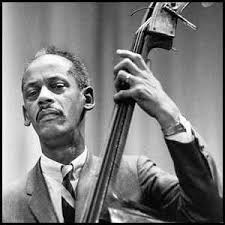
Tommy Potter was pensive when of his three wishes by the Baroness but answered her questions with:
- “An adequate amount of money to carry me through and take careof my family.”
- “A healthy situation for everyone immediately concerned with me, plus an adequate amount of knowledge.”
- “That I might be able to play music that is pleasing, not only to myself but to folks that will listen.”
*Excerpt from Three Wishes: An Intimate Look at Jazz Greats ~ Compiled and Photographed by Pannonica de Koenigswarter

More Posts: baroness,bass,history,instrumental,jazz,music,pannonica,three,wishes

Daily Dose Of Jazz…
Harry Roy was born Harry Lipman on January 12, 1900 in Stamford Hill, London, England, and began to study clarinet and alto saxophone at the age of 16. He and his brother Sidney formed a band which they called the Darnswells, with Harry on saxophone and clarinet and Sidney on piano. During the 1920s they performed in several prestigious venues such as the Alhambra and the London Coliseum, under names such as the Original Lyrical Five and the Original Crichton Lyricals. They spent three years at the Café de Paris, and toured South Africa, Australia, and Germany.
By the early 1930s, Harry was fronting the band under his own name, and broadcasting from the Café Anglais and the Mayfair Hotel. In 1935 he married Elizabeth Brooke, daughter of the white Rajah of Sarawak, with whom he appeared in two musical films, Rhythm Racketeer and Everything Is Rhythm.
During World War II, he toured with his band, Harry Roy’s Tiger Ragamuffins. He was at the Embassy Club in 1942, and a little later, toured the Middle East, entertaining troops. In 1948, Roy traveled to the United States but was refused a work permit, so returning to Britain, he reformed his band and scored a hit with his recording of Leicester Square Rag.
By the early 1950s the big band era had come to an end and his band split up, sending him drifting in and out of the music scene. That decade he ran his own restaurant, the Diners’ Club until it was destroyed by fire. By 1969 Harry returned to music, led a quartet in London’s Lyric Theatre’s show Oh Clarence and his own Dixieland Jazz Band residency during the summer at Sherry’s Dixieland Showbar in Brighton, but by then he was in failing health. Clarinetist and dance band leader Harry Roy passed away in London on February 1, 1971.
More Posts: bandleader,clarinet,history,instrumental,jazz,music
Requisites
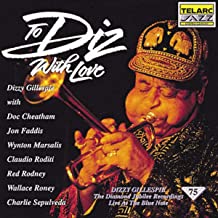
To Diz With Love ~ Dizzy Gillespie | By Eddie Carter
For this morning’s choice from the library, I’ve chosen a CD-album to honor a true pioneer. John Birks Gillespie, known throughout the world by his nickname Dizzy was a renowned bandleader, composer, singer, teacher, and trumpet player. He, alongside Charlie Parker, changed the face of jazz forever by creating and becoming the inspirational voice of Bebop. At the time of this CD-album’s release in October 1992, he was celebrating his 75th Birthday. The folks at Telarc Jazz recognized this significant achievement with their first release performed earlier in the year at The Blue Note in New York City. Forty-seven shows in all were recorded by Telarc over an entire month resulting in one of the best live albums that year. To Diz With Love (Telarc Jazz CD-83307) also features the talents of Doc Cheatham, Jon Faddis (track: 3), Wynton Marsalis (tracks: 2 & 4), Claudio Roditi, Wallace Roney (tracks: 1 & 5), and Charlie Sepulveda (track: 4) on trumpet, Red Rodney (track: 2) on fluegelhorn, Junior Mance on piano, Peter Washington on bass, and Kenny Washington on drums.
The opener, Billie’s Bounce by Charlie Parker was composed in 1945 and dedicated to Gillespie’s agent, trumpet player, Billy Shaw. Shaw was also the inspiration for Gillespie’s composition, Shaw ‘Nuff, written a year later. The ensemble starts this standard with a vivacious introduction by the rhythm section that grows into a rapid run of the opening chorus led by the front line. Claudio kicks off this uptempo cooker with a high-energy drive that builds its emotional level enthusiastically. Wallace produces a very hot flame of exhilarating verses on the second solo. Dizzy takes the next statement for a sizzling uptempo ride. Then, Junior takes charge, swinging with an intense and passionate feeling on the fourth interpretation. Peter keeps the ingredients stirring on the next performance with a soulful groove, and Kenny wraps up the solos with a fierce attack on the finale preceding the closing chorus and climax.
Parker’s Confirmation, written in 1946 adds Marsalis on trumpet and Rodney on flugelhorn to join Dizzy. The rhythm section provides a medium beat for the horns to strut comfortably during the melody. Marsalis solos first with full-toned ease at a relaxing momentum. Dizzy is up next using the mute to offer an endearing whispery reading. Rodney follows with a subtle tone and cool modality that winks to “Bird”. The front line provides a few more statements, then Mance delivers a soft, dreamy solo preceding the climax. Up next is Mood Indigo by Duke Ellington, Barney Bigard, and Irving Mills featuring Cheatham and Jon Faddis. It was written in 1930 for a radio broadcast and originally titled Dreamy Blues. The public went wild after hearing it, Mills renamed the song Mood Indigo and wrote the lyrics for it. Doc leads off the solos with a profoundly sensitive statement. Jon conveys an emotional impact on the next reading and Dizzy delivers the blues with subtle elegance. Junior expresses delight in a brief statement before the ensemble wraps it up.
Thelonious Monk’s Straight, No Chaser was written in 1951 and is given a spirited treatment with Marsalis and Sepulveda as the featured soloists. Wynton starts swiftly on the lead solo with phenomenal energy, then Charlie burns strongly on the next scintillating statement. Dizzy shows the depth of his intensity on the third interpretation, followed by Junior who says a mouthful on the next reading. Peter provides some powerful brushwork on the closing statement.
A Night In Tunisia is Gillespie’s signature and most famous tune. It was written in 1942 and opens with an invigorating theme by the ensemble collectively. Claudio is ablaze right from the start of the first interpretation. Dizzy lights an intense fire on the second solo, then Wallace responds with a torrid reading that burns fiercely. Junior embarks on an aggressive performance that’s executed beautifully. Kenny puts the final stamp on the standard with a fierce groove on the drums. The treat though, comes at the end when during the closing chorus, Dizzy brings Lew Soloff up from the audience to lead the group into the song’s conclusion.
Telarc has created a sonic masterpiece that’s a joy to listen to by engineers Jack Renner (one of the founders of the iconic label) and Michael Bishop. To Diz With Love is not just a celebration, but an exceptional musical performance by one of the undisputed masters of Bebop. It’s also the first of three final Gillespie performances recorded before his passing and is highly recommended for any jazz fan’s collection. The other two releases are To Bird With Love, and Bird Songs: The Final Recordings!
~Bird Songs: The Final Recordings (Telarc Jazz CD-83421); To Bird With Love (Telarc Jazz CD-83316) – Source: Discogs.com ~ Billie’s Bounce – source: JazzStandards.com ~ Mood Indigo – source: Wikipedia.org © 2020 by Edward Thomas Carter

More Posts: choice,classic,collectible,collector,history,instrumental,jazz,music,trumpet
Daily Dose Of Jazz…
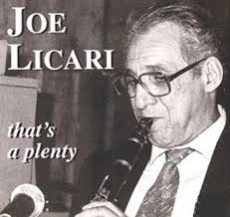
Joe Licari was born on January 10, 1934 in Brooklyn, New York and studied with Bob Wilber. His influences were Benny Goodman, Frank Teschemacher, Pee Wee Russell, Johnny Dodds, Sidney Bechet, and Jimmie Noone, using some of their ideas to find his own voice.
Known as an especially “hot” player with an exuberant and always emotive attack, Licari has worked along side of Roy Eldridge, Wild Bill Davison, Conrad Janis, Big Chief Russell Moore, Connie Kay, Bob Haggart, Vic Dickenson, Pee Wee Erwin, Doc Cheatham and the vocalist Julie Wilson. He’s also appeared in films, on television and radio shows and in clubs, sometimes standing in for Woody Allen.
As a leader, he recorded three albums and dozens as a sideman working as a featured player on albums by The Red Onion Jazz Band, Julie Wilson, Big Chief Russell Moore, Herb Gardner, Dick Voigt’s Big Apple Jazz Band, Jim Lowe, Dorothy Loudon, and Betty Comora. As a member of the Grove Street Stompers, they were a prominent fixture for decades on Monday nights at Arthur’s Tavern in Greenwich Village.
Clarinetist Joe Licari continues to record and perform at various clubs around New York City with The Speakeasy Jazz Babies, The Smith Street Society Jazz Band, Swing 39, Mark Shane. Delta Five, and Jon-Erik Kellso`s Hot Four.
More Posts: clarinet,history,instrumental,jazz,music