

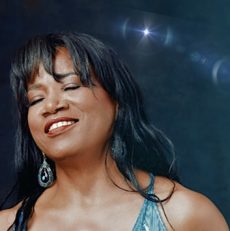
EUGENIE JONES
Eugenie Jones is an award-winning singer/songwriter/producer based in the Seattle, WA, area with an international fan base. Her recordings and concerts with jazz icons Reggie Workman, Bobby Sanabria, Julian Priester, Lonnie Plaxico, and many others have earned the entertainer praise in every major jazz publication, a #7 ranking on Jazz Week’s Top 50, and a #30 spot on Jazz Weeks top one-hundred albums. Jones is also a 2023 recipient of the Jazz Journalists Association’s Jazz Hero award for her efforts intersecting jazz performance events with community service.
Rating her recording Black Lace Blue Tears 3.5 out of 4 stars, DownBeat called the singer “impressive.” At the same time, legendary Blue Note Records artist Joe Chambers describes Jones as “an excellent singer, with a voice, style, and range that encompasses multiple idioms.”
Jones brings an authentic and electric presence to the stage, packaged within a uniquely exquisite voice. Accompanying her performance is an a-list line-up of New York musicians, including Lafayette Harris/p, Lonnie Plaxico/b, and Dwayne Broadnax. This concert will feature reimagined jazz classics, soulful jazz originals, and a taste of soul classics by Nina Simone, Anita Baker, James Brown & more!
More Posts: adventure,genius,jazz,museum,music,preserving,travel,vocal
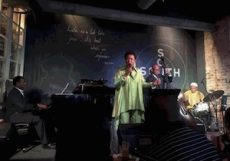
VANESSA RUBIN TRIO
Revered as both a torchbearer and a storyteller, jazz vocalist Vanessa Rubin possesses a voice hailed with crystalline clarity, hearth-like warm, emotional depth and keen burnished wisdom she can deliver with playful lioness sass. The Cleveland native brings a wealth of diverse influences to her vocal performances. From swing to bossa nova to blues, ballads and contemporary covers performed with small and large ensembles, Rubin’s interpretive ability to move through the Great American Songbook to modern jazz composers/arrangers like Tadd Dameron and Horace Silver to contemporary composers as Stevie Wonder, Bill Withers and Sting is masterful. “The Great American Songbook continues to expand with songs by outstanding composers who can paint pictures of the life of our times with their unique melodies and lyric that also stand the test of time”, Rubin asserts.
The Trio: Brandon McCune ~ piano | Kenny Davis ~ bass | Winard Harper ~ drums
Showtimes:
Saturday ~ 7:00pm | 9:30pm
Sunday ~ 6:30pm | 8:30pm
More Posts: adventure,club,genius,jazz,music,preserving,travel,vocal
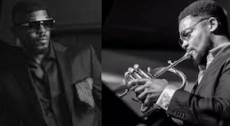
THE HIGHTOWER HARPER HANG
Singer/Songwriter Tony Hightower is taking up the mantle to be a bridge that ushers R&B audiences into Jazz…Real Jazz. With years of experience as a musical performer and actor with familiar roots that place him firmly within the music’s firmament, Atlanta-native Hightower is still just getting started on this benevolent turn in his journey. And he is bringing a lot of young people with him.
Growing up in Atlanta with a local legend mother who was a Funk-Rock singer but could sing anything and mentored many singers coming behind her, Tony learned music first-hand from Bobby Blue Bland and the Platters to Mother’s Finest, S.O.S. Band and Brick. And as mother Theresa evolved as a first-class singer – shifting her focus to Jazz that resulted in her historic residency at the Ritz Carlton Hotel in once fiercely segregated Buckhead district of Atlanta, Georgia – so, too, did Tony’s taste begin to broaden. The artist that Theresa followed at The Ritz: Freddy Cole, Nat’s brother.
Trumpeter Terence Harper started playing the drums at the age of two and at twelve years old began playing the trumpet. While in middle school he began playing the drums for one of the Spelman College Jazz ensembles under the direction of Joe Jennings, while also being featured on a recording with the Inman Middle School jazz band on both trumpet and drums.
Harper attended North Atlanta High School Center of the Performing Arts and played trumpet in both jazz band and symphonic band under the direction of Mr. Reginald Colbert. During his high school years he started to focus more on both classical and jazz trumpet and has won numerous auditions during his high school term including the Georgia Music Educators Association All State band, principal trumpet for the district honor band, The Talent Development Program and the Atlanta Youth Wind Symphony at Emory University. Terence has also attended the prestigious Interlochen Arts camp in Michigan and has also taught trumpet performance and jazz studies at Summerbridge Atlanta at the Lovett School.
He graduated from Rutgers University as a classical trumpet major in 2009, where he studied under William Fielder, who has been regarded as one of the greatest trumpet instructors of his generation.
Every Thursday: Music from 8:00pm ~ Midnight | Hang til 2:00am
Cover: $10.000 | Musicians: $5.00 | Free parking in the lot just past slutty vegan atl
More Posts: adventure,club,genius,jazz,music,preserving,restaurant,travel,trumpet,vocal
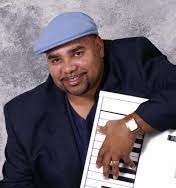
TYRONE JACKSON
The name Tyrone Jackson is the quintessential jazz piano player. His boundless creativity coupled with harmonic mastery, utilizes the piano as a blank canvas. Jackson is nationally recognized and has traveled the world as a solo artist and sideman. As a composer, Jackson has composed original music for Pulitizer Prize winning author Natasha Tretheway’s book of poems “Native Guard” turned theatrical play, Pearl Clege’s play, “Tell Me My Dream”, “Ethel” and this year’s Alliance Theater production of “Nick’s Flamingo Grill.” Jackson has recorded 4 Albums—“Dedicated”, “Another Voyage”, “Melody In Nede”, and new release “From The Mind Of.”
Currently Tyrone Jackson is a professor at Kennesaw State University where he is Lecturer of Jazz Piano and teaches a myriad of classes including: Aural Skills III & IV, Jazz Improvisation I, II & III, Jazz Combo, Jazz Theory, Applied Jazz Piano, Group Jazz Piano and History of the Blues. Jackson is also a clinician and teacher for the Rialto Arts Jazz program for middle school and is a clinician for Clayton County Arts Association.
Jackson has performed with Steve Turre, Larry Carlton, Carmen Bradford, Earl Klugh, Wynton Marsalis, Branford Marsalis, Wycliffe Gordon, Vincent Gardner, Joe Lovano, Dave Douglas, Wes Anderson, Greg Dawson, Jennifer Holliday, Karen Briggs, Clay Jenkins, Russell Gunn, David Sanchez, Damaris Carbough, Russell Malone, and Marcus Miller.
Hosted by Lori Williams
More Posts: adventure,club,genius,jazz,music,piano,preserving,travel
Daily Dose Of Jazz…
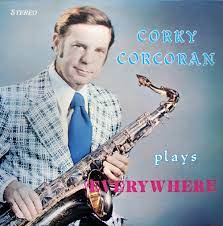
Corky Corcoran was born Gene Patrick Corcoran on July 28, 1924 in Tacoma, Washington and was considered a child prodigy. He began performing in bands at the age of 16.
Corcoran first played professionally in 1940 with Sonny Dunham, then joined Harry James’s ensemble from 1941 to 1947. Leaving James for a short time, Corky led his own ensemble and worked briefly in Tommy Dorsey’s band before rejoining James in 1949. He continued to work with James until 1957, playing concurrently with his own ensembles. Returning to James in 1962, he stayed almost up to his death.
Tenor saxophonist Corky Corcoran transitioned on October 3, 1979 in his hometown.

More Posts: bandleader,history,instrumental,jazz,music,saxophone