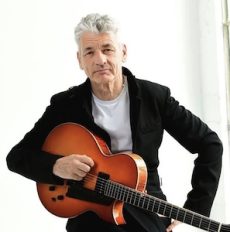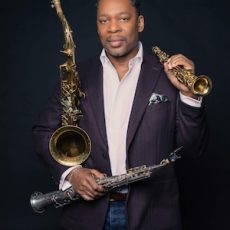
ETIENNE CHARLES
Trinidad born Etienne Charles is a performer, composer and storyteller, who is constantly searching for untold tales and sounds with which to tell them. His lush trumpet sound, varied compositional textures and pulsating percussive grooves enable him to invoke trance, soothing and exciting listeners while referencing touchy and sometimes controversial subjects in his music. Highlighting marginalized communities and engaging with them has been his mission, evident with projects such as his Guggenheim Fellowship Project, Carnival: The Sound of a People Vol. 1, San Jose Suite, Creole Soul, Gullah Roots, Folklore and his latest commission, San Juan Hill – A New York Story.
His concerts engage, enlighten, educate and enrich audiences with energized multidisciplinary performance utilizing original composition, thematic improvisation, dance, short films and spoken word to create a holistic experience. A firm believer in music and performance as a tool for provoking thought and dialogue, Charles’s themes speak to the status quo while drawing parallels to history. His work is actively connecting the African diaspora and drawing lines to the regions at the roots of migrations, evident in his latest release, NAACP Image Award nominated Creole Orchestra which was named #1 Jazz album on Jazzweek’s top 100 of 2024 after spending seven weeks at #1 on the chart in the summer.
His dedication to music as a tool for social uplift has seen him named as a Laureate of the Arts and Letters, Anthony N. Sabga Awards, Caribbean Excellence (2025). He was conferred the title of Chevalier de l’Ordre des Arts et des Lettres by the French Ministry of Culture (2024) and was awarded a Congressional Citation from the United States (2012).
As a sideman he has performed with and/or arranged for Roberta Flack, Chucho Valdes, Marcus Roberts, Marcus Miller, Count Basie Orchestra, Frank Foster’s Loud Minority Big Band, Monty Alexander, Gregory Porter, Terri Lyne Carrington, René Marie, David Rudder, Machel Montano and many others. He has been commissioned as a composer and arranger by Alvin Ailey American Dance Theater (2025), Lincoln Center for the New York Philharmonic (2021), Savannah Music Festival (2017), Chamber Music America (2015 & 2021), the Charleston Jazz Orchestra (2012), the Chicago Jazz Ensemble (2011) and the Danish Radio Big Band (2025).
He currently serves as Professor of Studio Music and Jazz at University of Miami Frost School of Music
The Band:
Etienne Charles ~ Trumpet
Mikailo Kasha ~ Bass
Miles Turk ~ Drums
Tickets: $20.00, $30.00, $40.00, $50.00 +$5.50 processing and ticketing fee.
More Posts: adventure,bandleader,club,genius,instrumental,jazz,music,preserving,travel,trumpet

SAMARA JOY
With a style that harkens back to the ‘50s and ’60s eras of jazz music, the twenty-six year old Samara Joy McLendon is an emerging singer from the Bronx, New York. Her childhood was filled with soul and Motown classics, but gospel music was the most dominant due to many of her elder relatives having been involved with the genre.
Though she performed in the jazz band and won Best Vocalist at the Essentially Ellington Competition & Festival while in high school, her true introduction to jazz came when she enrolled at Purchase College as a voice major in their jazz program. During her studies, a video she made with the head of Purchase’s jazz program performing Ella Fitzgerald’s “Take Love Easy” went viral, and that exciting experience was enough for Samara to create a GoFundMe campaign to cover the expenses in putting together her debut album.
The end result, Samara Joy, was released two months after her college graduation in 2021. Her second album Linger Awhile arrived on September 16, 2022, and has allowed Samara to receive her first of many Grammy Awards thus far: one for Best New Artist and another for Best Jazz Vocal Album.
Tickets: $179.00 ~ $651.00
More Posts: adventure,bandleader,genius,instrumental,jazz,music,preserving,travel,vocal
Daily Dose Of Jazz…
Ingrid Jensen: From Subway Platforms to the World’s Greatest Stages
Born on January 12, 1966, in North Vancouver, British Columbia, Ingrid Jensen grew up in nearby Nanaimo, Canada, where she first picked up the trumpet as a child. What began as childhood curiosity blossomed into exceptional talent—so much so that scholarship offers poured in. Jensen made her way through Malaspina University before landing at the prestigious Berklee College of Music, where her distinctive voice on the trumpet truly began to emerge.
Hustle and Heart in the Big Apple< Like so many jazz dreamers before her, Jensen arrived in New York City determined to make her mark. Her early days weren't glamorous—she played in subway stations, trumpet case open for tips, honing her chops and building confidence one commuter at a time. It was the kind of apprenticeship that forges character as much as skill, and Jensen emerged from it ready to take on the jazz world.
Breaking Through
Her rise to prominence has been both steady and impressive. Jensen has signed with and released albums on respected labels including Enja, Justin Time, Universal, and ArtistShare. Her debut album, Vernal Fields, featuring drumming legend Lenny White, saxophonist George Garzone, and bassist Larry Grenadier, earned her a Juno Award—Canada’s highest musical honor. She’s been nominated for several more since, cementing her status as one of jazz’s essential voices.
A Musical Life in Motion
Today, Jensen divides her time between leading her own projects and serving as a featured soloist with the Grammy Award-winning Maria Schneider Jazz Orchestra—one of the most celebrated large ensembles in contemporary jazz. She’s also a sought-after educator, guest-teaching at prestigious universities around the world, sharing not just technique but the wisdom gained from decades on the bandstand.
Family Harmony
Music runs deep in the Jensen family. Ingrid occasionally collaborates with her sister, the accomplished saxophonist Christine Jensen, creating performances that showcase not just their individual artistry but the intuitive connection that only siblings can share.
A Who’s Who of Collaborators
ensen’s résumé reads like a jazz encyclopedia. She’s performed with Steve Wilson, Jeff “Tain” Watts, Dr. Lonnie Smith, Gary Bartz, Bob Berg, Terri Lyne Carrington, Geoffrey Keezer, Chris Connor, Clark Terry, Frank Wess, Dr. Billy Taylor, and the DIVA Big Band, among many others. Each collaboration has added another dimension to her musical vocabulary.
Beyond Jazz
Her trumpet has also crossed genre boundaries—she’s performed with British soul singer Corinne Bailey Rae on Saturday Night Live and even backed comedian Denis Leary, proving that great musicianship transcends stylistic borders.
Still Climbing
Ingrid Jensen continues to perform, record, and tour, bringing her warm tone, impeccable technique, and creative spirit to audiences worldwide. From those early days busking in New York subway stations to standing ovations on international stages, her journey is a testament to talent, perseverance, and an unshakeable belief in the power of music.
For anyone who loves the sound of a trumpet played with both virtuosity and soul, Ingrid Jensen is essential listening.
More Posts: bandleader,history,instrumental,jazz,music,trumpet

Requisites
Greensleeves ~ Shoji Yokouchi Trio plus Yuri Tashiro | By Eddie Carter
I was looking for something interesting to play at the start of my Tuesday morning when I came across an album by the Shoji Yokouchi Trio and Yuri Tashiro. Greensleeves (Three Blind Mice TBM-5011) is a 1978 release with a program of four jazz standards and three creative originals. The personnel consists of Yuri Tashiro on Hammond organ (tracks A1 to A4, B3), Shoji Yokouchi on folk guitar (tracks A1, A2), electric guitar (tracks A4, B1, B2), and gut guitar (tracks A3, B3), Kunimitsu Inaba on bass, and Hajime Ishimatsu on drums. The copy I own is the 2017 Impex Records U.S. Limited Edition stereo audiophile reissue, sharing the original catalog number. No. 2581 of 3000.
Side One opens with Willow Weep For Me by Ann Ronnell. Shoji’s gentle introduction gets things off to a good start for the quartet’s slow-paced melody. Shoji has the first say and tenderly embraces the opening solo. Yuri follows with a thoughtfully passionate reading, while Kunimitsu and Hajime complement both elegantly into the theme’s reprise and finale. Bobby Timmons’ Moanin’ affords everyone solo space beginning with the quartet’s happy, upbeat theme. Shoji takes the song’s first lively reading, then Yuri makes her presence felt with skillful assurance. Kunimitsu follows with a brief statement, and Shoji and Hajime share a short exchange, preceding the closing chorus and vibrant climax.
Misty by Erroll Garner and Johnny Burke begins with Shoji setting the stage as he leads the ensemble through the gorgeous theme. He continues to reveal his lyrical side in a delicate opening statement. Yuri then enhances the song’s charm with a graceful interpretation. Kunimitsu and Hajime contribute the romantic, disciplined accompaniment, leading into the reprise and a soothing finale. The first of three compositions by Shoji Yokouchi, Drink Up, Vodka Martini, features the guitarist in a playful mood throughout the introduction and melody. As the song’s only soloist, Shoji conveys a driving vitality that bounces along, and the band’s chemistry shines, supporting him ahead of the melody’s restatement.
New Orleans Sunday is a trio performance featuring Shoji, Kunimitsu and Hajime. The trio puts the song through its paces with a catchy melody out of the gate. Shoji launches the opening with a driving rhythm, then Kunimitsu mines a vein of unsuspected riches in the following solo. Shoji and Hajime add a tasty treat in a short conversation before the trio’s reprise and conclusion. Greensleeves begins with a haunting intro, before picking up pace for the trio’s theme. Shoji takes the lead solo in a series of infectiously propulsive choruses. Kunimitsu goes for a lightly swinging walk next, then Hajime enters the spotlight to give a brief workout, leading back to the ending theme and soft summation.
Your Watch Is Ten Minutes Slow picks up the tempo one final time to wrap up the album. The quartet’s agile melody starts things off, then Shoji gets down to business on the opening solo. Yuri responds with a spirited reading ahead of the foursome’s return to the theme and close. Takeshi Fujii produced the initial session, and Yoshihiko Kannari managed the recording console. Bernie Grundman mastered this audiophile reissue, and Chris Bellman engineered it. The reissue features a thick cardboard cover; the sound quality is excellent, with a spacious, clear, and detailed soundstage. The record was pressed on 180-gram audiophile vinyl and is silent until the music begins.
Shoji Yokouchi recorded 46 albums over his career, and Yuri Tashiro released 51 titles over her career. If you’re in the mood for an album that weaves together beloved jazz standards with fresh, creative compositions, I invite you to check out Greensleeves by the Shoji Yokouchi Trio and Yuri Tashiro, the next time you’re out record-shopping. It’s an excellent place to start discovering the music of both artists. A delightful album that’s perfect for late-night listening and is sure to please any jazz enthusiast and fans of guitar and organ-centered ensembles!
~Misty, Moanin’, Willow Weep For Me – Source: JazzStandards.com ~ Greensleeves – Source: Wikipedia.org © 2026 by Edward Thomas Carter
More Posts: choice,classic,collectible,collector,guitar,history,instrumental,jazz,music,organ

Daily Dose Of Jazz…
Wilbur de Paris: From Plantation Shows to the World Stage
Born on January 11, 1900, in Crawfordsville, Indiana, Wilbur de Paris grew up in a household where music wasn’t just entertainment—it was the family business. His father was a multi-instrumentalist who played trombone, banjo, and guitar, and he had big plans for his musically gifted son.
A Childhood on the Road
By the autumn of 1906, when little Wilbur was just five years old, he had already begun learning the alto saxophone. A year later—at an age when most children are still in elementary school—he was working professionally in his father’s plantation shows, crisscrossing the South on the Theater Owners Booking Association (TOBA) circuit. It was a grueling apprenticeship, but one that would serve him well.
The Moment Everything Changed
At sixteen, while performing in a summer show at the Lyric Theatre, de Paris heard jazz for the first time. The experience was transformative. Soon after, while playing saxophone at the legendary Tom Anderson’s Cafe with A. J. Piron’s band, he met a young trumpet player who would change music history: Louis Armstrong. These encounters lit a fire that would burn for the rest of de Paris’s life.
Building His Own Sound
After high school, de Paris continued working with his father before joining various traveling shows in the East. In the early 1920s, he made his way to Philadelphia and took a bold step—forming his first band, Wilbur de Paris and his Cottonpickers. He was building something of his own.
Surviving the Crash, Finding New York
When the Wall Street Crash of 1929 devastated the entertainment industry, de Paris disbanded his second group and made the move that would define his career: he headed to New York City. There, he spent years playing and recording with jazz royalty, absorbing every influence and honing his distinctive approach to the trombone.
The New New Orleans Sound
In the late 1940s, Wilbur teamed up with his brother Sidney to launch an ambitious project: a band called New New Orleans Jazz. The ensemble featured legendary figures including Jelly Roll Morton, drummer Zutty Singleton, and clarinetist Omer Simeon. But this wasn’t mere nostalgia—de Paris had a vision of blending traditional New Orleans jazz with the sophisticated swing that had emerged in the intervening decades.
The concept caught fire. Throughout the 1950s, the band became a beloved institution in New York City, recorded extensively, and toured the world, bringing their unique fusion of old and new to audiences everywhere.
A Legacy of Innovation
Wilbur de Paris passed away on January 3, 1973—just eight days before what would have been his 73rd birthday. He left behind a legacy that proved you could honor tradition while pushing it forward, that New Orleans jazz and swing weren’t competing styles but complementary voices in the grand conversation of American music.
From a five-year-old on the TOBA circuit to an internationally recognized bandleader, Wilbur de Paris lived the full arc of jazz’s golden age—and helped shape its sound every step of the way.
More Posts: bandleader,history,instrumental,jazz,music,trombone