

Daily Dose Of Jazz…
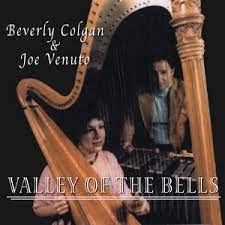
Joseph A. Venuto, Jr. was born on June 20, 1929 in Bronx, New York into an Italian immigrant family where he received his first drum kit from his grandfather. Having had lessons with Henry Adler, he moved on to Phil Kraus to learn mallet percussion. After earning a master’s degree from the Manhattan School of Music, he became a member of the Sauter-Finegan Orchestra, with whom he made his first recordings Doodletown Races on the RCA label in 1953. He was a featured soloist with the orchestra on Solo for Joe and Swingcussion. The DownBeat Reader’s Poll voted him the best vibraphonist that year.
From the mid-1950s, Venuto worked with Billy Byers in the Westchester Workshop, the Kent Harian Orchestra, Bobby Dukoff, and the Johnny Richards Orchestra before joining Radio City Music Hall as a session musician in the recording and television studios. By 1959 he recorded his debut album for Everest Records under his own name.
Between 1953 and 1975 Joe was involved in 104 recording sessions with Jack Teagarden, Kenyon Hopkins, Rex Stewart, The Creed Taylor Orchestra, Irene Kral/Al Cohn Orchestra, Mary Ann McCall, Don Costa, Hal Mooney, Ruth Brown, Gene Krupa and His Orchestra, LaVern Baker, Budd Johnson, Marion Montgomery, Benny Goodman, Shirley Scott, Solomon Burke, Gary McFarland, Johnny Hodges, Hank Jones/Oliver Nelson, and numerous more.
the early 1970s when he was in his Forties, he left New York City and moved to Reno, Nevada. He met, married, performed and recorded with his wife, harpist Bev Colgan, in a harp/vibes duo. Percussionist Joe Venuto, who also played the vibraphone, marimba, bongos and drums, transitioned on Feb. 14, 2019 at age 89.

More Posts: bongos,drums,history,instrumental,jazz,marimba,music,percussion,vibraphone
Daily Dose Of Jazz…
Pierre Favre was born June 2, 1937 in Le Locle, Switzerland. Not much is known about his childhood or his early music career.
He recorded the album Singing Drums in 1984 on the ECM label with Paul Motian and Nana Vasconcelos. He also appears on John Surman’s album, Such Winters of Memory released the year beore.
He has recorded with several well-known musicians, including Tamia, Michel Godard, Mal Waldron, Paul Giger, Jiří Stivín, Michel Portal, Irene Schweizer, Samuel Blaser, the ARTE Quartett, Barre Phillips and the London Jazz Composers Orchestra.
He has recorded six albums as a leader and drummer and percussionist Pierre Favre continues to explore his craft, perform and record.
More Posts: bandleader,drums,history,instrumental,jazz,music,percussion
Daily Dose Of Jazz…
Bryan Carrott was born in Queens, New York on April 23, 1959. After graduating from Fiorello H. LaGuardia High School of Music & Art and continued at the Manhattan School of Music before studying percussion with Morris Lang at Brooklyn College, then studied vibraphone with Dave Samuels at William Paterson University, receiving his Bachelor of Music degrees in Jazz Studies and Jazz Performance.
He has toured and/or recorded with David Fathead Newman, Ralph Peterson, Henry Threadgill, Muhal Richard Abrams, Sam Rivers, Don Byron, Dave Douglas, Charlie Hunter, Bob Moses, Roy Campbell, Herbie Mann, Cassandra Wilson, John Lurie & the Lounge Lizards, Greg Osby, Tom Harrell, Bennie Wallace, Steve Kroon, Joe Batan, and Kip Hanrahan, among others.
Carrott is an assistant professor and coordinator of percussion instruction at Five Towns College. He is a clinician and has led educational performances across the United States, Taiwan and Taipai. A featured soloist with Cologne, Germany’s WDR Orchestra conducted by Gunther Schuller, he was a mallet percussionist for Disney’s Broadway production of The Lion King.
For seven consecutive years, Bryan was cited in DownBeat Magazine’s International Critics’ Poll in the vibe category for Talent Deserving Wider Recognition, and has been featured on several film soundtracks, including 3 A.M. with Branford Marsalis. He currently serves as coordinator & professor of percussion studies at Five Towns College in Dix Hills, N.Y.
Vibraphonist and composer Bryan Carrott, who also plays marimba, piano, and leads his own trio, quartet and quintet, has yet to record as a leader but continues to perform and teach new generations of musicians.
More Posts: bandleader,composer,history,instrumental,jazz,marimba,music,percussion,piano,vibraphone
Daily Dose Of Jazz…
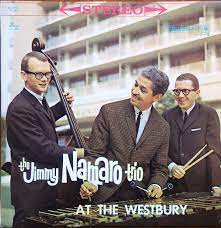
Jimmy Namaro was born James Namaro on April 14, 1913 in La Rosita, Mexico however, his family moved to Hamilton, Ontario in 1921. This is where he studied piano with Sid Walling and Eric Lewis.
He made his radio debut as a marimba player on CHML, Hamilton, and was heard in his teens on CFRB, Toronto, and on the CBC. In 1933, he was assistant conductor of a marimba band at the Chicago World’s Fair. Namaro subsequently pursued dual careers as the leader of pop or light jazz trios and quartets in nightclubs in Toronto, Canada and New York and as a popular CBC radio performer.
As a member of the Happy Gang from 1943 to 1959, he was also bandleader or soloist on several other CBC radio and television programs before moving to the United States in the Seventies. He was music director for Frankie Laine 1978-1993, with whom he toured the USA, Canada, and the UK. Namaro moved to Richmond, British Columbia, in 1987, where he continued to compose and to work with Laine.
His discography includes LPs Between 1958 and 1972 he recorded for Sparton, RCA Victor, Quality, Camden and others originally produced by the Canadian Talent Library Trust (CTL). Namaro wrote many jingles and composed music for CBC dramas such as the TV series Seaway, for the Broadway production Andorra, and for ballet. His paintings, in the primitive style, have had several exhibitions.
Vibraphonist, marimbist, percussionist, composer, painter Jimmy Namaro, who was naturalized Canadian around 1945, transitioned in Richmond, British Columbia on April 25, 1998.
More Posts: bandleader,composer,history,instrumental,jazz,marimba,music,percussion,vibarphone
Daily Dose Of Jazz…
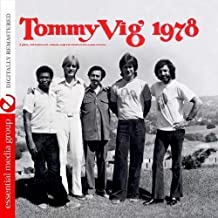
Tommy Vig was born on July 14, 1938 in Budapest, Hungary. Internationally recognized as a child prodigy by the age of 6, he played drums with his father, clarinetist Gyorgy Vig and performed concerts on Budapest State Radio, at the City Theatre, the Academy of Music, and the National Circus. By age 8, he made the album The World Champion Kid Drummer with Austrian jazz players in Vienna, Austria including Hans Koller, Ernst Landl, and the Hot Club of Vienna for Elite Special. The following year his drumming won him the 1947 MGM-Jazz Competition in Budapest and as a result made several recordings with the Chappy’s Mopex Big Band for His Master’s Voice.
Completing his studies at the Bartók Conservatory in 1955 and the Ferenc Erkel Music High School in 1956, due to the crushing of the Hungarian Revolution of 1956, he fled to Vienna, where he played concerts with Fatty George and Joe Zawinul. A move to the United States saw him on scholarship at Juilliard School of Music. Since then he has been writing and conducting concerts.
In 1970 Vig relocated to Los Angeles, California where he worked in the studios of Warner Bros., Fox, Universal, CBS, Columbia, ABC, Disney, Goldwyn, MGM, and Paramount. He played on 1500 studio sessions in Hollywood, two Academy Awards, and produced, directed, and conducted the official 1984 Olympic Jazz Festival for the Los Angeles Olympic Organizing Committee. He wrote the music for 30 films and television shows, and added percussion on the recording of Quincy Jones’s soundtrack to Roots.
Vig has worked with Red Rodney, Don Ellis, Cat Anderson, Terry Gibbs, Art Pepper, Milcho Leviev, Joe Pass, the Miles Davis-Gil Evans Big Band. Frank Sinatra, Sammy Davis Jr., Tony Curtis, Woody Allen, Judy Garland, Tony Bennett and Rod Stewart.
Since 2006, vibraharpist, drummer, percussionist, xylophonist and marimba player Tommy Vig, who has won several awards, has been performing concerts with his wife, appearing on radio and television, and recording albums.
More Posts: bandleader,drums,educator,history,instrumental,jazz,marimba,music,percussion,vibraharp,xylophone