

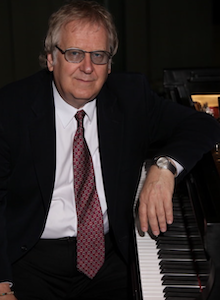
TED HOWE TRIO
Ted’s natural persistence and relentless fascination of developing his craft dominated his life. He soon became not only a student at Berklee, but a professor of piano arranging, theory and improvisation — all before reaching the age of 24. He joined the faculty of Georgia State University where he assisted in developing its first jazz education program.
Ted has produced “An Evening Of Duke Ellington With Ted Howe & The Ruth Mitchell Dance Theatre”, a full fledged ballet featuring 21 dancers, choreographed by members of the Alvin Ailey Dance Company. The ballet music was entirely Ted’s arrangements of Duke’s music set to dance. Premiering in Atlanta to glowing reviews, the ballet was performed to sold out houses.
As a Summit Records artist he has released three albums and has performed with a long list of sixty-nine musicians and vocalists that included Henry Mancini, Diahann Carroll, Russell Malone, Lainie Kazan, Morgana King, Tiger Okoshi, Carol Channing, Rene Marie, Herb Pomeroy, Ed Thigpen, Billy Daniels, Mel Torme and more.
The Band:
Ted Howe: Piano
Neal Starkey: Bass
Jerry “Guru” Fields: Drums
Cover: $30.00
More Posts: adventure,bandleader,bass,club,drums,genius,instrumental,jazz,piano,preserving,travel
Daily Dose Of Jazz…
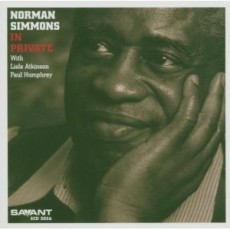
Norman Simmons was born on October 6, 1929 in Chicago, Illinois. As a child he was captivated by the sounds of the big band era, in particular, Duke Ellington’s orchestra. He started teaching himself piano and by sixteen enrolled in the Chicago School of Music, completing in four years.
In 1949 Norman formed his own group and began recording in 1952. An accomplished composer his tune “Jan” was a hit for tenorist Paul Bascomb the following year. Keeping a steady gig at the noted Chicago jazz spot “The Beehive” gave him the opportunity to back touring musicians like Wardell Gray, Lester Young and with Charlie Parker on his final Chicago performance in February 1955. But it was Ernestine Anderson who convinced him to move to New York City to continue working with her.
In New York Simmons performed with Johnny Griffin and played and wrote intricate arrangements for Eddie “Lockjaw” Davis. Upon the latter’s recommendation he teamed up with Carmen McRae for nine years before moving on with Betty Carter and Anita O’Day, where he found greater improvisational freedom. Late in the 70’s decade he began his long collaboration with Joe Williams and would work with Helen Humes and Sarah Vaughan among others.
As an educator he has taught at Paterson State College since 1982, participated in the Jazzmobile program for over twenty years, and has fostered music in public schools. His arrangement of Ramsey Lewis‘ 1966 hit of “Wade In The Water” became a large commercial success, he was a member of the Ellington Legacy Band beginning in 2002.
He arranged The Little Giant, The Big Soul-Band, and White Gardenia for Johnny Griffin, Teri Thornton‘s Devil May Care and Mark Murphy‘s Memories of You: Remembering Joe Williams.
Pianist, arranger, composer, and educator,Norman Simmons continued to perform, compose and arrange until he passed away on May 13, 2021.
More Posts: piano
Daily Dose Of Jazz…
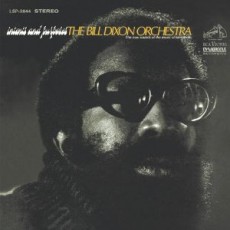
Bill Dixon was born on October 5, 1925 in Nantucket, Massachusetts and his family later moved to Harlem, New York City when he was about 7. It wasn’t until some twenty years later that he became interested in music and trumpet began his five-year studies at the Hartnette Conservatory of Music in 1946. He studied painting at Boston University, the WPA Arts School and the Art Students League. During the early 1950s while employed at the United Nations, he founded the UN Jazz Society.
By the 1960’s Dixon established himself as a major force in the jazz avant-garde movement, organizing and producing the “October Revolution in Jazz”. This first free-jazz festival comprised four days of music and discussions at the Cellar Café in Manhattan with musicians such as Cecil Taylor and Sun Ra participating.
Bill would later found the Jazz Composers Guild, become a professor of music at Bennington College, establish their Black Music Division, and was one of four featured musicians in the Canadian documentary Imagine the Sound in 1981 with Cecil Taylor, Archie Shepp and Paul Bley.
Dixon recorded relatively little over the decade and a half beginning in the late Sixties but co-led a few sessions with Archie Shepp, appeared on Cecil Taylor’s “Conquistador!” and some solo trumpet recordings has emerged. His recording career as a leader and sideman would pick up in the 80s into the new millennium with his last album being issued posthumously in 2011.
On June 16, 2010, Bill Dixon, who played trumpet, flugelhorn and piano died in his sleep at his home after suffering from an undisclosed illness.
More Posts: flugelhorn,piano,trumpet
Daily Dose Of Jazz…
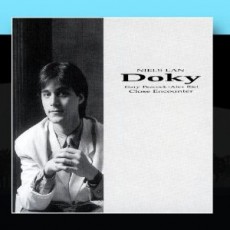
Niels Lan Doky was born in Copenhagen, Denmark on October 3, 1963 and first learned to play guitar before switching to piano at age 11. At the age of 15, he began working with Thad Jones, Ernie Wilkins, Kenny Drew, Ed Thigpen and others living and playing around his hometown. Shortly after finishing high school in 1981, following the advice of Thad Jones, he moved to the U.S. and studied at Berklee College of Music in Boston before establishing himself in New York City’s jazz scene.
Bassist Niels-Henning Ørsted Pedersen helped Doky land his first recording contract with Storyville records in 1986 and toured and recorded with him across Europe and in the USA during the rest the decade and well into the 1990s. During that period Pederson became a mentor and played a crucial role in helping him find his own musical voice and develop his own personal style.
Over the course of his career pianist Niels Lan Doky has recorded thirty-three albums, played for Pope Paul II, received an award from Denmark’s royal family, was appointed Member of the Music Committee under the Danish Arts Council, and made his film directing debut with the acclaimed feature film “Between a Smile and a Tear”.
He has performed with Joe Henderson, Gary Peacock, Jack DeJohnette, Ray Brown, Michael Brecker, David Sanborn, Pat Metheny, Alvin Queen, John Scofield, John Abercrombie, Woody Shaw, Bob Berg, Dianne Reeves, Al Jarreau, Charlie Haden, Gino Vannelli, and John McLaughli among numerous others, in addition to leading The Doky Brothers and groups under his own name currently today.
More Posts: piano
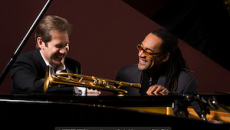
JOE GRANSDEN & KENNY BANKS SR.
The Art of The Song
Two of Atlanta’s finest jazz artists come together for an evening celebrating the enduring beauty of the Great American Songbook. Joe Gransden and Kenny Banks Sr. bring warmth, soul, and swing to timeless songs, shaped by their deep musical connection and years of shared artistry. With elegance, spontaneity, and a true love of the music, they make each performance feel both familiar and fresh.
Cover: $40.00
More Posts: adventure,bandleader,club,genius,jazz,music,piano,preserving,travel,trumpet,vocal