

Daily Dose Of Jazz…
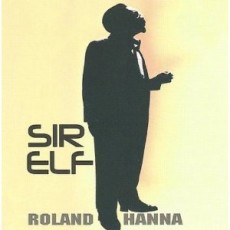
Roland Hanna was born on February 10, 1932 in Detroit, Michigan and began private classical piano lessons at an early age but had a strong interest in jazz. After graduation from Cass Technical High School and a two-year stint in the US Army, he continued his musical studies at the Eastman and Juilliard Schools of Music.
He worked with several big names, such as Benny Goodman and Charles Mingus in the 1950s, from 1967 to 1974 was a regular member of the Thad Jones-Mel Lewis Orchestra and was also a member of the New York Jazz Quartet during this decade. He also performed solo, contributed to orchestras, bands, and small groups; provided sensitive, sympathetic accompaniment to such artists Sarah Vaughn (also her musical director), Carmen McRae and Al Hibbler.
Hanna went into semi-retirement for most of the 1980s, though he played piano and wrote the song “Seasons” for Sarah’s 1982 album Crazy and Mixed Up, however, he returned to music later in the decade. Over the course of his career he recorded some 50 albums, formed a record label, became a tenured professor of music at Aaron Copeland School of Music, Queens College and City College of New York, and was knighted by Liberian President William Tubman for his humanitarian services to that country.
Sir Roland Hanna passed away on November 13, 2003 in Hackensack, New Jersey.
More Posts: piano
Daily Dose Of Jazz…
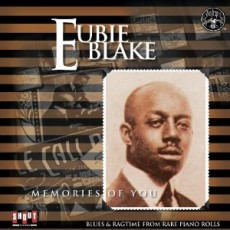
James Hubert Blake was born on February 7, 1887 in Baltimore, Maryland to former slaves and was the only surviving child of eight. Blake’s musical training began when he was just four or five years old when he wandered into a music store, climbed on the bench of an organ, and started “fooling’” around. The store manager recognized his genius, told his mother and subsequently bought an organ.
At seven, he received music lessons from the Methodist church organist, by fifteen he played piano at Aggie Shelton’s Baltimore bordello and got his first big break in the music business when world champion boxer Joe Gans hired him to play the piano at Gans’ Goldfield Hotel, the first “black and tan club” in Baltimore in 1907. In 1912, Blake began playing ragtime in vaudeville with James Reese Europe’s “Society Orchestra” which accompanied Vernon and Irene Castle’s ballroom dance act. Shortly after World War I, Blake joined forces with performer Noble Sissle forming the vaudeville music duo, the “Dixie Duo” that transformed into 1921’s “Shuffle Along”, the first hit musical on Broadway written by and about African-Americans.
Throughout his career Blake made three films with Sissle for Lee DeForest’s Phonofilm Sound-On-Film, later played the Boathouse nightclub in Atlantic City, was bandleader with the USO during World War II, with his career winding down in 1946 enrolled and graduated from New York University, revived in 1950 with new interest in ragtime as artist, historian and educator, received the Presidential Medal of Freedom from President Reagan, awarded numerous honorary doctorates and had another hit Broadway play “Eubie!” in his honor. Eubie Blake continued to play piano and record until his death on February 12, 1983 in Brooklyn, New York. He was 96.
More Posts: piano
Daily Dose Of Jazz…
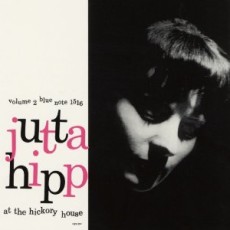
Jutta Hipp was born on February 4, 1925 in Leipzig, Germany. She first studied painting in Germany, but later played jazz during the war and she indicated jazz was important to her during that period. After the war she moved to West Germany due to the Soviet Union working with Hans Zoller and leading a quintet.
In 1954 Jutta played with Attila Zoller where critic Leonard Feather was so impressed with her work that soon after she moved to New York City. She drew some criticism initially from critics who felt she was too similar to her sponsor Horace Silver. In 1956 she played the Newport Jazz Festival and cut a studio album with Zoot Sims that is considered possibly her best.
Hipp went on to work in New York based trios determined to be accepted as an equal amongst her male counterparts, but felt intense nervousness and the anxiety led to her abandoning jazz in 1958. From then on she made her living primarily as a seamstress and returned to her first interest of painting and her portraits of various jazz musicians became popular with musicians.
Although she maintained some contact with musicians like Lee Konitz, she cut herself off from the music industry to the point that by 2000 Blue Note did not know where to send her royalty checks. Jazz pianist Jutta Hipp, who primarily played in the bebop and cool jazz genres during her short musical career, gained new interest after her passing in Queens on April 7, 2003 as a woman instrumentalist in the New York Jazz scene.
More Posts: piano
Daily Dose Of Jazz…
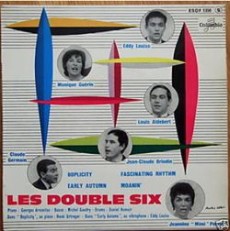
Jeannine “Mimi” Perrin was born February 2, 1926 in France and began private music instruction including piano as a child and pursued English studies at the Sorbonne. Recovering from tuberculosis, in 1949 she hit the French jazz scene in the cabarets of Saint-Germain-des-Pres and came to prominence with her trio. Towards the end of the 50s she worked as a studio background vocalist but was also a member of Blossom Dearie’s vocal group Blue Stars of France.
In 1959, she formed the vocal sextet Les Double Six, alluding to the fact that the group used overdubbing in the studio to sing twelve-part songs. The group became successful in the Sixties patterning itself to the vocalise of King Pleasure and Lambert, Hendricks & Ross. Mimi toured her group throughout Europe and North America recording with Quincy Jones, Dizzy Gillespie and Ray Charles.
Perrin was the leader and principal soloist in the group and established herself as a soloist and one of the great jazz singers with John Coltrane’s “Naima”. A later group, founded in 1966 by Perrin, did not achieve her previous success, and she abandoned music after another bout of tuberculosis.
From 1972 onwards, she worked as a translator of science fiction and fantasy and in the 1980s and 1990, she translated such novels Dean Koontz and John LeCarre as well as Alice Walker’s The Color Purple, along with the biographies of Nina Simone, Dizzy Gillespie, Quincy Jones and Steven Spielberg. Vocalist and pianist Mimi Perrin passed away on November 16, 2010 in Paris, France.

Daily Dose Of Jazz…
Joseph Leslie Sample was born February 1, 1939 in Houston, Texas and began playing piano at age five, taking lessons from organ and piano great, Curtis Mayo. While in high school during the 1950s, Sample teamed up with two friends, saxophonist Wilton Felder and drummer Stix Hooper and formed the group “Swingsters”. While studying piano at Texas Southern University he added trombonist Wayne Henderson and several other players to the Swingsters, which evolved into the Modern Jazz Sextet and then the Jazz Crusaders in emulation of Art Blakey’s Jazz Messengers. Prior to graduation in 1960 the Jazz Crusader moved to Los Angeles.
The group quickly found opportunities on the West Coast, making its first recording, Freedom Sounds in 1961 and releasing up to four albums a year over much of the 1960s. The Jazz Crusaders played at first in the dominant hard bop style of the day, standing out by virtue of their unusual front-line combination of saxophone and trombone. Another distinctive quality was the funky, rhythmically appealing acoustic piano playing of Sample, who helped steer the group’s sound into a fusion between jazz and soul[2] in the late 1960s.
In 1969 Sample made his first recording under his own name titled Fancy Dance that was followed by a string of albums such as Rainbow Seeker and Street Life. He continued to record and perform as a solo artist while maintaining steerage of The Crusaders into jazz fusion, changing the name in 1971 which it remained until the group disbanded in 1987.
Sample has had a very successful career working and recording with the likes of Miles Davis, George Benson, Joni Mitchell, Jimmy Witherspoon, B.B. King, Eric Clapton, Steely Dan, The Supremes, Minnie Riperton, Marvin Gaye, Ray Brown, Shelly Manne, Randy Crawford, Anita Baker, Lalah Hathaway, Howard Hewitt, George Duke and Lizz Wright, well into the new millennium.
His song “One Day I’ll Fly Away” was sung by Nicole Kidman in the film Moulin Rouge; and “Rainbow Seeker” is included on the Weather Channel Presents: Smooth Jazz II. Pianist, keyboardist and composer Joe Sample, who has played through various genres of jazz, continued to perform, record and tour with the Coryell Auger Sample Trio with his son Nicklas, who plays bass, until his passing on September 12, 2014 at age 75 in Houston, Texas.