Daily Dose Of Jazz…

Hugues Panassié was born on February 27, 1912 in Paris, France and when he was fourteen, he was stricken with polio, limiting extracurricular physical activities. So he took-up the saxophone and fell in love with jazz in the late Twenties. In 1932 he was the founding president of the Hot Club de France.

During the Germans occupation of northern France the Nazi’sbanned American jazz because they regarded jazz as low music from an inferior people. However Hugues got past the censors by submitting alternate and obscure French titles and continue to broadcast. One example was La Tristesse de Saint Louis, which translates to Sadness of Saint Louis, but in reality it was Louis Armstrong’s The Saint Louis Blues.

Panassié would go on to produce several jazz records by artists that include Sidney Bechet and Tommy Ladnier, author thirteen books about jazz, was an ardent exponent of Dixieland and Black players and a controversial critic of bad musicians such as Benny Goodman’s clarinet being inferior to the likes of Jimmy Noone and Omer Simeon. He dismissed bebop as a form of music distinct from jazz and held in esteem a lone example of a white musician who played jazz authentically in Mezz Mezzrow.

But he was not without his critics and historians who saw him creating a wedge between Black and Caucasian musicians by insisting that Black jazz was superior. He penned the liner notes for a 1956 RCA Victor compilation Guide to Jazz that included 16 recording by prominent jazz artists. After spending five months in New York City, critic, record producer and impresario Hugues Panassié met his assistant Madeleine Gautier, married, returned and settled in Montauban, France until his passing away on December 8, 1974.

Sponsored By
VOICES FROM THE COMMUNITY

Voices From The Community
NJ-TWITTER

  #preserving genius

More Posts:

Daily Dose Of Jazz…

Blaise Siwula was born in Detroit, Michigan, on February 19, 1950 and grew up in a working/middle-class Black neighborhood. His next-door neighbor practiced saxophone in the afternoon and occasionally allowed him inside to watch him play. He began studying the alto saxophone at the age of 14, playing in the middle-school concert band. But, upon hearing John Coltrane’s Om in 1969, he was compelled to take the tenor saxophone and make it his voice.

He attended college on and off for an extended period from 1968-1980, studying theory and composition at Wayne State University and earning his B.F.A. degree. Siwula’s first personal encounters with jazz musicians came around 1971 with drummer Doc Watson, while both were living in a hotel near the downtown campus of Wayne State. Then the saxophonist got married, moved to San Francisco, California and started playing free improvised music in coffee houses and writing poetry.

Influenced by hearing Art Pepper in San Francisco, as well as Ornette Coleman, Sonny Stitt, Archie Shepp, Pharoah Sanders, Sun Ra, Blue Mitchell, Elvin Jones, and Miles Davis in memorable live performances around the Detroit area in the early ‘1970s. After spending four years in Northern California, Blaise moved back to Detroit, then headed for Europe in 1989, working and traveling as a street musician for three months, then returning to the States and settling in New York City.

Active on the metro New York improvisation scene, he worked with Amica Bunker, the Improvisers Collective, and the Citizens Ontological Music Agenda (COMA) series. During the decade of the 2000s, he concentrated his efforts as a spontaneous composer incorporating traditional musical scoring techniques with visual/graphic and performance-oriented presentations.

Over the course of his career he has played or collaborated with Doug Walker’s Alien Planetscapes, Cecil Taylor’s Ptonagas, William Hooker’s ensembles, Judy Dunaway’s Balloon Trio, Dialing Privileges with Dom Minasi and John Bollinger, Karen Borca, William Parker, Jeff Platz, Adam Lane, Wilber Morris, Vincent Chancey, Theo Jörgensmann, Rashid Bakr, Tatsuya Nakatani,, Jay Rosen, Sarah Weaver, Fala Mariam, Ernesto Rodrigues, Hilliard Greene, Joe McPhee, Ernesto Diaz-Infante, Maria De Alvear, Vattel Cherry, and Jeff Arnal, among others.

Avant-garde alto saxophonist Blaise Siwula also plays the clarinets, flutes, percussion and string instruments and continues to perform and record free jazz and curate.

Sponsored By

SUITE TABU 200

www.whatissuitetabu.com
NJ-TWITTER

  #preserving genius

More Posts: ,,,,

Daily Dose Of Jazz…

Hans Koller was born February 12, 1921 in Vienna, Austria. He attended the University of Vienna from 1936 to 1939 and served in the armed forces from 1940 to 1946. Following World War II he returned home and played with the Hot Club of Vienna.

Emigrating to Germany in 1950, Hans formed a small ensemble there. During the decade of the Fifties he played with Freddie Brocksieper, Albert Mangelsdorff, Jutta Hipp, Dizzy Gillespie, Bill Russo, Lee Konitz, Stan Kenton, Eddie Sauter, Benny Goodman, Attila Zoller, Oscar Pettiford, Kenny Clarke, Zoot Sims and Jimmy Pratt.

From 1958 to 1965 he directed the jazz workshops of the Norddeutscher Rundfunk in Hamburg, Germany before returning to Vienna in 1970. Soon after his return he formed his own ensemble, Free Sound, and later that decade he worked with the International Brass Company. In addition to playing and bandleading, Koller also composed; among his original works are a 1968 ballet titled New York City.

Tenor saxophonist and bandleader Hans Koller, who was also a recognized abstract painter, passed away on December 21, 2003 in his hometown of Vienna.

Sponsored By

SUITE TABU 200

www.whatissuitetabu.com
NJ-TWITTER

  #preserving genius

More Posts:

Daily Dose Of Jazz…

Walter Purl “Foots” Thomas was born on February 10, 1907 in Muskogee, Oklahoma, elder brother tos alto saxophonist and songwriter Joe Thomas. Moving to St. Louis, Missouri he played in Ed Allen’s Whispering Band of Gold in the early 1920s and in 1924 recorded with Fate Marable’s Society Orchestra.

1927 saw Foots, as he was affectionately known, in New York City, where he played with the New Orleans pianist and composer Jelly Roll Morton and Joe Steele. He then joined The Missourians in 1929, just before Cab Calloway took the band over. Among his arrangements was the 1931 hit song, Minnie the Moocher.

Leaving Calloway’s orchestra in 1943 he went to work with saxophonist and composer Don Redman. He went on to lead a 1944 recording session with sidemen including Coleman Hawkins, Hilton Jefferson, Eddie Barefield and Jonah Jones, as well as another session that year featuring Ben Webster, Budd Johnson, and Emmett Berry.

During the mid-1940s he taught at a studio on West 48th Street in New York City and among his students was the hard bop alto saxophonist Jackie McLean. In the 1950s he became a manager and booking agent; he worked for the Shaw Artists Corporation and for a time one of his clients was the trumpeter Dizzy Gillespie.

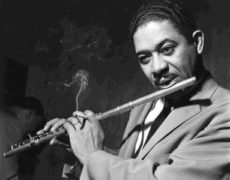
Tenor saxophonist, flautist and arranger Foots Thomas, who played in one of the most famous orchestras of the Swing era, passed away from cancer on August 26, 1981. He was posthumously inducted into the Oklahoma Jazz Hall of Fame in 1996.

Sponsored By
FAN MOGULS.jpg

NJ-TWITTER

  #preserving genius

More Posts: ,

Daily Dose Of Jazz…

James Richard Skidmore was born on February 8, 1916 in Manor Park, London, England. After teaching himself to play tenor saxophone when he was 20, he played with Harry Parry and George Shearing, becoming especially active in the years immediately following World War II. He attracted attention as a member of the Vic Lewis Jazzmen and in the Fifties played and recorded with Kenny Baker and Humphrey Lyttelton, forming part of the latter’s non-traditionalist saxophone line-up alongside Tony Coe and Joe Temperley.

During the 60s and 70s he continued to perform in clubs but the frequency of his playing diminished. A combination of changing musical times and his own casual approach to his music adversely affected the success his talent deserved. In the mid-80s he still played in the London area and apparently took the jazz world a little more seriously than he had in the past. He celebrated his 80th birthday by appearing alongside his tenor saxophonist son Alan, who had gained the lion’s share of public attention from the mid-60s on..

Tenor saxophonist Jimmy Skidmore passed away on August 22, 1998 in Welwyn Garden City, Hertfordshire, England.

Sponsored By

NJ-TWITTER

  #preserving genius

More Posts:

« Older Posts       Newer Posts »