


Daily Dose Of Jazz…
Willis Leonard Holman was born on May 21, 1927 in Olive, California. Known to the jazz world as Bill Holman, he has worked primarily in the jazz idiom as a songwriter, conductor, composer, arranger and saxophonist.
Through his acquaintance with composer Gene Roland he was introduced to Stan Kenton and in the early fifties was hired as a tenor sax player. Beyond his sax playing, Holman had the ability to integrate counterpoint and dissonance in subtle yet distinctive ways thus making Kenton’s band swing. He became Kenton’s chief arranger writing much of Kenton’s late 1950s repertoire and continued to write for Kenton, on and off, throughout the 1960s and 70s.
In addition to working for Kenton, Bill provided charts for Woody Herman, Doc Severinsen, Buddy Rich, Terry Gibbs, Count Basie, Gerry Mulligan, The Association, The Fifth Dimension and Natalie Cole among others. In 1975 he formed his own band that continues to perform in the U.S. and worldwide. In 1997 he won a Grammy for his recording Brilliant Corners: The Music of Thelonious Monk. He continues to create his legacy in jazz.
Daily Dose Of Jazz…
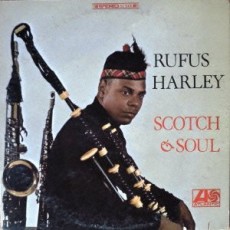
Rufus Harley, Jr. was born near Raleigh, North Carolina on May 20, 1936 of mixed Cherokee and African ancestry but at an early age his mother relocated with him to North Philadelphia, Pennsylvania. At age 12 he began playing the C melody saxophone and the trumpet and ten years later he was studying saxophone, flute, oboe and clarinet. His interest in the bagpipes came when he saw the Black Watch perform during President Kennedy’s funeral in 1963. Traveling to New York he bought a set in a pawnshop for $120 and quickly adapted it to the idiom of jazz, blues and funk.
Harley made his Scottish great Highland bagpipe debut in 1964 and over the next five years released four albums for Atlantic records and recorded as a sideman during that period and into the seventies with Herbie Mann, Sonny Stitt, and Sonny Rollins. He would later record with Laurie Anderson on “Big Science” in 1982, The Roots album “Do You Want More?!!!??!” in 1995 as a result of an appearance on the Arsenio Hall show.
Rufus often wore Scottish garb including kilt and a Viking style horned helmet. After watching him on television, a Scottish family gave him his MacLeod tartan, which he wore for the rest of his life. His bagpipe technique was unorthodox in that he placed the drones over his right shoulder instead of his left and favored a B-flat minor key.
Residing in the Germantown neighborhood of Philadelphia, when not working as a maintenance worker for the housing authority, Rufus gave presentations in area public schools, toured around the world, appeared on television shows like “What’s My Line” and “To Tell The Truth”, and had small roles in films “You’re A Big Boy Now” and “Eddie and the Cruisers”. In addition to bagpipes when recording, he would play tenor saxophone, electric soprano saxophone and flute.
Rufus Harley passed away at Philadelphia’s Albert Einstein Medical Center on July 31, 2006 of prostate cancer. In memoriam a documentary titled “Pipes of Peace” gives an intimate profile and a posthumous retrospective “Courage – The Atlantic Recordings containing all four albums was released in a limited edition.
Daily Dose Of Jazz…
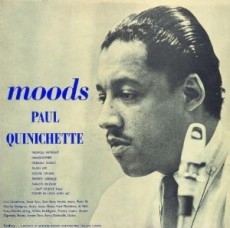
Paul Quinichette was born on May 17, 1916 in Denver, Colorado. Known as the Vice President or Vice Prez for his emulation of the breathy style of Lester Young a.k.a. Prez, but Quinichette was also capable of a gruffer style of playing.
The young Paul started playing the saxophone and clarinet, first on alto and then switching to tenor as R&B work started rolling in. Gaining experience playing with Nat Towles, Lloyd Sherock and Ernie Fields he became a feature in Jay Mcshann’s band from 42-46. He followed with stints on the west coast with Johnny Otis, and in New York with Louis Jordan, Lucky Millinder, Red Allen and Hot Lips Page.
Quinichette’s big break came when Basie hired him to play solos like Lester Young. His success with Basie garnered him an Emarcy record contract, the release of several albums and a modicum of fame. Over the course of his career Quinichette worked with Benny Goodman, recorded with Lester Young, John Coltrane, Billie Holiday, Sammy Price and Buddy Tate but mainly led his own group sessions.
In the late 50s he left music to become an electrical engineer only to return briefly in the Seventies. Poor health forced retirement for tenor saxophonist Paul Quinichette who passed away on May 25, 1983 in New York City.
More Posts: saxophone

Daily Dose Of Jazz…
Sidney Bechet was born on May 14, 1897 in New Orleans, Louisiana to a wealthy Creole family. At age six he picked up his brother’s clarinet, learned to play by on his own, eventually playing at a family birthday party exhibited his new talent. Later he would study with renowned Creole clarinetists Lorenzo Tio, Big Eye Louis Nelson and George Baquet. He would be found improvising jazz in many New Orleans ensembles led by John Robichaux, Bunk Johnson and King Oliver.
By the time he was 17 Bechet was touring as far north as Chicago and two years later landed in New York playing with Marion Cook’s Syncopated Orchestra. This led him to Europe and the Royal Philharmonic Hall where he attracted attention with his playing. It was in London that Sidney found the straight soprano and quickly developed a style different from his warm clarinet.
Sidney became one of the first important soloists in jazz, eclipsing Louis Armstrong into the studio by several months, and was possibly the first notable jazz saxophonist. His forceful delivery and well-constructed improvisations characterized his distinctive and wide vibrato playing although his lively and unpredictable temperament did not gain him wide acclaim until well into the late forties.
Returning to New York in 1922 he began recording songs like “Wild Cat Blues” and “Kansas City Man’s Blues” with sessions led by pianist and songwriter Clarence Williams. Over the next three decades Bechet continued to record and tour although his success was intermittent. He relocated to France in 1950, got married and shortly before his death dictated his poetic autobiography “Treat It Gentle”. Sidney Bechet, clarinetist, saxophonist and composer died in Garches, France of lung cancer on May 14, 1959, his 62nd birthday.
Daily Dose Of Jazz…
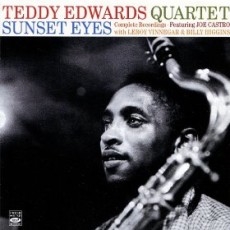
Teddy Edwards was born Theodore Marcus Edwards in Jackson, Mississippi on April 26, 1924. Learning to play at a very early age he began on alto, then clarinet, finally settling on the tenor. His first professional gig was with the Royal Mississippians prior to his uncle sending for him in Detroit where he lived for a short time. Although presented with the chance for greater opportunities family illness took him back to Jackson.
Venturing to Louisiana he met Ernie Fields who persuaded him to join his band and touring through Tampa, Washington, DC thwarted his dream of New York and Edwards ended up in Los Angeles, which would become his permanent residence in 1945. It was during this period in his career when he started playing with Howard McGhee’s band that Teddy switched to the tenor saxophone.
Teddy played with such notables as Charlie Parker, Roy Milton, Wynonie Harris, Vince Guaraldi, Joe Castro, Ernie Andrews among others and recording “The Duel” with Dexter Gordon in 1947 set Edwards up as a dueling legend. As a leader, throughout the 50s and 60s he worked with Max Roach, Clifford Brown, Benny Carter, Benny Goodman, Milt Jackson Sarah Vaughan, Tom Waits and Jimmy Smith, recording on Onyx, Pacific Jazz, Contemporary, Prestige and other labels, writing his best known composition Sunset Eyes.
Teddy Edwards, who became one of the most influential tenor saxophonists passed away on April 20, 2003. His sound exemplified an affinity for the blues and tone-quality that accompanies within a fluent post-bop vocabulary.

More Posts: saxophone