


Daily Dose Of Jazz…
Ornette Coleman was born March 9, 1930 hailing from Fort Worth, Texas where he began performing R&B and bebop on the tenor. He found his way out of Texas taking a job with traveling shows, first Silas Green and then rhythm and blues. After his tenor was destroyed in an attack, Ornette switched to alto that has remained his primary instrument.
From the beginning Coleman was ear was unorthodox, his approach to harmony and chord progression was less rigid than that of bebop musicians who considered him out-of-tune. However there were some who heard the same sound and by the 50s he was making music with Paul Bley, Don Cherry, Billy Higgins, Don Payne, Walter Norris, Shelly Manne and Charlie Haden.
Regarded by some as iconoclastic, others like conductor Leonard Bernstein and composer Virgil Thomson saw his genius and innovation. Ornette became one of the major influences in the free jazz movement and a major player in the genesis of avant-garde jazz. Throughout the sixties and seventies he played with Freddie Hubbard, Eric Dolphy, Scott LaFaro and Ed Blackwell and introduced brief thematic dissonant fanfares, regular but complex pulse and solos where band mates were able to chime in as they wish.
His friendship with Albert Ayler influenced his development of the trumpet and violin. His evolution continued and subsequent quartets included his son Denardo, Sunny Murray, Jimmy Garrison, Elvin Jones, and Dewey Redman. It also forwarded his sojourn into electrified instruments, adopting a jazz-fusion mode fashionable at the time and bringing in such artists as Jerry Garcia of the Grateful Dead. He has brought to his recordings Pat Metheny, Geri Allen, and Joachim Kuhn but seldom appeared as a sideman.
Ornette Coleman is a saxophonist, violinist, trumpeter, and composer whose timbre is easily recognized with his keen, crying sound drawing upon the blues. In 2007 he won a Pulitzer for his album Sound Grammar and honored with a Grammy for lifetime achievement He continued to push the envelope with younger musicians from radically different cultures until his passing on June 11, 2015 in Manhattan, New York.

Daily Dose Of Jazz…
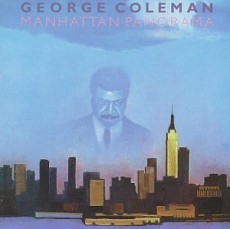
George Edward Coleman, born March 8, 1935 in Memphis, Tennessee, taught himself to play alto saxophone during his teen years inspired by Charlie Parker. Growing up his classmates were Harold Mabern, Booker Little, Frank Strozier, Hank Crawford and Charles Lloyd.
He began his career working with Ray Charles and by 1953 joined B. B. King where he switched to tenor. Moving to Chicago with Booker Little in 1956 he started working with Gene Ammons and Johnny Griffin before joining Max Roach in ’58. Coleman recorded with Jimmy Smith, Lee Morgan, Curtis Fuller, Eddie McFadden, Kenny Burrell and Donald Bailey before moving to New York with Max Roach.
Subsequent gigs with Ron Carter, Slide Hampton, Jimmy Cobb and Wild Bill Davis led him to become a part of the Miles Davis Quintet, recording among others Seven Steps to Heaven, My Funny Valentine and Four and More. This was followed up with his joining Herbie Hancock on his seminal work Maiden Voyage.
A foray into Hollywood placed Coleman on the sets of Freejack with Estevez, Jagger and Hopkins and on the Preacher’s Wife set with Denzel Washington and Whitney Houston.
The hard bop tenor, bandleader, composer and educator George Coleman has an impressive list of performances and recordings too numerous to name but suffice it to say he has worked with everyone from Mingus to Jamal to Hampton from the 60’s to the present day. He continues to lead his own groups, performing and recording regularly both as a leader and sideman.

More Posts: saxophone
Daily Dose Of Jazz…
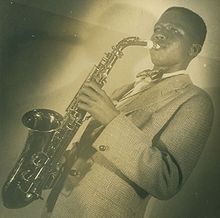
Pee Wee Moore was born Numa Smith Moore on March 5, 1928 in Raleigh, North Carolina. Attending Hampton Institute as a pre-med major, after one semester switched to music taking up the saxophone, joining the Royal Hamptonians and touring on a USO circuit. While asleep in the back seat driving back to New York, Pee Wee lost his left eye in a car accident. However this had no effect on his playing.
In the 30’s Moore played with the Jeter-Pillars Orchestra, recorded with Floyd Ray and sat alongside Dizzy Gillespie in the Les Hite big band from 1939 to 1942. His first recordings with Dizzy Gillespie’s ensemble occurred from 1946-47.
Throughout the fifties Moore played with Lucky Millinder, Louis Jordan, Illinois Jacquet, James Moody, Mary Lou Williams and Dizzy Gillespie, whom he recorded several albums with for Verve. He worked with pianist Bill Doggett in the mid-sixties.
Moore moved back to Raleigh to care for his ailing mother and recover from alcohol addiction. Earning a living as a handyman, he continued to play throughout the rest of his life at various venues in the Raleigh-Durham area. On April 13, 2009 jazz saxophonist Pee Wee Moore passed away at the age of 81.

More Posts: saxophone
Daily Dose Of Jazz…
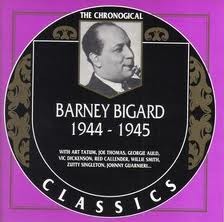
On March 3, 1906 Barney Bigard was born Albany Leon Bigard in New Orleans, Louisiana. As a child he studied music and clarinet with Lorenzo Tio. In the early twenties his move to Chicago had him working and recording with Joe “King” Oliver, Johnny Dodds, Jelly Roll Morton and numerous others.
Bigard’s initial fame came as a tenor saxophonist in the twenties and was #2 behind Coleman Hawkins before moving to the clarinet. In 1927 his swinging style joined the ranks of the Duke Ellington Orchestra, a relationship that lasted till 1942, both as a featured soloist and section tenor. Credited with composing or co-composing several tunes, Barney’s most notable is the Ellington standard “Mood Indigo”.
Tiring of the road with Ellington, Bigard moved to Los Angeles getting into sound tracking, with an on-screen performance with Louis Armstrong in the 1946 film “New Orleans”. By the late 40’s he teamed with Kid Ory followed by once again touring the world with Louis Armstrong’s All Stars band from 1947 to 1955. In the late 50’s he played with Cozy Cole and became semi-retired by 1962, occasionally playing and recording with Art Hodes, Earl Hines and sometimes as a leader.
Considered one of the most distinctive clarinetists in jazz, composer and tenor saxophonist Barney Bigard passed away on June 27, 1980 in Culver City, California.

Daily Dose Of Jazz…
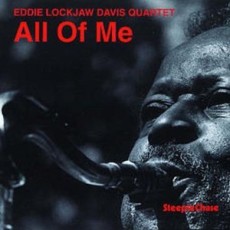
Edward Davis was born on March 2, 1922 in New York City. He was known to his friends, peers, jazz enthusiasts and aficionados by his nickname “Lockjaw” and became one of the pre-eminent jazz saxophonists of the 20th century.
In the early to mid-forties he played with Cootie Williams, Lucky Millinder, Andy Kirk, Louis Armstrong and Cont Basie. By 1946 he was leading his own band “Eddie Davis and His Beboppers” that housed Fats Navarro, Al Haig, Huey Long, Gene Ramey and Denzil Best.
In the 50’s he teamed with Sonny Stitt, from 1960 to ’62 he co-led a quintet with Johnny Griffin, and he and Griffin performed as part of the Kenny Clarke-Franz Boland Big Band. Davis recorded with Ella Fitzgerald, collaborated with Shirley Scott and played off and on with Count Basie’s Orchestra in the early 70’s.
In his later years he played with Harry “Sweets” Edison and remained busy as a soloist until his death on November 3, 1986 at the age of 64. Eddie “Lockjaw” Davis performed within the jazz genres swing, bop, hard bop, Latin and soul jazz.
More Posts: saxophone