

Daily Dose Of Jazz…
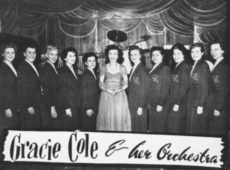
Gracie Cole was born Grace Elizabeth Agnes Annie Cole on September 8, 1924 in Rowlands Gill, County Durham, England. Her father Albert moved to Yorkshire in search of work as a miner when she was two years old. He played cornet in colliery bands, and taught her to play the cornet at the age of 12. She went on to play with local brass bands in her teens, including the Firbeck Colliery Band alongside her father. In 1939 at 15, she made her first broadcast on the BBC Radio for Children’s Hour.
From 1940, Cole appeared as a guest soloist in two concerts with the Besses o’ th’ Barn brass band, and played with various other bands including the Grimethorpe Colliery Band. In 1942 she became the first woman to compete for the Alexander Owen memorial scholarship and won by an unprecedented 21-point margin. That same year Cole switched to being a dance band trumpeter, initially joining Gloria Gaye’s All Girls Band, who toured playing theatres and forces entertainment shows organised by the Entertainments National Service Association.
Following WWII playing with Rudy Starlita’s All-American Band entertaining American G.I.s, she joined Ivy Benson’s band as lead trumpet and soloist, and toured Britain, Europe and the Middle East with them for the next five years. The Fifties saw her joining the George Evans Band, then joined the Squadronaires, but finding male prejudice uncomfortable, Gracie left to form her own all-female band in 1952 for the next four years. She would work with singers like Carol Carr and Cleo Laine and front an all-male band at Mecca Ballrooms.
From the 1960s she concentrated on bringing up her two daughters and played on a freelance basis. She was active in encouraging local brass bands, and was made a freeman of the City of London in 1990 Toward the end of the decade cornetist, trumpeter and bandleader Gracie Cole developed Alzheimer’s disease and passed away on December 28, 2006 in Westcott, Surrey, United Kingdom at the age of 82.

More Posts: trumpet
Daily Dose Of Jazz…
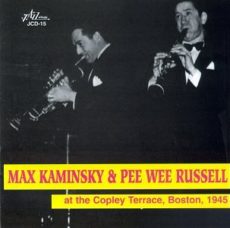
Max Kaminsky was born on September 7, 1908 in Brockton, Massachusetts and started his career in Boston, Massachusetts in 1924. By 1928 he was working in Chicago, Illinois with George Wettling and Frank Teschemacher at the Cinderella Ballroom and in New York for a brief time in 1929 with Red Nichols.
From about 1933-1938, he worked in commercially oriented dance bands, and recorded with Eddie Condon and Benny Carter’s Chocolate Dandies, with Mezz Mezzrow. He played with Tommy Dorsey, Artie Shaw, and performed and recorded with Bud Freeman. He worked again with Shaw from 1941 to 1943, who led a navy band with which Kaminsky toured the South Pacific.
From 1942 he took part in important concerts in New York City that were organized by Condon at Carnegie Hall and Town Hall, and from the following year he played Dixieland with various groups. He also worked in the 1940s with Sidney Bechet, George Brunis, Art Hodes, Joe Marsala, Willie “The Lion” Smith, and Jack Teagarden.
Moving into television, Max led Jackie Gleason’s personal band for several seasons, then toured Europe with Teagarden and Earl Hines’ All Stars in 1957, and performed at the Metropole and Ryan’s in New York at intervals from the late 1960s to 1983, the Newport Jazz Festival and the 1964 New York World’s Fair.
In 1963 he published My Life in Jazz with V. E. Hughes, in 1975 and 1976 he recorded as a leader that well illustrate his style, which is full-toned, economical and swinging in the manner of King Oliver, Freddy Keppard and Louis Armstrong. At one time he played with the Original Dixieland Jass Band.
Trumpeter Max Kaminsky, known for his Dixieland and whose legacy lives on at the Hogan Jazz Archives at Tulane University, passed away on September 6, 1994, one day before what would have been his 86th birthday.

More Posts: trumpet
Daily Dose Of Jazz…
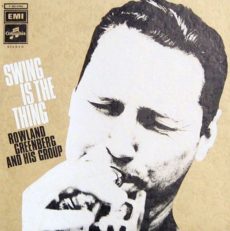
Rowland Charles Wentworth Greenberg was born on August 28, 1920 in Oslo, Norway who first began as one of the country’s leading cyclists. He was Oslo champion at 17 and the following year he won the team championships at the junior National Championships. Turning to music he fashioned his trumpet style was inspired by the English trumpeter Nat Gonella, and by 1939 he was guesting in leading orchestras such as the Hot Dogs and Funny Boys.
Making several trips to England between 1938 and 1939 with Vic Lewis and George Shearing, he was a central part of Oslo’s swing-jazz milieu. He led his own Rowland Greenberg Swing Band from 1939 to 1941 with Arvid Gram Paulsen on sax, Lulle Kristoffersen on piano and Pete Brown on drums. He also led his Rowland Greenberg Rytmeorkester from 1940 to 1944 with tenor saxophonist Gordon Franklin, Arvid Gram Paulsen on alto sax, Robert Normann on guitar, Kjell Bjørnstad, Frank Hansen, Lyder Vengbo on trombone, Fred Lange-Nielsen on bass. He release an album in 1942 that was banned by the German regime, and he was jailed for breaching the Rytmeklubbforbundet by viewing jazz films 1943.
After his release Rowland became active in Sweden with Cecil Aagaard, Thore Erling and Malte Johnson and in England with Jimmie Woode and Sam Samson. He toured Norway with his own band for two years beginning in 1948 playing bebop to the country. He was a part in the All-Star Trumpets session at the 1949 Paris Jazz Festival with Miles Davis, Bill Coleman, Jimmy McPartland and Aime Barelli, played with Charlie Parker, Louis Armstrong, and Down Beat gave him the first chart placing of his career. During the Fifties he played extensively in the orchestras led by Egil Monn-Iversen, Leiv Flisnes and Terje Kjær, led his own orchestras including Mikkel Flagstad on piano, Totti Bergh on saxophone, Knut Young on bass, Ivar Wefring on piano, Bjørn Krokfoss on drums until 1981, and played with Ben Webster and Teddy Wilson.
Trumpeter Rowland Greenberg recorded three albums as a leader and won two jazz awards before passing away on April 2, 1994.

More Posts: trumpet
Daily Dose Of Jazz…
Eric Boeren was born in Baarle-Nassau, Netherlands on August 22, 1959 and started out playing euphonium and tuba in the Ulicoten fan fair. He took workshops with Arnold Dooijeweerd in the Bimhuis, from which the Amsterdam Creative Ensemble originated.
In 1983 Eric replaced trumpeter Jimmy Sernesky in the group Available Jelly, for which he also composed. In the Eighties he was part of several groups with Maarten Altena, Kenny Wheeler, Willem van Manen, JC Tans, Sean Bergin, and by the end of the decade joined Ab Baars and Paul Termos.
1990 saw Boeren joining Michiel Braam’s Bik Bent Braam, an association that continues today. In 1993, he founded his first group as a leader, Specs, which was short-lived. During the 1990s he played with Franky Douglas, Martin van Duynhoven, and Guus Janssen.
In 1995 he organized a series of PH31 concerts in Amsterdam with his trio trio comprised of Michael Vatcher and Wilbert de Joode. He enlisted another saxophone to play Ornette Coleman’s early quartet music. He also played Coleman’s music in the Bimhuis with the eleven-member band Go Dutch. He founded the Quartet Boers! That later became the Eric Boeren 4tet. His love for Coleman’s music resulted in two CDs – Cross Breeding and Joy of a Toy.
Boeren went on to play into the new millennium with the band NEWS with Cor Fuhler, bassist Nate McBride and drummer Mike Reed, and the quintet HO & I, that included Douglas and Paul Pallesen. Trumpeter Eric Boeren is one of the initiators of the music collective foundation dOeK (De Exercise de Kunst) and he currently performs, records and tours with his quartet Boerenbond, features Peter Evans, Tobias Delius and Jason Adasiewicz.
More Posts: trumpet

Daily Dose Of Jazz…
Johnny Claes was born Octave John Claes on August 11, 1916 in London, England and received his education at Lord Williams’s School. He began playing trumpet in a jazz band that included Max Jones on reeds, and another with Billy Mason on piano. By the 1930s he had moved to the Netherlands, where he worked with Valaida Snow and Coleman Hawkins and in Belgium he worked with Jack Kluger’s.
Returning to England, Johnny led his own group, the Clay Pigeons, making a recording in 1942. Unfortunately for the jazz world in the late 1940s he abandoned his jazz career and settled in Belgium as a professional racing driver.
By 1955 Claes’ he had contracted tuberculosis and his health problems worsened. Finally trumpeter, bandleader and professional racer Johnny Claes succumbed to the disease in Brussels on February 3, 1956 at the age of 39.

More Posts: trumpet