

Requisites
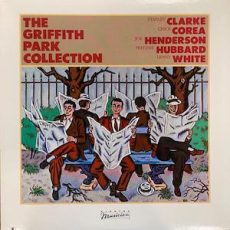
The Griffith Park Collection ~ Stanley Clarke, Chick Corea, Joe Henderson, Freddie Hubbard, Lenny White | By Eddie Carter
This morning’s record from the library unveils a unique jazz collaboration. The Griffith Park Collection (Elektra Musician E1-60025) is the second of two studio albums recorded over four days with an all-star ensemble: Freddie Hubbard on flugelhorn (tracks: A3, B3) and trumpet (A1, A2, B1), Joe Henderson on tenor sax (A1 to A3, B1, B3), Chick Corea on piano, Stanley Clarke on upright bass, and Lenny White on drums. Their first record was Echoes of An Era, an album of jazz standards with Chaka Khan. This was a rare reunion for Corea, Clarke, and White, who had not played together since they were members of Return to Forever. My copy is the 1982 U.S. Stereo release.
The opener is L’s Bop by Lenny White. The quintet’s lively theme takes off at a brisk pace, leading to Joe’s swinging opening solo. Freddie maintains the vigorous intensity in the second reading; then Chick skillfully navigates the third statement into a short exchange with Lenny until the theme’s reprise and fade out. The pace slows down slightly for Why Wait by Stanley Clarke, a medium-tempo blues that opens with the ensemble’s theme. Joe gets this grooving affair going in the first solo. Freddie answers him with an exceptional performance; then Chick provides the exclamation point preceding the group’s return for the closing chorus and exit.
October Ballade by Chick Corea begins with the pianist’s soothing introduction ahead of Freddie’s tender melody. Joe has the first solo and builds each chorus gently with deep emotion until Chick takes over for a brief, lovely interpretation. The quintet wraps up things with a poignantly touching reprise and finale. Side Two gets underway with Happy Times by Freddie Hubbard, a cheerful tune that the group takes to heart in the theme. Joe greets the opening statement joyfully, and then Freddie comes in for a bright and bubbly solo. Chick adds to the festive atmosphere in the second interpretation. Lenny delivers a finale that is quite enjoyable before the close.
Remember, by Steve Swallow is a beautiful waltz that opens with the trio’s thoughtfully polite introduction and theme. Chick carefully cultivates the lead solo with delicate notes. Stanley’s reply is an affectionately warm interpretation as Lenny’s drums softly compliment him until the ensemble’s theme restatement. Guernica by Lenny White is a musical portrait of Pablo Picasso’s Spanish Civil War painting. It is a haunting song and the album’s most adventurous tune with a melancholy theme. Joe begins the opening solo with an airy, nostalgic tone. Freddie emerges next with a breathtaking reading; then Chick delivers an enthusiastic statement preceding the group’s return for the climax.
Lenny White produced The Griffith Park Collection and Bernie Kirsh was the recording engineer. The album’s sound quality is good, with a softer soundstage in the highs, midrange, and bass. At just under forty minutes, it is a hidden gem that flows with a beat and does not disappoint. If you are in the mood for an excellent album with remarkable chemistry and exceptional performances. In that case, I invite you to check out The Griffith Park Collection by Stanley Clarke, Chick Corea, Joe Henderson, Freddie Hubbard, and Lenny White on your next record shopping trip. It is a wonderful album that I highly recommend for your library, and I am sure it will reward your purchase for years to come!
~ Echoes of An Era (Elektra E1-60021) – Source: Discogs.com © 2024 by Edward Thomas Carter
More Posts: bass,choice,classic,collectible,collector,drums,history,instrumental,jazz,music,piano,saxophone,trumpet
Daily Dose Of Jazz…
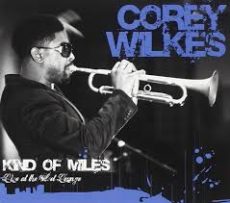
Corey Wilkes was born June 3, 1979 in Chicago, Illinois. He began his musical journey at a young age and received a full scholarship to Berklee College of Music in Boston, Massachusetts. After graduating, he became an in-demand touring and recording artist, collaborating with the Art Ensemble of Chicago, Roy Hargrove, Kahil El Zabar, James Carter, Tedeschi Trucks Band, Nicole Mitchell, Dr. Lonnie Smith, Makaya McCraven and many more.
Wilkes’ talents as a composer won him an Outstanding Achievement for Documentary Program ~ Historical Emmy Award for his film score for the Ida B Wells documentary. He is also a Grammy-nominated musician for his work as a member of the Ethnic Heritage Ensemble. His electro-acoustic soulmusic blends jazz, electronic music, and soulful vocals in his solo projects.
Beyond music Corey has also worked with visual artists such as Theaster Gates, Nick Cave, Lucy Slivinski and Rashid Johnson, creating multi-disciplinary performances that blend music, art, and culture. He has also worked with renowned House Music DJ’s such as Osunlade, Ron Trent, Jaimie Principle, and Vick Lavender, fusing jazz with electronic and house music.
Trumpeter, producer, composer and actor Corey Wilkes continues to captivate audiences around the world.
More Posts: bandleader,composer,history,instrumental,jazz,music,producer,trumpet
Daily Dose Of Jazz…
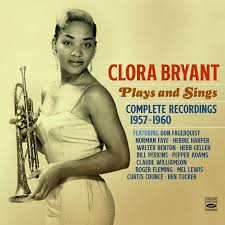
Clora Larea Bryant was born on May 30, 1927 in Denison, Texas to Charles and Eulila Bryant, the youngest of three children. As a young child she learned to play piano with her brother Mel, and was a member of a Baptist church choir. Her brother Fred left his trumpet when he joined the military, she picked it up and learned to play. In high school she played trumpet in the marching band.
She turned down scholarships from Oberlin Conservatory and Bennett College to attend Prairie View College in Houston, Texas starting in 1943. Bryant was a member of the Prairie View Co-eds Jazz Band which toured in Texas and performed at the Apollo Theater in New York City in 1944. Her father got a job in Los Angeles, CAlifornia and she transferred to UCLA in 1945, and where she first heard bebop on Central Avenue.
In 1946 she became a member of the International Sweethearts of Rhythm, an all-female jazz band, earned her union card and dropped out of school. Dizzy Gillespie became her mentor and provided her with work. She joined the black female jazz band the Queens of Swing as a drummer, and went on tour with the band.
In 1951 she worked in Los Angeles as a trumpeter for Josephine Baker and Billie Holiday. The same year the Queens of Swing became the first women’s jazz group to appear on television and performed as The Hollywood Sepia Tones. Clora was called onto Ada Leonard’s all-girl orchestra show, however, racist directed calls to the station the engagement. In 1954 she briefly moved to New York because she had lost inspiration from playing in bands.
Bryant recorded her first and only album, Gal With A Horn, in 1957 before returning to the life of a traveling musician. She worked with Louis Armstrong and Harry James, toured with singer Billy Williams and around the world with her brother Mel, had a TV show in Australia and became the first female jazz musician to tour in the Soviet Union after writing to Mikhail Gorbachev.
After a heart attack and quadruple bypass surgery in 1996, Bryant was forced to give up the trumpet but she continued to sing. She also began to give lectures on college campuses about the history of jazz, co-edited a book on jazz history in Los Angeles titled Central Avenue Sounds: Jazz in Los Angeles, and worked with children in Los Angeles elementary schools.
Trumpeter and vocalist Clora Bryant, who was the only female trumpeter to perform with Dizzy Gillespie and Charlie Parker and was a member of the International Sweethearts of Rhythm, died at Cedars-Sinai Medical Center in Los Angeles on August 25, 2019, after suffering a heart attack at home.

More Posts: bandleader,history,instrumental,jazz,music,trumpet,vocal
Daily Dose Of Jazz…
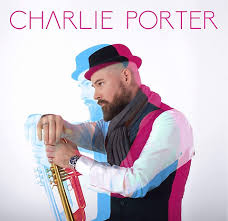
Charles William Porter was born May 10, 1978 in Boynton Beach, Florida. He studied trumpet at the Dreyfoos School of the Arts, The Juilliard School, Manhattan School of Music and was a Fulbright Scholar at the Paris Conservatory. His mentors include Wynton Marsalis, Mark Gould, Raymond Mase, Guy Touvron, and Laurie Frink.
Porter started in the New York jazz scene in the 1990s while studying classical music under Wynton Marsalis at the Juilliard School. He became a long-standing member of the Absolute Ensemble, and is a frequent member of the Charlie Porter Quintet, The Alan Jones Sextet and the Chuck Israels Jazz Orchestra.
As a bandleader, he has toured as both a jazz and classical musician, and released his debut self-titled album, Charlie Porter, and a sophomore project Immigration Nation. As a sideman he has recorded some two dozen albums with Philip Glass, Absolute Ensemble, Paquito D’Rivera, Tristan Murail, Billy Martin, Anthony Coleman, Russ Spiegel, Majid Khaliq, Chuck Israels, Alan Jones, and Derek Hines.
As an educator he is currently based in Portland, Oregon and presently holds the position of adjunct professor of jazz trumpet at Portland State University. Trumpeter, composer and music educator Charlie Porter, who has won several trumpet competitions and awarded a Grammy for his collaboration on the Joyce DiDonato album Songplay, continues to perform, record and teach.
More Posts: bandleader,composer,educator,history,instrumental,jazz,music,trumpet

Daily Dose Of Jazz…
Duke Jones was born Albert Jones on May 6th in White Plains, New York. The nickname was given to him by his favorite aunt due to his love of music at an early age. He began learning trumpet at the age of nine and played in elementary school through high school. He formed a band with The Lewis Brothers and Sharon Bryant that ultimately became Atlantic Starr.
Jones attended Northwestern University in Evanston, Illinois, studying music and film. He worked the New York club circuit and continued his studies with traditional island rhythms, calypso and soca at the University of Virgin Islands. He was influenced by Kenny Dorham, Woody Shaw, Lee Morgan, Benny Bailey and Miles Davis.
He would go on to tour Japan, Europe and Africa, working with The Temptations, Angela Bofill, Larry Coryell and Marion Meadows. He has collaborated and recorded with August Darnell, and drummer Norman Connors. Duke served as Vice President of Creole Records, a label started with then band mate August Darnell (Kid Creole). In 2005, he formed Café Soul All-Stars, recording their debut album Love Pages which featured George Benson, Roy Ayers and Kenny Garrett among others.
Trumpeter and flugelhornist Duke Jones continues to perform, record and collaborate with his music.
More Posts: bandleader,flugelhorn,history,instrumental,jazz,music,trumpet