

Daily Dose Of Jazz…
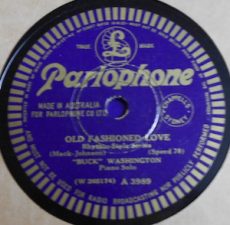
Ford Lee “Buck” Washington was born October 16, 1903 in Louisville, Kentucky. He and John W. Sublett, known by his stage name Bubbles, first began working together in the 1910s, while in his teens. Their duo was known as Buck and Bubbles.
Bubbles was primarily a tap dancer while Washington sang and played stride piano and sang. They were so popular that the duo moved to Manhattan, New York City in 1919 and by the late 1920s they were on Broadway. They played together in the Columbia Theater, the Palace, performing with Eddie Cantor, Al Jolson, and Danny Kaye. They were in the Ziegfeld Follies of 1931.
They became the first black artists to perform at Radio City Music Hall. They toured Europe in the 1930s and appeared on television and in films, including Calling All Stars in 1937 and Cabin in the Sky in 1942. They performed live in the first scheduled high definition television program on November 2, 1936 at Alexandra Palace in London, England for the BBC. In 1927, when Buck and Bubbles were performing at the Sunset Café, Buck developed a working relationship and friendship with Louis Armstrong.
As a pianist, Washington also recorded sessions in the 1930s with jazz musicians including Armstrong, Bessie Smith, Benny Goodman and Coleman Hawkins. He also played trumpet, though he only made home recordings on the instrument. He continued working with Bubbles until 1953, and then for a couple of years worked with Timmie Rogers and Jonah Jones.
Pianist, singer and vaudeville performer Buck Washington, with partner Bubbles were the first black artists to appear on television anywhere in the world, transitioned on January 31, 1955 in New York City.

More Posts: history,instrumental,jazz,music,piano,trumpet,vocal
TERENCE BLANCHARD: ABSENCE
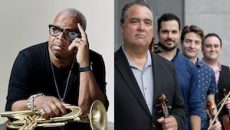
Terence Blanchard has blown audiences away with his bands, film scores, operas, and most recently in performance with Herbie Hancock. Called “a brass-wielding force of nature” by the Los Angeles Times, the trumpeter/composer returns with his 2021 Blue Note release Absence—a powerful tribute to the great Wayne Shorter.
Teaming up with Turtle Island Quartet and his electric ensemble the E-Collective, Blanchard reimagines songs from across Shorter’s vast catalog and shares original music inspired by the legendary saxophonist—resulting in “a lush and dramatic soundscape that calls to mind Blanchard’s career as a successful film composer.” (The New Yorker).
E-Collective
Terence Blanchard (Trumpet/Synths)
Charles Altura (Guitar)
Taylor Eigsti (Piano/Keyboard/Synths)
David Ginyard, Jr. (Electric Bass)
Oscar Seaton (Drums)
Turtle Island Quartet
David Balakrishnan (Violin)
Gabriel Terracciano (Violin)
Benjamin von Gutzeit (Viola)
Naseem Alatrash (Cello)
Showtimes: 7:00pm & 9:00pm
More Posts: adventure,album,club,festival,genius,jazz,museum,music,preserving,restaurant,travel,trumpet
The Jazz Voyager
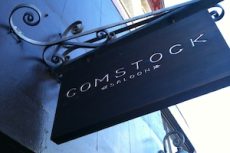
Masked up and on the wing to that city by the bay is the next stop for this Jazz Voyager to take in an evening at the Comstock Saloon situated at the crossroads of North Beach, Chinatown, Financial District and Jackson Square. I’ve been hearing about Gaucho Jazz, and having sparked my curiosity, decided to satisfy or see if it will kill this cat. So it’s off to hear them live and experience a performance for myself.
Of course while I’m in this city I’ll ride another trolley, make my way down the crooked street, roll across the bridge to Berkeley, go hang in the Tenderloin, Haight~Ashbury and Nob Hill and just enjoy the sights and sounds. I’ve also heard about this Dynamo Spiced Chocolate Donut that the saloon serves up with vanilla ice cream and during the night I’m going to see what this dessert hoopla is all about.
Showtime is 8:00pm ~ 11:00pm and there is no mention of a cover or reservations required. I guess I’ll be dropping in a little before showtime. The address of the Comstock Saloon is 155 Columbus Avenue, San Francisco, California 94133. For more information, the number is 415-617-0071 or comstocksaloon.com.

More Posts: accordion,adventure,album,bass,club,drums,festival,genius,jazz,museum,music,piano,preserving,restaurant,saxophone,travel,trumpet
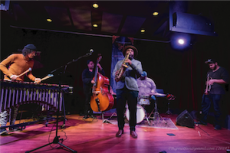
ROY HARGROVE BIRTHDAY TRIBUTE
CELEBRATING THE CO-FOUNDER OF THE JAZZ GALLERY
Jaleel Shaw ~ saxophones
Giveton Gelin – trumpet
Orrin Evans -piano
Mimi Jones -bass
Johnathan Blake –drums
With Special Guests
Renee Neufville -vocals
Tadataka Unno -piano
Justin Robinson –saxophone
Guest MC: Lezlie Harrison
Sets at 7.30pm + 9.30pm ET
$30/$10 members; cabaret seating: $40/$20 members; LIVESTREAM: $20/$5 members
More Posts: adventure,album,bass,club,drums,festival,genius,jazz,museum,music,piano,preserving,restaurant,saxophone,travel,trumpet,vocal
Daily Dose Of Jazz…
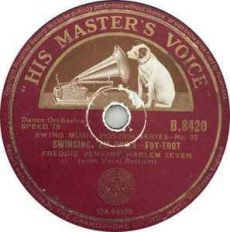
Freddie Jenkins was born on October 10, 1906 in New York City, New York and played in the Jenkins Orphanage Band when young before he attended Wilberforce University. Following this he played with Edgar Hayes and Horace Henderson between 1924 and 1928.
He then took a position in Duke Ellington’s Orchestra in 1928 where he soloed in the 1930 film Check and Double Check, during a performance of the song Old Man Blues. He remained with the Ellington Orchestra until 1935, when lung problems forced him to quit.
Recovered, he formed his own group in 1935, recording one session as a leader. His sidemen included Ward Pinkett, Albert Nicholas and Bernard Addison. After this he played with Luis Russell in 1936. Rejoining Ellington in 1937 he played with him for a year, then for a short time thereafter played with Hayes Alvis.
After 1938, his lung ailment returned and he retired again from performance. In his later years he worked as a songwriter, disc jockey, and in music press. He became a deputy sheriff in Fort Worth, Texas.
Trumpeter Freddie Jenkins transitioned in 1978.
Bestow upon an inquiring mind a dose of a New York City trumpeter to motivate the perusal of the genius of jazz musicians worldwide whose gifts contribute to the canon…
Freddie Jenkins: 1906~1978 | Trumpet
More Posts: bandleader,history,instrumental,jazz,music,trumpet