


Daily Dose Of Jazz…
Pepsi Auer was born Josef Auer on June 14, 1928 in Munich, Germany. He first played accordion in a youth orchestra, then he taught himself to play the vibraphone in 1936. A move to America in 1945 saw him performing in jazz clubs and by 1949 he moved to the piano. He would go on to work in the combo of Freddy Christmann in 1954, ultimately taking leadership two years later.
Pepsi worked with Freddie Brocksieper in 1958, the German All Stars in ’58, worked and toured from 1958 to 1960 with Albert Mangelsdorff jazz ensemble and then with Kurt Edelhagen. By the Sixties his style of approach mimicked Bud Powel and Horace Silver and in 1962 he worked in the Bayerischen Rundfunks.
Auer accompanied Stan Getz, Eric Dolphy and Benny Bailey on their tours of Germany, as well as with Miriam Klein. He would team up once again with Freddie Brocksieper from 1955-1964 and participate in recording sessions as well as with the German All Stars. From the mid-1960s he worked as a studio musician and increasingly composed music for television such as “A Summer With Nicole”.
In 1967 he took part in the Montreux Jazz Festival as a member of the Jazz Orchestra of the Bayerischer Rundfunk, where he and Don Manza were co-leaders. Pianist, vibraphonist and composer Pepsi Auer passed away on March 29, 2013.

Jazz Is Global – Share
More Posts: piano,vibraphone
Daily Dose Of Jazz…
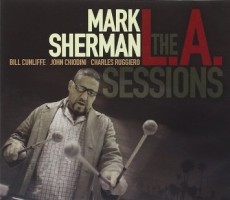
Mark Sherman was born April 17, 1957 in Manhattan, New York City to a Juillliard trained soprano mother who performed with the Cleveland and Boston symphonies, so it was natural that he studied classical piano as a child.
Sherman graduated from The High School of Music and in 1975, then went on to study classical percussion at Juilliard. He performed in ensembles under the direction of Leonard Bernstein, Sir George Solti, Zubin Mehta and Herbert Von Karajan. While there he would jam regularly with Wynton Marsalis. During the course of his career, Sherman also studied with Elvin Jones, Rohland Kohloff, Justin Diccocco, Roland Hanna and Jackie Byard among others.
While still in his teens, Mark played drums in a trio with pianist Kenny Kirkland who he introduced to Wynton. At 21, he began working on Broadway and in New York’s active studio scene, playing percussion, piano, drums and vibraphone. In 1980 he released his first album Fulcrum Point on Unisphere records. The decade saw him in studio working on commercial jingles.
Sherman spent a lot of his time in the studio in the 1980s, working on commercial jingles. Pianist Mike Renzi took him under his wing, connecting him with Peggy Lee and other singers performing with Lee, Tony Bennett, Mel Torme, Lena Horne and Ruth Brown. In 1986 he signed with Columbia Records and released his major label debut, A New Balance.
He continued to perform with Peggy Lee in the early 1990s, began a seven-year playing relationship with Larry Coryell, became an active studio musician, and played on numerous films and Broadway soundtracks. Reemerging as a leader playing vibraphone, he also continued his active career as a sideman, recording with Capathia Jenkins, Jennifer Holiday, Ann Hampton Callaway, Liz Minnelli and others.
Sherman continued to release his own albums on Miles High Records, won the Rising Star (Vibes) category in the Down Beat Critics Poll in 2007, 2008, 2009 and 2010 and has been a Jazz Ambassador for the U.S. State Department and Jazz at Lincoln Center.
Vibraphonist, pianist and drummer Mark Sherman is currently on the faculty of Juilliard jazz program, New Jersey City University and the New York Jazz Workshop.
Inspire A Young Mind
More Posts: drums,piano,vibraphone
Daily Dose Of Jazz…
Victor Stanley Feldman was born on April 7, 1934 in Edgware, London, England and caused a sensation as a musical prodigy when he was discovered at aged seven. His family members were all musical and his father founded the Feldman Swing Club in 1942 to showcase his talented sons. His first professional appearance was playing drums at No. 1 Rhythm Club as a member of the Feldman Trio with brothers Robert on clarinet and Monty on piano accordion.
At eight years old the drummer was featured in the films King Arthur Was A Gentleman and Theatre Royal, in 1944 he was featured as “Kid Krupa” at a Glenn Miller AAAF band concert when he was 10, and went on to play vibraphone for Ralph Sharon Sextet and the Roy Fox band. Victor eventually made piano his instrument of choice and became best known.
Feldman recorded with Ronnie Scott’s orchestra and quintet from 1954 to 1955, and then in 1955 came to the U.S. He first worked with Woody Herman, then with Buddy Defranco. He recorded some thirty albums as a leader and recorded with Benny Goodman, George Shearing, Milt Jackson, Blue Mitchell, Lalo Schifrin, John Klemmer Sam Jones, Cannonball Adderley and others, as well as, Miles Davis on Seven Steps To Heaven, having composed the title track. He was a part of the 5-LP recording of Shelly Manne Black Hawk sessions in 1959.
Feldman settled in Los Angeles permanently and specialized in the lucrative session work for the film and recording industry. He also branched out to work with a variety of musicians outside of jazz, working with artists such as Frank Zappa, Steely Dan, Joni Mitchell, Tom Waits and Joe Walsh through the Seventies and Eighties.
Vibraphonist, drummer, percussionist, pianist and composer Victor Feldman died on May 12, 1987 at his home in Woodland Hills, California at age 53, following a heart attack. In 2009, he was inducted into the Musicians Hall of Fame and Museum in Nashville, Tennessee.
Give A Gift Of Jazz – Share
More Posts: drums,percussion,piano,vibraphone
Daily Dose Of Jazz…
Bobby Scott was born Robert William Scott on January 29, 1937 in Mount Pleasant, New York and began his studies at the La Follette School of Music under Edvard Moritz at age 8, and by 11 was working professionally. He became a pianist, vibraphonist and singer, but could also play the accordion, cello, clarinet and double bass.
In 1952 he began touring with Louis Prima, and also performed with Gene Krupa and Tony Scott in the 1950s. In 1956 he hit the U.S. Billboard Hot 100 with the song “Chain Gang”, peaking at #13. (not the same Sam Cooke song) It sold over one million copies, and was awarded a gold disc.
As a bandleader, he recorded sessions for Verve, ABC-Paramount, Bethlehem and Musicmasters. Booby won a Grammy Award for Best Instrumental Composition for the song “A Taste of Honey”, and co-wrote the song “He Ain’t Heavy, He’s My Brother”.
In the 1960s he became a music teacher and studied again under Moritz, but occasionally recorded as well, including a Nat King Cole tribute album released in the 1980s. He also arranged for jazz and easy listening musicians.
Musician, songwriter and record producer Bobby Scott died of lung cancer on November 5, 1990, at the age of 53. He left a catalogue of twenty-seven recordings from 1953 to 1990 that include performing on soundtracks such as The Pawnbroker, Joe, Slaves, In The Heat of the Night and The Color Purple.
Take A Dose On The Road
More Posts: piano,vibraphone,vocal
Daily Dose Of Jazz…
Oli Bott was born January 16, 1974 in Hofheim am Taunus, Germany. He learned his trade on the vibraphone first in his native town under the tutelage of drummer Detlef Biedermann. Subsequent study in music was at the Berklee College of Music in Boston with Gary Burton, Bob Brookmeyer, Phil Wilson, Greg Hopkins, John LaPorta and Hal Crook, completing in 1996 with a diploma in Jazz Composition.
As a freelance musician in Berlin he has received several grants from the Berlin Senate and composition commissions for his own jazz orchestra. Bott’s awards include the NDR music prize for jazz directors, 1st prize at the Leipzig Improvisation competition, the Europ Jazz Contest and the Wayne Shorter Award.
Vobraphonist Oli Bott is currently active as a musician in various bands. In addition to his work as a composer and conductor for his twelve-headed “Oli Bott Orchestra”, he is also leads a quartet “Vibratanghissimo”. It is a project with original compositions as well as those by Astor Piazzolla, originally composed for bandoneon. They are now being reinterpreted on the vibraphone, part of the repertoire of this group. With his partner, guitarist Thomas Wallisch, he also performs his own compositions on “Thomas Wallisch & Oli Bott Duo”.
Give The Gift Of Knowledge
More Posts: vibraphone