

Daily Dose Of Jazz…
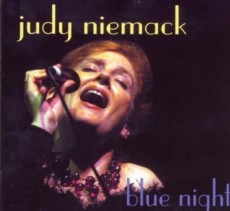
Judy Niemack was born on March 11, 1954 in Pasadena, California and started singing in a church choir from age seven. She decided to turn professional at age 17, and soon after met Warne Marsh who encouraged her to explore jazz.
Judy studied at Pasadena City College and later at the New England Conservatory of Music followed by her matriculating through the Cleveland Institute of Music.
Niemack released her debut album By Heart in 1977 and has since recorded eleven albums under her own name. She has toured Europe and has worked with Toots Thielemans, James Moody, Lee Konitz, Clark Terry, Kenny Barron, Fred Hersch, Kenny Werner, Joe Lovano, Eddie Gomez and the Widespread Depression Jazz Orchestra.
As an educator vocalist Judy Niemack teaches music has authored two books titled “Jazz Vocal Standards”, an introduction to singing and vocal improvisation and “Hear It, Sing It” that explores modal jazz. She continues performing and recording.

Give A Gift Of Jazz – Share
More Posts: vocal
Hollywood On 52nd Street
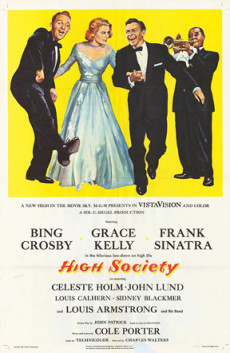
You’re Sensational was a tune written by Cole Porter for the 1956 film High Society starring Bing Crosby, Grace Kelly and Frank Sinatra, who introduced the song.
The Story: The highly successful jazz musician C.K. Dexter Haven (Crosby) was divorced from wealthy Newport, Rhode Island socialite Tracy Samantha Lord (Kelly) but remains in love with her. She, however, is about to get married to a bland gentleman of good standing, George Kittredge.
Spy Magazine, a fictional tabloid newspaper in possession of embarrassing information about Tracy’s father, sends reporter Mike Connor (Sinatra) and photographer Liz Imbrie to cover the nuptials. Tracy begins an elaborate charade as a private means of revenge, pretending that her Uncle Willy is her father Seth Lord and vice versa. Connor falls in love with Tracy. She must choose between three very different men in a course of self-discovery.
Sponsored By

www.whatissuitetabu.com
Daily Dose Of Jazz…
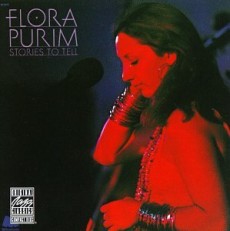
Flora Purim was born on March 6, 1942 in Rio de Janeiro to Jewish parents who were both classical musicians, her father a violinist and her mother a pianist. She discovered jazz when her mother played 78 vinyl rpms of Dinah Washington, Billie Holiday, Frank Sinatra, Bill Evans, Oscar Peterson, and Erroll Garner while her husband was out of the house.
Purim began her career in Brazil during the early 1960s. During this period, she made a recording of bossa nova standards by Carlos Lyra and Roberto Menescal titled Flora e M.P.M. Later in the decade she became lead singer for the Quarteto Novo, led by Hermeto Pascoal and Airto Moreira.
Flora mixed jazz with radical protest songs to defy the repressive Brazilian government of that time and a 1964 military coup led to censorship of song lyrics. Shortly before leaving Brazil she married Airto and arriving in New York in 1967, they became immersed in the emerging Electric Jazz. They toured Europe with Stanley Clarke, Stan Getz and Gil Evans. In 1972, alongside Clarke and Joe Farrell, they were, for the first two albums, members of Return To Forever. That year the band released their debut self-titled album Return To Forever, followed the same year as Light as a Feather.
In 1973, Purim released her first solo album in the United States, titled Butterfly Dreams. She was chosen by the Down Beat reader’s poll as one of the top five jazz singers. She worked with Carlos Santana and Mickey Hart and throughout the 1970s, Flora released a string of albums for the Milestone label, became involved with the Uruguayan band Opa, (which means “hi” in Uruguay), Purim collaborated in vocals in the band’s second album Magic Time, and in return, Opa played in “Corre Niña” on Flora’s album Nothing Will Be as It Was…Tomorrow .
In the 1980s Purim toured with Dizzy Gillespie’s United Nation Orchestra, culminating with Gillespie’s Grammy Award-winning album Dizzy Gillespie and the United Nation Orchestra – Live at the Royal Festival Hall, London. The Nineties saw her singing on the Grammy Award-winning album Planet Drum by Mickey Hart, the release of her own album and world tour, Speed of Light and a new band with contributions from Billy Cobham, George Duke, Alphonso Johnson, Giovanni Hidalgo and others.
Through the 1990s, Purim worked on a number of Latin projects, collaborated with P.M. Dawn on the album Red Hot + Rio. She has a huge catalogue of music that showcases her rare six-octave voice renders a vocal style influenced by Sarah Vaughan and Ella Fitzgerald, drifting from lyrics to wordlessness without ever losing touch with the melody and rhythm. She broadened her repertoire to include traditional mainstream jazz, bebop and doing numbers in 4/4 time instead of the traditional Brazilian 2/4 beat. She is a 4-time winner Down Beat’s Best Female Jazz Vocalist and 2-time Grammy nominee for Best Female Jazz Performance and has been named “Order of Rio Branco” by Brazil President Fernando Henrique Cardoso. She continues to perform, record and tour.
Take A Dose On The Road
More Posts: vocal
Daily Dose Of Jazz…
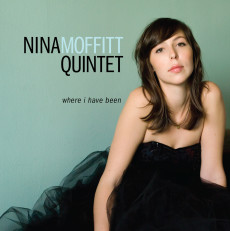
Nina Moffitt was born on March 3, 1987 in Brooklyn, New York and began piano lessons at the age of five. She took up percussion in her father’s church ensemble and finally became a vocalist by leading the church congregation throughout her formative years. Attending the LaGuardia Arts High School of Performing Arts in Manhattan, she studied classical music, gospel, jazz, and new music composition. Simultaneously she studied jazz voice privately at the Brooklyn Conservatory of Music.
By 2005 Moffitt was singing with the All City Jazz Band at Lincoln Center, was granted an Honorary Mention from the National Foundation for Advancement in the Arts in the category of jazz voice, and performed as a backup singer with pop star Josh Groban.
Graduating from Oberlin College with honors for her work in cultural and linguistic anthropology, not only did Nina study with world renowned Oberlin Conservancy professors like Lorraine Manz and Marcus Belgrave, she performed with the Oberlin Jazz Ensemble for four years, led jazz worship services at First Church of Oberlin and Trinity Church in Cleveland.
She cites Joni Mitchell, Sarah Vaughan, Wayne Shorter, and Nina Simone as her influences and has added bossa nova phrasing to her arsenal having studied Portuguese in Brazil. Vocalist Nina Moffitt has recorded her debut album Where I Have Been with her quintet and continues to perform with her band in the New York area.
Give A Gift Of Jazz – Share
More Posts: vocal
Hollywood On 52nd Street
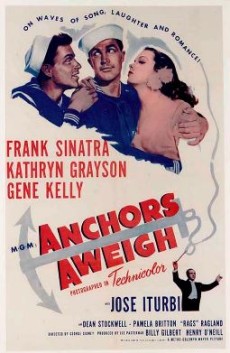
I Fall In Love Too Easily is a 1944 song composed by Jule Styne with lyrics by Sammy Cahn. Frank Sinatra introduced the song in the 1945 film Anchors Aweigh. The film won an Academy Award for its music; the song was nominated for Best Original Song but lost. The other stars of the film were Kathryn Grayson and Gene Kelly.
The Story: Two Navy sailors, Joe Brady and Clarence Doolittle on a four-day leave in Hollywood. Joe has his heart set on spending time with his girl, the unseen Lola. Clarence, the shy choirboy turned sailor, asks Joe to teach him how to get girls. Enter Susan, aunt to a small boy who wants to join the Navy and Clarence is smitten with her at first sight. Susan goes on to tell them that she has been trying to find work in music, and longs to perform with José Iturbi. Trying to impress her with Clarence, Joe tells her that he has arranged an audition. That night, they go out to a cafe, where Clarence meets a girl from Brooklyn, and they hit it off.
With no audition in sight they decide to come clean. Susan gets her screen test on her own, it’s successful and in they end all is forgiven and the lovers kiss as a choir sings the theme song.
Sponsored By
www.whatissuitetabu.com