

Daily Dose Of Jazz…
Jimmy Jewell was born on February 18, 1945 in the United Kingdom and began his career in 1962, participating in several jazz and rhythm and blues bands including Eddie Marten and the Sabres. Going professional the following year he joined the band Kris Ryan and the Questions after the band’s drummer Geoff Wills recommended his inclusion. With Jewell’s participation, Questions shifted genres, from rock to something more soul-oriented. Owing to artistic differences with Ryan, he left the band after final gigs in Germany during 1965.
In 1966 he moved to London, England played for a while in the Freddie Mack Sound and subsequently toured Germany with Chris Andrews and the Paramounts. Jimmy joined the Magics, a Berlin band, and toured Germany. In 1967, back in London, he played gigs with Lord “Caesar” Sutch & the Roman Empire, and the joined soul band Stewart James Inspiration, with whom he toured until their dissolution 1968.
After joining the Keef Hartley Band, Jewell played Woodstock and a couple of albums were released with his saxophone sound: The Battle of North West Six and The Time Is Near. A was a prolific session musician and band member during the 1970s, he recorded during 1973 and 1974 appearing on Ronnie Lane’s Anymore for Anymore. He recorded with the Hollies on their self-titled album. In the Seventies he recorded for Maggie Bell and Andy Fairweather Low, toured with Gallagher and Lyle and appeared on two of their albums.
He recorded with Fairport Convention, Chris de Burgh, performed with Roger Daltrey, John Lodge and with the Hollies. Jimmy went on to release two albums: I’m Amazed and From the First Time I Met You. By the Eighties work became occasional, including small jazz bands and collaboration with bluesman Lonnie Brooks on the 1981 album Turn On The Night.

More Posts: history,instrumental,jazz,music,saxophone

Daily Dose Of Jazz…
Anne Phillips was born on February 17, 1935 in Wyomissing, Pennsylvania. Studyinged piano growing up in suburbia, she didn’t hear jazz until she was a senior in high school. She studied at Oberlin College where she joined a jazz club and sang with the school’s big band and had a radio show.
By the time she turned nineteen she was in New York City playing piano and clubs six nights a week. Phillips started working in demo recordings for songwriters in the 1950s, and was a member of the Ray Charles Singers on the Perry Como Show. In 1959, she recorded her first jazz album, Born to Be Blue, for Roulette Records.
She went on to work as a singer, music arranger, conductor, writer, and producer for national commercials including Pepsi, Revlon, and Sheraton. Her Pepsi campaign included The Turtles, The Four Tops, The Hondells, and the Trade Masters. Anne has worked with Carole King, Burt Bacharach, and Neil Diamond
Composing and arranging then became more of her musical life. She went on to write the Christmas album Noel Noel for 25 singers a cappella. She followed this by writing The Great Grey Ghost of Old Spook Lane, a children’s musical, then an environmental piece What Are We Doing To Our World?, and a full musical, Damn Everything But The Circus. for which I wrote both music and lyrics with book writer Stephanie Braxton, has had several readings and is close to production.
Founding Kindred Spirits, a not-for-profit organization founded with her husband, Bob Kindred, the organization sponsors a yearly performance of Bending Towards the Light – A Jazz Nativity, which she composed. They also have an educational program for inner-city children called The Kindred Spirits Children’s Jazz Choirs which teaches jazz music.
Vocalist, composer, arranger, producer Anne Phillips is celebrating her 90th birthday.
More Posts: arranger,bandleader,composer,history,instrumental,jazz,music,vocal
Requisites
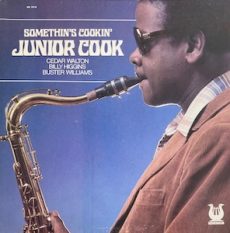
Somethin’s Cookin’ ~ Junior Cook | By Eddie Carter
Junior Cook takes center stage this morning with an excellent 1982 album, Somethin’s Cookin’ (Muse Records MR 5218). This was the tenor saxophonist’s fifth release as a leader and his second for the Muse label. He is accompanied by a stellar rhythm section: Cedar Walton on piano, Buster Williams on bass, and Billy Higgins on drums. My copy is the U.S. Stereo release. Side One opens with Cedar Walton’s Fiesta Español, a Latin-inspired tune that smoothly shifts from the introduction into the quartet’s easygoing theme. Junior’s relaxed performance sets the tone. Cedar responds with a delightful solo, and then the ensemble wraps up with a return to the melody and a satisfying finale.
Detour Ahead by Herb Ellis, John Frigo and Lou Carter starts with a concise piano introduction, leading into Junior’s delicately tender melody and personal opening statement. Cedar’s gracefully elegant solo follows while Buster and Billy maintain a gentle tempo, setting the stage for Junior’s final, reflective thoughts ahead of the ending. Illusion of Grandeur by Larry Willis changes the pace to mid-speed as the quartet begins the opening chorus. Junior seizes the expansive musical landscape with a confident, inspired interpretation. Cedar’s creativity shines in the closing solo, complemented by Buster and Billy’s support before the foursome wraps up matters.
Side Two kicks off with an energetic introduction to Heavy Blue by Larry Willis. Junior navigates the melody and opening solo with unparalleled skill. Cedar follows the leader in an enthusiastic performance. Then, Junior and Billy engage in a brief exchange before the quartet brings the song to a close. Hindsight by Cedar Walton begins with the pianist leading the way to the quartet’s melody. Buster gets the opening nod and takes a splendid walk in the lead solo. Junior gets into a soundly swinging groove on the following interpretation. The pianist concludes the solos with an impressive performance ahead of the theme’s reprise.
Chi-Chi by Charlie Parker picks up the tempo with Billy’s crisp introduction, setting the stage for the ensemble’s buoyant theme. Junior dives in with a dynamic solo right out of the gate. Cedar keeps the energy high in the following interpretation. Buster then walks exuberantly through the third performance. Lastly, Junior and Billy take us home in a short conversation, leading to a lively reprise of the melody. Cedar Walton produced Somethin’s Cookin’, and Rudy Van Gelder was the recording engineer. The album sounds fantastic; the highs sparkle, the midrange has plenty of depth, and the bass is deep and solid.
Junior Cook recorded one other album for Muse as a leader but appears as a sideman on three others with Bill Hardman and one with Walter Bishop Jr. He recorded with quite a few musicians, and his longest time as a sideman was six years with Horace Silver and five with Blue Mitchell. He also taught for a year at the Berklee School of Music during the seventies. He died at the age of fifty-seven on February 3, 1992. If you’re a fan of the tenor sax and are unfamiliar with the music of Junior Cook, I invite you to check out Somethin’s Cookin’ on your next record-shopping trip. It’s a fantastic album that will enrich any jazz fan’s library, whether you’re a beginner or a seasoned listener!
~ Detour Ahead, Junior Cook – Source: Wikipedia.org
© 2025 by Edward Thomas Carter


Daily Dose Of Jazz…
Gerald “Jerry” Segal was born on February 16, 1931 and raised in Philadelphia, Pennsylvania. He majored in music at Mastbaum High before graduating and working with Bennie Green and Pete Rugolo in local clubs.
In the late 1950s he played with Johnny Smith, Terry Gibbs, Teddy Charles, Stan Getz, Charles Mingus, Herbie Mann, Lennie Tristano, Bob Dorough, Teo Macero, Curtis Fuller, Hampton Hawes, Dick Cary, Mal Waldron, Addison Farmer, the Australian Jazz Quintet, and Mose Allison.
From 1958 to 1960 he played with Bernard Peiffer and with the composer Edgar Varese in the 1950s. The 1960s saw him with Dave McKenna.
Raising his children he primarily became the big act show drummer for the honeymoon resort, the Mount Airy Lodge in the Poconos through the 60’s.
Drummer Jerry Segal, who never recorded as a leader, eventually disappeared from the jazz scene and died in August 1974. He was 43 years old.
More Posts: drums,history,instrumental,jazz,music

Daily Dose Of Jazz…
Pekka Eerik Juhani Sarmanto was born February 15, 1945 in Helsinki, finland. He first studied classical violin at the Sibelius Academy from 1958 to 1964 before switching to upright bass. He initially played dance music but was soon invited to perform in jazz clubs by bandleaders like Eero Koivistoinen and Esa Pethman.
1967 saw him joining the house band of Down Beat Club where he played with musicians like Ben Webster and Dexter Gordon. In 1975 Sarmanto founded UMO, abbreviation of Uuden Musiikin Orkesteri, (New Music Orchestra) and the group accompanied many international jazz musicians visiting Finland. As a result Pekka was able to meet and play with Charles Mingus in Belgrade, Serbia; Gil Evans, Edward Vesala and Sonny Rollins.
Sarmanto received the Georgie Award of the Finnish Jazz Federation in 1978. In 1982 he worked on the album To a Finland Station with Dizzy Gillespie and Arturo Sandoval, released on the Pablo label in 1983. He considers this to be his most successful recording.
In 1996 the bassist founded the Pekka Sarmanto Trio and in 2007 he retired from UMO but he still keeps performing actively with different groups, including with his own trio..
More Posts: bandleader,bass,history,instrumental,jazz,music