

Daily Dose Of Jazz…
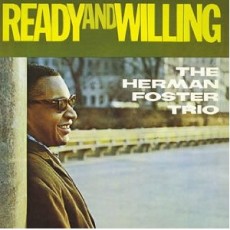
Herman Foster was born on April 26, 1928 in Philadelphia, Pennsylvania and began his musical career before age ten playing the violin, clarinet, saxophone, and piano. A self-taught pianist, Foster created a distinguished earthy sound. When his family moved to New York City in 1947, Herman began to attend jam sessions and then played with Eric Dixon, Dick Carter and the big band of Herb Jones.
His success came when he met Lou Donaldson and the two played together for thirteen years from 1953 to 1966. During the 1950s he worked with King Curtis, Bill English and Seldon Powell, in the 1960s with Al Casey, in addition to playing with his own trio over the next decade. He returned to work in Donaldson’s quartet in the 1980s.
He released four records as a leader for Epic, Argo and Timeless Records and as a sideman recorded nineteen albums with Lou Donaldson, Gloria Lynne, Johnny Hartman, Hisayo Tominaga, George V. Johnson Jr., Joan Shaw, Al Casey and King Curtis.
On April 3, 1999, bebop pianist Herman Foster passed away in New York City.

More Posts: piano
Daily Dose Of Jazz…
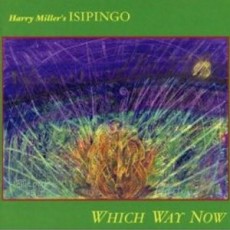
Harry Miller was born Harold Simon Miller on April 25, 1941 in Cape Town, West Cape, South Africa. He began his career as a bassist with Manfred Mann, and settled in London. He became a central figure in the mixture of South-African township music and free jazz, which became dynamic on the London scene at the end of the Sixties and into the Seventies.
Miller recorded frequently with musicians such as Mike Westbrook, Chris McGregor, John Surnam, Mike Cooper, Louis Moholo, Keith Tippett and Elton Dean. He found work as a session player and appeared on the 1971 album Islands by the progressive rock band, King Crimson. For economic reasons at the end of the 1970s he moved to the Netherlands, working with musicians of Willem Breuker’s circle.
He recorded five albums between 1972 and 1983 for Cuneiform, Reel Recordings, and his Ogun Records that he founded with his wife Hazel Miller. The label was vital for documenting that period, and is still active today.
Bassist Harry Miller passed away on December 16, 1983, in the Netherlands.
More Posts: bass
Daily Dose Of Jazz…
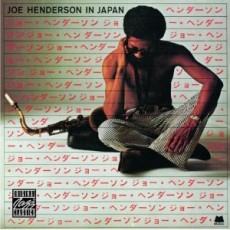
Joe Henderson was born on April 24, 1937 in Lima, Ohio and was encouraged by his parents to study music. Growing up he studied drums, piano, saxophone and composition, and listened to Lester Young, Stan Getz, Dexter Gordon, Charlie Parker, Flip Phillips, Lee Konitz and Jazz at the Philharmonic recordings. While in high school he wrote several scores for the school band and rock groups.
Active on the Detroit jazz scene by eighteen, Henderson was playing jam sessions with visiting New York stars in the mid-50s. He attended Wayne State University studying sax, flute and bass, Joe played with fellow classmates Yusef Lateef, Barry Harris and Donald Byrd.
A two-year Army stint saw him touring worldwide entertaining troops and while in Paris met Kenny Drew and Kenny Clarke. After discharge he moved to New York, and soon joined Horace Silver’s band, providing the seminal solo on Song For My Father. Leaving Silver he freelanced and in 1966 co-led a big band with Dorham, whose arrangements went unrecorded until 1996 on the Joe Henderson Big Band.
Henderson appeared on nearly three-dozen albums as a leader and over 50 as a sideman during his career. He would join but never record with Miles Davis, move to Milestone Records, co-lead the Jazz Communicators with Freddie Hubbard, became more politically and socially conscious with his music, played with Blood, Sweat & Tears briefly and started teaching.
He would play with Echoes Of An Era, the Griffith Park Band, Chick Corea, but remained a leader experiencing a resurgence in 1986, record for An Evening with Joe Henderson for Red Records, get signed with Verve and enjoy critical success and popularity after releasing Lush Life: The Music of Billy Strayhorn.
On June 30, 2001, saxophonist Joe Henderson passed away of heart failure after a long battle with emphysema.
More Posts: saxophone
Daily Dose Of Jazz…
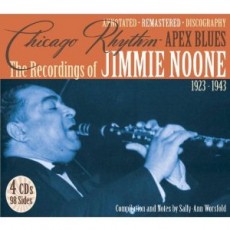
Jimmie Noone or Jimmy Noone was born on April 23, 1895 in Cut Off, Louisiana and started playing guitar. By 15 he switched to the clarinet, moved to New Orleans, studied with Lorenzo Tio and thirteen year old Sidney Bechet.
1912 found Jimmie playing professionally with Freddie Keppard in Storyville and over the next five years he performed with Buddy Petit, Kid Ory, Papa Celestin, the Eagle Band, and the Young Olympia Band, before moving to Chicago, Illinois and joining the Original Creole Orchestra. The following year, he joined King Oliver’s Creole Jazz Band, then in 1920 reunited with Keppard in Doc Cook’s band, which he would remain and make early recordings for six years.
Noone started leading the band at Chicago’s Apex Club in 1926. This band, Jimmie Noone’s Apex Club Orchestra, included alto saxophonist and clarinetist Joe Poston and pianist Earl Hines. Signing with Brunswick on their Vocalion label her recorded prolifically from 1928 to 1935, then moved to Decca the following year followed with a year at Bluebird.
A move to New York City in 1935 produced a short-lived band and club with Wellman Braud and Noone returned to Chicago. He continued to play at various clubs until 1943, moved to Los Angeles, California, joined Kid Ory’s band, which was featured for a time on a radio program hosted by Orson Welles.
After playing only a few broadcasts with the band, the lyrical and sophisticated clarinetist Jimmie Noone, who would influence later clarinet players such as Artie Shaw, Irving Fazola and Benny Goodman, died suddenly of a heart attack at 48, in Los Angeles, California on April 19, 1944.
More Posts: clarinet
Daily Dose Of Jazz…
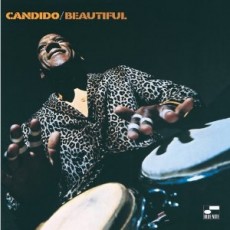
Candido was born Candido de Guerra Camero on April 22, 1921 in Havana, Cuba and learned to play percussion as a child listening to the music of his native land. Early in his career, Camero focused on conga and bongo, recording in his native Cuba with fellow jazz musician Machito. Although he has been credited as the first person to use the congas in jazz music, both Diego Iborra and Luciano “Chano” Pozo Gonzales preceded him in the 1940s.
Moving to New York in 1952 he started recording with Dizzy Gillespie and from 1953-54 he was in the Billy Taylor Quartet. The next year saw him performing and recording with Stan Kenton. During the Seventies Candido enjoyed success during the disco era, most notably with the Babatunde Olatunji-penned track “Jingo” from his Dancin’ and Prancin’ album on the Salsoul Record label, that has been acknowledged as a precursor five years prior to the birth of the house music genre.
He has performed and recorded Errol Garner, Gene Ammons, Art Blakey, Sonny Rollins, Wes Montgomery, Elvin Jones and Lionel Hampton on the short list of jazz luminaries. Percussionist Candido was honored with the National Endowment for the Arts Jazz Masters Award in 2008. In 2014, Camero recorded his last album, The Master, also for Chesky.
He continued to perform in jazz clubs in New York until the late 2010s. AWhen he was 96 years of age he was residing in his home in Cuba. Candido, who played conga, bongo, tres and bass died on November 7, 2020, at his home in New York. He was 99.
More Posts: percussion