

Daily Dose Of Jazz…
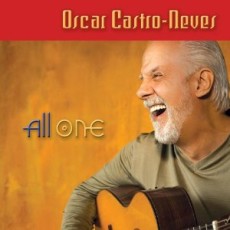
Oscar Castro-Neves was born one of triplets on May 15, 1940 in Rio de Janiero. Discovering his interest in music at an early age, by six he was playing the little viola and the cavaquinho and forming a band with his brothers. He found his musical interest in the synthesis of European classical influenced altered chords with the bittersweet samba-cancao.
He would learn from Johnny Alf who was deeply influenced by jazz, as would all musicians who chose the path to bossa nova. However it wasn’t until the 60s that it would catch on and in 1962 he was part of the historic Carnegie Hall Bossa Nova Festival.
Soon after he befriended Paul Winter and recorded his debut Oscar! on Paul’s label Living Music. That recording led to other sessions as a leader and performances with the likes of Vinicius de Moraes, Dorival Caymmi, and Quarteto em Cy. In 1966 he recorded with Tom Jobim on his Apresenta album before joining Sergio Mendes and Brazil 66 and recording Fool On The Hill. Having recorded three albums, he had already gained immediate fame blending commercially Brazilian, jazz and American pop.
As an arranger he has worked for Quincy Jones, Flora Purim, Laurindo Almeida, Joao Gilberto, played with Yo Yo Ma, Michael Jackson, Barbra Streisand, Toots Thielemans, Stevie Wonder, John Klemmer and Stan Getz and been involved in projects with Dave Grusin, Herbie Hancock and Michael Brecker.
Guitarist Oscar Castro-Neves continues to record, compose, arrange, score movies and television, perform and tour worldwide.
Daily Dose Of Jazz…
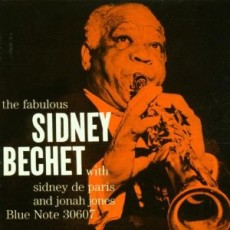
Sidney Bechet was born on May 14, 1897 in New Orleans, Louisiana to a wealthy Creole family. At age six he picked up his brother’s clarinet, learned to play by on his own, eventually playing at a family birthday party exhibited his new talent. Later he would study with renowned Creole clarinetists Lorenzo Tio, Big Eye Louis Nelson and George Baquet. He would be found improvising jazz in many New Orleans ensembles led by John Robichaux, Bunk Johnson and King Oliver.
By the time he was 17 Bechet was touring as far north as Chicago and two years later landed in New York playing with Marion Cook’s Syncopated Orchestra. This led him to Europe and the Royal Philharmonic Hall where he attracted attention with his playing. It was in London that Sidney found the straight soprano and quickly developed a style different from his warm clarinet.
Sidney became one of the first important soloists in jazz, eclipsing Louis Armstrong into the studio by several months, and was possibly the first notable jazz saxophonist. His forceful delivery and well-constructed improvisations characterized his distinctive and wide vibrato playing although his lively and unpredictable temperament did not gain him wide acclaim until well into the late forties.
Returning to New York in 1922 he began recording songs like “Wild Cat Blues” and “Kansas City Man’s Blues” with sessions led by pianist and songwriter Clarence Williams. Over the next three decades Bechet continued to record and tour although his success was intermittent. He relocated to France in 1950, got married and shortly before his death dictated his poetic autobiography “Treat It Gentle”. Sidney Bechet, clarinetist, saxophonist and composer died in Garches, France of lung cancer on May 14, 1959, his 62nd birthday.
Daily Dose Of Jazz…
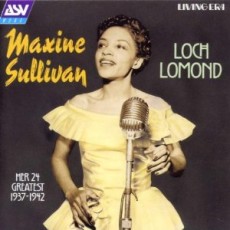
Maxine Sullivan was born Marietta Williams on May 13, 1911 in Homestead, Pennsylvania who developed a subtle and lightly swinging jazz style. Maxine possessed an affable delivery that slighted no lyric.
Over the course of her long career Sullivan first moved to New York and sang during intermissions at the Onyx Club. It was here she was discovered by Claude Thornhill who recorded her in front of a septet singing standards and a couple of Scottish tunes in swinging fashion. One of those tunes “Loch Lomond” would become her big hit and her career signature song.
During the forties Maxine appeared in movies opposite Louis Armstrong, on Broadway in Swingin’ The Dream, with then husband John Kirby and his sextet, and starred a radio show “Flow Gently Sweet Rhythm” for two years receiving reasonable success with a solo career.
By the 50s she became trained as a nurse and over the next several years was absent from music. However, 1968 saw Sullivan’s comeback performing at festivals and even playing a little valve trombone and flugelhorn.
During the later years of her career she intermittently appeared with the World’s Greatest Jazz Band, sang with mainstream jazz groups and recorded in concert her first hit Loch Lomond. Passing away on April 7, 1987 in New York City, vocalist Maxine Sullivan was inducted into the Big Band Hall of Fame in 1998.
More Posts: vocal
Daily Dose Of Jazz…
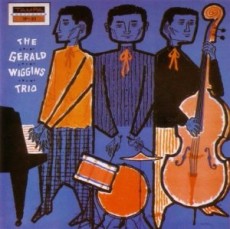
Gerald Wiggins was born on May 12, 1922 in New York City. He started classical piano lessons when he was four but by his teenage years became interested in jazz. He doubled on bass while attending High School & Art and for a period in the 40s accompanied Stepin’ Fetchit. Following this he worked and toured with the big bands of Les Hite, Louis Armstrong and Benny Carter. Stationed in Seattle while in the military he played in the local jazz clubs.
By the mid 40s Wiggins relocated to Los Angeles and played music for television and film. He has worked with Lena Horne, Kay Starr, Nat King Cole, Lou Rawls, Jimmy Witherspoon Helen Humes, Joe Williams, Ernie Andrews and Eartha Kitt to name a few. He also worked at the Hollywood studios as a vocal coach and worked with Marilyn Monroe and others.
Always a highly flexible pianist, Wiggins was comfortable in swing and bop settings with a consistently witty style filled with catchy riffs became his distinctive signature. His best-known recording as an organist was Wiggin’ Out but it was Wiggins’ trio work with Andy Simpkins and Paul Humphreys that is legendary. Pianist Gerald Wiggins passed away at the age of 86 on July 13, 2008.
More Posts: piano
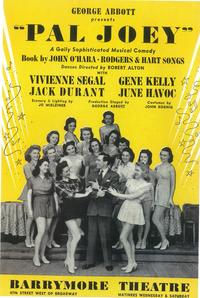
From Broadway To 52nd Street
Pal Joey premiered at the Ethel Barrymore Theatre on December 25, 1940 and ran for 374 performances. Richard Rodgers and Lorenz Hart scored the music with the show starring Vivienne Segal, Gene Kelly, June Havoc, Jack Durant, Leila Ernst and Van Johnson. From the musical came the songs that rose to the roster of jazz classics I Could Write A Book, and Bewitched, Bothered and Bewildered.
The Story: Set in San Francisco, an irresistible heel named Joey Evans (Kelly) gets a job at the Mike’s Club, and becomes attracted to Linda English (Leila Ernst). Joey drops her for a rich, bewitched dowager Vera Simpson (Segal). Vera falls for Joey and builds him his own club, Chez Joey, but soon tires of him. With an encounter by blackmailers, (Durant & Havoc) Joey is off in search of other conquests. Unlike the movie version with Sinatra, Hayworth and Novak, the boy doesn’t get the girl in the end. This play marked the only Broadway musical that Kelly played a major role.
Broadway History: In the 18th century, Broadway ended at the town commons north of Wall Street Wall, where traffic continued up the East Side of the island via Eastern Post Road and the West Side via Bloomingdale Road. The western Bloomingdale Road would be widened and paved during the 19th century, and called “The Boulevard” north of Columbus Circle. On February 14, 1899. The name “Broadway” was extended to the entire Broadway/Bloomingdale/Boulevard Road.
Sponsored By

www.whatissuitetabu.com
More Posts: broadway