

Daily Dose Of Jazz…
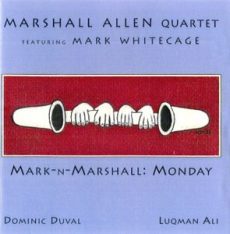
Marshall Belford Allen was born in Louisville, Kentucky on May 25, 1924. During World War II he enlisted in the 92nd Infantry Division and was stationed in France. He studied alto saxophone in Paris, France and played in Europe with Art Simmons and James Moody.
Best known for his mastery of explosive, jarring, chaotic sound effects on the alto saxophone, the opportunity came to create a long association with Sun Ra, with whom he performed almost exclusively from 1958 to Ra’s death in 1993. Marshall recorded with Paul Bley in 1964 and Olatunji during the mid-1960s.
Since Sun Ra death Allen has led the Arkestra and has recorded two albums. Allen often appeared in New York-area collaborations with bassist Henry Grimes, and participated in the Innerzone Orchestra with Francisco Mora Catlett, Carl Craig and others in an appreciation of Sun Ra’s music.
In 2022, the building at 5626 Morton Street known as the Arkestral Institute of Sun Ra was listed as a historic landmark in the Philadelphia Register of Historic Places. Free and avant-garde jazz alto saxophonist Marshall Allen, who also plays flute, oboe, piccolo, and EWI, at the age of 99 continues to live at the Institute, which has been his home since 1968.

More Posts: bandleader,ewi,flute,history,instrumental,jazz,music,oboe,piccolo,saxophone
Daily Dose Of Jazz…
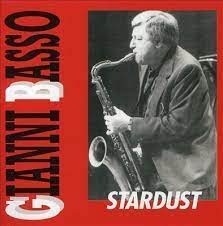
Gianni Basso was born May 24, 1931 in Asti, Italy. He started his career shortly after World War II, at first as a clarinetist, then switched to the tenor saxophone playing in Germany and Belgium with Raoul Faisant’s Big Band.
By the Fifties he became established as a commercial GB or general business player in Milan, Italy and had a steady presence at jazz events. The middle of the decade saw Gianni studying music in Turin, Italy and collaborating with trumpeter and composer Oscar Valdambrini. They created a small group combo which soon became one of the most popular jazz groups in Italy during the Fifties.
Due to their popularity Basso went on to work with a number of touring American jazz musicians, including Chet Baker, Buddy Collette, Slide Hampton, Maynard Ferguson, Phil Woods and Gerry Mulligan.
During the Seventies he founded the Saxes Machine and fronted the Gianni Basso Big Band. His senior years had him settling into the Rome, Italy studio scene while playing clubs and enjoying his historical stature.
Tenor saxophonist Gianni Basso, who was influenced by Stan Getz, transitioned on August 17, 2009.
More Posts: bandleader,history,instrumental,jazz,music,saxophone
Three Wishes
Francis Paudras replied to the query of three wishes by the Baroness with:
- “To ‘ave ze Beatles naked on ze stage on all fours, cut zeir ‘air, and zen close zem up, and force zem to listen to ze works of Monk, twenty-four hours on twenty-four!”
- “Zat ze world of music take conscience of ze importance, ze true place of Bud Powell in music, not just jazz.”
- “I would like for jazz coming ze ambassador for peace in ze world.”
*Excerpt from Three Wishes: An Intimate Look at Jazz Greats ~ Compiled and Photographed by Pannonica de Koenigswarter

More Posts: baroness,history,instrumental,jazz,music,pannonica,piano,three,wishes,writer
Daily Dose Of Jazz…
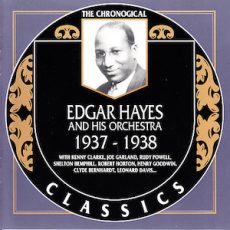
Edgar Junius Hayes was born on May 23, 1902 in Lexington, Kentucky and attended Wilberforce University, graduating with a degree in music. In 1922 he toured with Fess Williams, and formed his own group in 1924, the Blue Grass Buddies, in Ohio. The following year he played with Lois Deppe. Later in the decade he led the groups Eight Black Pirates and the Symphonic Harmonists.
For five years from 1931 to 1936 Hayes played and arranged for the Mills Blue Rhythm Band. Hayes again led his own orchestra from 1937 to 1941 and Kenny Clarke was among his sidemen. His most popular recording was a version of the song Stardust and the original recording of In the Mood which was later covered by Glenn Miller; both songs were recorded in 1938.
Moving to California in 1942 and led a quartet there for most of the decade. Following this he played solo, continuing to perform live into the 1970s. He recorded under his own name several times between 1937 and 1960.
Pianist and bandleader Edgar Hayes transitioned in San Bernardino, California on June 28, 1979.
More Posts: bandleader,history,instrumental,jazz,music,piano
Daily Dose Of Jazz…
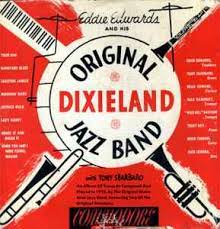
Edwin Branford “Eddie” Edwards was born on May 22, 1891 in New Orleans, Louisiana and started on violin at age 10 and five years later he picked up the trombone. In 1916, he was chosen to go to Chicago, Illinois by Alcide Nunez to play trombone with Johnny Stein’s Jazz Band. With a few changes of personnel, this band became the Original Dixieland Jass Band, which made the first jazz records in 1917. He played on one of the first commercially released jazz recordings, Livery Stable Blues, later released as Barnyard Blues.
Leaving the band after being drafted into the United States Army, he served from July 1918 to March 1919. After being discharged, Eddie led his own band and worked in Jimmy Durante’s band before returning to the Original Dixieland Jass Band. After that band broke up, he again led a band in New York City for most of the 1920s until retiring from music in the early Thirties. He then ran a newspaper stand and worked as a sports coach.
Coming out of retirement he returned to music in 1936 when Nick LaRocca reformed the Original Dixieland Jazz Band, playing with them until 1938. He played in other bands with Larry Shields, Tony Sbarbaro, and J. Russell Robinson in New York City into the 1940s. He continued playing professionally intermittently until shortly before his death.
His composition Sensation Rag or Sensation was performed at the 1938 Benny Goodman jazz concert at Carnegie Hall and was included on the album The Famous 1938 Carnegie Hall Jazz Concert. Darktown Strutters’ Ball, composed by Shelton Brooks, a Black man, was recorded by the Original Dixieland Jass Band and inducted into the Grammy Hall of Fame in 2006.
Trombonist Eddie Edwards, who played both violin and trombone, and who also played minor-league baseball and worked as an electrician, transitioned on April 9, 1963 in his hometown at the age of 71.
More Posts: bandleader,history,instrumental,jazz,music,trombone,violin