


Daily Dose Of Jazz…
Joe Ford was born on May 7, 1947 in Buffalo, New York and was singing in his mother and aunt’s family choir by age 5. At seven he started taking piano lessons and by the time he was eleven he started playing saxophone. In high school and college Joe played in a variety of campus jazz and funk bands.
Ford studied saxophone under Makanda Ken McIntyre, Jackie McLean and Frank Foster, and percussion under Joe Chambers. After graduating from Ohio’s Central State University He returned home to teach in the Buffalo public schools from 1968 to 1972. It was while working at the Buffalo Public Library in 1974 that Joe played in the Birthright Ensemble, and then would go on to join McCoy Tyner in 1976, recording eight albums with him through 1993.
Since the early 1980s Ford worked extensively as a sideman with Sam Jones, Lester Bowie, Jimmy Owens, Idris Muhammad, Abdullah Ibrahim, Chico O’Farrill, Avery Sharpe, Jerry Gonzalez, Malachi Thompson, Steve Berrios, Nova Bossa Nova and Freddy Cole amongst others.
In the late 1990s he led two ensembles, the Black Art Sax Quartet and a big band called The Thing. As a leader, saxophonist Joe Ford released his one album in 1993, “Today’s Night” on Blue Moon Records featuring Charles Fambrough, Kenny Kirkland and Jeff “Tain” Watts.
Saxophonist Joe Ford continued to perform and tour until his death on May 25, 2025, at the age of 78..
More Posts: saxophone
Daily Dose Of Jazz…
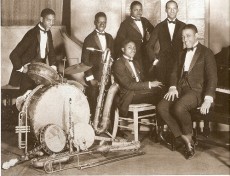
Charlie Irvis was born May 6, 1899 in New York City. He first played trombone professionally with Bubber Miley in his youth and then with blues singer Lucille Hegamin in the “Blue Flame Syncopators” from 1920 to 1921. Following this stint, Charlie played with Willie “The Lion” Smith and with Duke Ellington’s Washingtonians and later with his orchestra from 1924 to 1926. During the years 1923 to 1927 he also recorded occasionally with Clarence Williams.
Irvis, along with friends Miley and Tricky Sam Nanton contributed to the development of “jungle sounds” or “growl effects” in trombone playing. After leaving Ellington’s band, for the rest of the decade and into the early 1930s he recorded with Fats Waller, played with Charlie Johnson and Jelly Roll Morton. Some of his final recordings were in 1931 with Miley again, and shortly thereafter with Elmer Snowden.
After the early 1930s, Charlie Irvis, best known for his work with Duke Ellington’s band, stopped playing and passed away in New York City sometime around 1939 in obscurity. He is pictured 2nd from left in the photograph.
More Posts: trombone

Daily Dose Of Jazz…
Pablo Aslan was born in Buenos Aires, Argentina on May 5, 1962 and began playing bass in his youth. He received his music education at University of California – Santa Cruz, CalArts and UCLA, and in the 90’s in the clubs of New York.
Pablo has led several groups like New York Buenos Aires Connection, Avantango, and New York Tango Trio, which included musicians such as the late Thomas Chapin, pianist Ethan Iverson (now of The Bad Plus), drummer Kenny Wollesen, saxophonist Donny McCaslin, and bandoneonists Raul Jaurena and Tito Castro.
Aslan has worked with Yo Yo Ma, Lalo Schifrin, Pablo Ziegler, Osvaldo Golijov, Arturo O’Farrill, Emilio Solla and Fernando Otero. In 2009 he released “Tango Grill” that was nominated for both a Grammy and Latin Grammy. He has collaborated with Paquito D’Rivera, “Tango Jazz” Live at Jazz @ Lincoln Center” and also for a tribute to tango master Astor Piazzolla on the 90th anniversary of his birth. Bassist Pablo Aslan continues to champion the fusion of jazz and tango as he records, performs and tours.
Daily Dose Of Jazz…
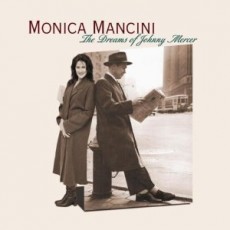
Monica Mancini was born on May 4, 1952 in Los Angeles, California to film composer Henry Mancini. She began her singing career at fourteen as a member of the Henry Mancini chorus, which later led to a successful career in the Los Angeles studios.
Monica is a Concord Record recording artist and two-time Grammy award nominee, who has carved out an impressive career as a singer performing on club and concert stages, and with major symphony orchestras worldwide.
She has appeared on countless film scores, and recorded with artists including Placido Domingo, Horace Silver, Quincy Jones, Michael Jackson Stevie Wonder, Kenny Rankin and Plas Johnson among others. She has recorded four albums, fronted the Los Angeles Philharmonic Orchestra and sung Senza Fine on the soundtrack for the 2002 film Ghost Ship. She continues to perform and tour.
More Posts: vocal
Requisites
Serenade To A Bus Seat ~ Clark Terry Quintet | By Eddie Carter
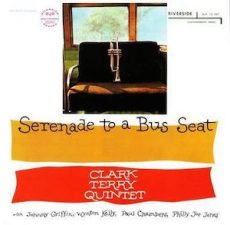
This morning’s spotlight shines on a remarkable trumpeter who, in my view, always delivered flawless performances. Serenade To A Bus Seat (Riverside RLP 12-237) by the Clark Terry Quintet is the subject of this discussion. Clark enjoyed an illustrious career performing with Charlie Barnet, Count Basie, Duke Ellington, Quincy Jones, and Oscar Peterson. He was also a member of The Tonight Show Band from 1962 to 1972. Terry’s influence extended far beyond his performances; his jazz career spanned more than 70 years, and he became one of the most-recorded jazz musicians, appearing on more than 900 recordings. He also mentored Terry Lyne Carrington, Miles Davis, Herbie Hancock, Quincy Jones, Wynton Marsalis, Pat Metheny, and Dianne Reeves.
On his third album as a leader, Clark Terry is working with Johnny Griffin, tenor saxophone; Wynton Kelly, piano; Paul Chambers, bass; and Philly Joe Jones, drums. The copy I own is the 1977 Riverside Original Recording Series Japanese mono reissue (SMJ-6209M) by Victor Musical Industries. The opener, Donna Lee by Charlie Parker, begins with Philly’s introduction ahead of the quintet’s brisk melody. Johnny ignites the first solo with bursts of passionate fire, then Clark and Philly share an energetic conversation. Kenny caps off the solos with an impressive display of vibrant energy ahead of the group’s lively closing chorus and dead stop.
Boardwalk by Clark Terry is a blues that begins with an enjoyable, medium-tempo theme by the ensemble. Terry opens with a poised, almost dignified solo, then he engages in a friendly exchange of ideas with Griffin. Kelly then provides the exclamation point with a laid-back interpretation before the group reconvenes for the climax. Terry’s second creation, Boomerang, is a lively little original that takes off with the front line’s melody in unison. Clark gives his undivided attention to the opening solo, then Johnny enters and simply swings. Wynton follows with a strong statement that’s a joy to listen to. Paul takes a short walk preceding the group’s return to the theme’s reprise and close.
Digits by Clark Terry turns the temperature down for an easygoing theme by the ensemble. Terry steps up first to give a relaxing solo, then shares the next happy statement with Griffin. Kelly wraps up everything with a leisurely reading until the quintet returns for the closing chorus. The title tune, Serenade To a Bus Seat by Clark Terry, is a swinging homage to the trips musicians took from city to city with big bands. It’s off to the races with the ensemble’s melody, then Johnny is up first to ignite the first solo with passionate fire. Clark meets the challenge with an effervescent interpretation. Wynton gets the last spot and handles it comfortably before the front line’s fine blowing signals the end.
Hoagy Carmichael and Mitchell Parish’s classic, Stardust, is one of the most recorded songs in history. Both horns deliver a gentle introduction leading to Terry’s delicately phrased melody. Terry and Griffin are the featured soloists, and both turn in two beautiful solos that complement each other until the theme returns and the song ends softly. Cruising by Clark Terry opens with an easy-flowing theme led by both horns, before stepping aside for Johnny to lead off with an excellent first solo. Clark speaks his piece in the following statement, then Wynton follows at an unhurried pace, leading to the restatement of the theme and climax.
That Old Black Magic by Harold Arlen and Johnny Mercer is an old favorite from 1942 that first appeared in the film, “Star Spangled Rhythm.” The quintet wraps the album up in a bow with a short Latin rendition, which begins and ends with Terry using a cowbell and Griffin on the claves. In between, both Terry and Griffin, on trumpet and tenor sax, make swinging comments. Orrin Keepnews produced the initial session, and Jack Higgins was behind the recording console. The Victor Japanese mono reissue is a delight to hear, with a breathtaking soundstage that places the musicians in your listening room’s sweet spot with stunning fidelity.
For anyone who admires Clark Terry or is just beginning to discover his discography and enjoys hard bop, I strongly recommend picking up Serenade To a Bus Seat by the Clark Terry Quintet the next time you’re at your favorite record store. It’s a fabulous album that should make a meaningful addition to any jazz library, especially for those who appreciate the artistry of a masterful trumpeter!
~Stardust, That Old Black Magic – Source: <ahref=”http://jazzstandards.com”>JazzStandards.com

More Posts: choice,classic,collectible,collector,history,instrumental,jazz,music,trumpet