

Daily Dose Of Jazz…
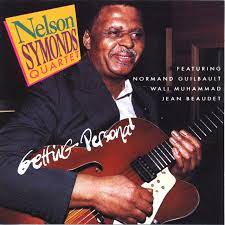
Nelson Symonds was born on September 24, 1933 in Upper Hammonds Plains, Nova Scotia, Canada. After pursuing the banjo at a young age he switched to the guitar. He gained his first performance experience touring on a travelling carnival from 1955 to 1958 throughout the United States. Upon returning to Canada he settled in Montreal in 1958 and played in the group The Stablemates led by Alfie Wade Jr.
During the Sixties and 1970s Nelson played mainly with bassist Charlie Biddle and drummer Norman Marshall Villeneuve at The Black Bottom, Rockhead’s Paradise and other similar venues. The 1970s saw him and Biddle performing as a duo in numerous Laurentian resorts. Throughout his 30-plus year career, he played at all of the major jazz venues in Montreal including Upstairs, Biddles and Cafe La Bohème among others.
Symonds reportedly resisted recording until the 1990s, cutting three collaborative albums, and one as leader. Unfortunately for the jazz world, in 1996 he underwent a quadruple bypass that put an end to his musical career.
Guitarist Nelson Symonds transitioned on October 11, 2008 in Montreal, Quebec, Canada due to a heart attack at the age of 75.

More Posts: bandleader,guitar,history,instrumental,jazz,music

Daily Dose Of Jazz…
Tiny Bradshaw was born Myron Carlton Bradshaw on September 23, 1907 in Youngstown, Ohio. Graduating from high school he went on to matriculate through Wilberforce University with a degree in psychology, then turned to music for a living.
In Ohio, he sang and played drums with Horace Henderson’s campus oriented Collegians. Relocating to New York City in 1932 he drummed for Marion Hardy’s Alabamians, the Charleston Bearcats, and the Mills Blue Rhythm Band, and sang for Luis Russell. Two years later Bradshaw formed his own swing orchestra, which recorded eight sides in two separate sessions for Decca Records that year in New York City. The band would go on to record in 1944 for Manor Records with the music leaning more towards rhythm and blues than jazz or swing. In 1947 he recorded for Savoy Records.
The band recorded extensively for the rhythm and blues market with King Records between late 1949 and early 1955. His influence as a composer is evidenced in the rock world with his 1951 song The Train Kept A-Rollin’ that has been recorded by Johnny Burnette & The Rock and Roll Trio, The Yardbirds with Jeff Beck, Aerosmith, Motörhead and performed by Jimmy Page as the first song played, at the very first rehearsal of the band that would become Led Zeppelin.
Returning to R&B with Soft and Heavy Juice, he brought along with him on both of these 1953 hits, Red Prysock on tenor saxophone. Tiny’s later career was hampered by severe health problems, including two strokes, the first in 1954, that left him partially paralyzed. However he made a return to touring in 1958.
As a bandleader, he was an invaluable mentor to important musicians and arrangers including Sil Austin, Happy Caldwell, Shad Collins, Wild Bill Davis, Talib Dawud, Gil Fuller, Gigi Gryce, Big Nick Nicholas, Russell Procope, Red Prysock, Curley Russell, Calvin “Eagle Eye” Shields, Sonny Stitt, Noble “Thin Man” Watts, and Shadow Wilson.
Weakened by the successive strokes as well as the rigors of his profession, bandleader, singer, composer, pianist, and drummer Tiny Bradshaw, who was important to the development of rock and roll, transitioned from a final stroke on November 26, 1958 in Cincinnati, Ohio at 51 years of age.
More Posts: bandleader,composer,drums,history,instrumental,jazz,music,piano,vocal
Daily Dose Of Jazz…
Robert Falk was born in Paris, France on September 22, 1953 but soon moved to Brussels, Belgium where he studied guitar at the Université Libre de Bruxelles. He started playing folk-music, then jazz-rock before getting interested in computer-aided musical composition.
He played in several bands in the 80’s such as Spring with Michel Delory and François Garny, and Falklands with Alain Rochette and Sam Mc Kinney. In 1989 he visited Zaire giving him the opportunity to get acquainted with African music.
He became active as a producer-arranger for various African artists in the Nineties and has produced Embowassa, Dominic Kakolobango, Malick Pathé Sow & Welnere, and early in the new century Diariyata and Pas Mal +.
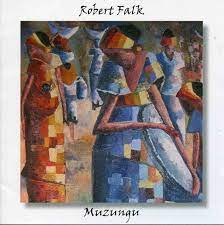
He recorded and released his debut album Muzungu as a leader in 2006 featuring his afro-jazz compositions. Mixing intello jazz with african rythms that mainly come from the Congo, Rwanda and Burundi.
His sophomore project is afro-jazz centered around West~African music but includes Brazilian influences as in a congolese samba. It is titled Xelu Sowu, which translates to The Spirit of the West in wolof.
Guitarist and composer Robert Falk continues to perform and record.
More Posts: bandleader,composer,guitar,history,instrumental,jazz,music

Daily Dose Of Jazz…
Born on September 21, 1927 Ward Lamar Swingle grew up in Mobile, Alabama and studied music, particularly jazz, from a very young age. He learned clarinet, oboe and the piano as a child and played in Mobile-area big bands before he was out of high school. He continued his music studies at the Cincinnati Conservatory of Music, graduating summa cum laude in 1950.
Moving to France in 1951 on a Fulbright scholarship, he studied piano with Walter Gieseking and worked as a rehearsal pianist for Les Ballets de Paris. He met a French-born violin student, Françoise Demorest, and got married in 1952. 1959 saw Swingle as a founding member of Les Double Six of Paris, which specialised in scat singing of jazz standards.
This concept of scatting to Johann Sebastian Bach was the foundation for The Swingle Singers, which became fully established by 1962. They released their albums Jazz Sebastian Bach and Bach’s Greatest Hits in 1963 and their early recordings won five Grammy Awards. Disbanding the original Swingle Singers in 1973 he moved to London, England and formed a new group, and expanded their repertoire to include classical and avant-garde works along with the scat and jazz vocal arrangements.
Returning to live in America in 1984 he remained musical advisor for his London-based group, but devoted most of his time to workshops, guest conducting and the dissemination of his printed arrangements through his publishing company, Swingle Music. He went on to conduct several chamber and philharmonic choirs, and conduct workshops and seminars at universities in Europe and North America.
In 1994 he moved back to France, where he continued his work in arranging, composing and guest conducting. He wrote an autobiography and treatise titled Swingle Singing, in which he defined ‘Swingle Singing’ techniques with illustrations from his arrangements and compositions.
Vocalist, pianist and arranger Ward Swingle, who was named Officier de l’Ordre des Arts et des Lettres (Officer of the Order of Arts and Letters) by the French Minister of Culture and Information, transitioned in Eastbourne, England, on January 19, 2015.
More Posts: arranger,bandleader,history,instrumental,jazz,music,piano
Daily Dose Of Jazz…
Winston Clifford was born on September 19, 1965 in Islington, England and began playing drums as a child. He studied with former Tubby Hayes drummer Bill Eyden and Trevor Tomkins at the Guildhall School of Music. His playing is free from the usual restraints of stylistic expectations and a true reflection of listening and responding in the moment.
This training has led him to become one of the most in-demand drummers in Britain. He has performed or recorded with over five dozen luminary jazz musicians from both sides of the Atlantic. To name a few one must include Bheki Mseleku, Joanne Bracken, Stanley Turrentine, Benny Golson, James Williams, Chico Freeman, Phillip Catherine, John Abercrombie, Birelli Lagrene, Joe Lovano, Eddie Henderson, Archie Sheep, Carmen Lundy, Ronnie Laws, Freddie Hubbard, Art Farmer, Gary Bartz, Joey Calderazzo, Dave Valentin, Larry Coryell, Monty Alexander, Eddie Harris, Bobby Watson, Billy Childs, Houston Person, Courtney Pine, Julian Joseph, and the list goes on.
Post bop drummer Winston Clifford continues to perform and record.
More Posts: drums,instrumental,jazz,music