

Daily Dose Of Jazz…
Albert King was born on June 19, 1912 in Panama and raised in Kingston, Jamaica where he attended Alpha Boys School. During the 1930s he led his own band, Bertie King and his Rhythm Aces, one of Jamaica’s foremost dance orchestras.
Leaving the island in 1936, he sailed to England on the same ship as his friend Jiver Hutchinson. Once in London he joined Ken Snakehips Johnson’s West Indian Dance Band, then played with Leslie Hutchinson’s band. He also worked with visiting American musicians including Benny Carter, George Shearing and Coleman Hawkins.
In 1937, while in the Netherlands he recorded four sides in the Netherlands with Benny Carter, and the next year he recorded with Django Reinhardt in Paris, France. In 1939 he joined the Royal Navy. He left the Navy in 1943 and formed his own band, also working and recording with Nat Gonella.
Returning to Jamaica in 1951, he assembled his own band, the Casa Blanca Orchestra, playing in the mento style. With no Jamaican record labels at this time, he arranged for his recordings to be pressed in a plant in Lewisham, England, owned by Decca Records. Bertie returned a number of times to the United Kingdom, working and recording with Kenny Baker, George Chisholm, Chris Barber, Kenny Graham and Humphrey Lyttelton. During this period in his career he toured Asia and Africa with his own band and played and recorded in London with some of the leading Trinidadian calypsonians.
King went on to lead the Jamaica Broadcasting Corporation house band in the 1950s. His sidemen included Ernest Ranglin and Tommy Mowatt. He recorded extensively with this outfit, until 1965 when he moved to the USA. His last known public performance was in New York City in 1967. Clarinetist and saxophonist Bertie King passed away in 1981.
More Posts: bandleader,clarinet,history,instrumental,jazz,music

Daily Dose Of Jazz…
Lutz Templin was born Ludwig Templin on June 18, 1901 in Düsseldorf, Germany. He started out playing violin and saxophone, and studied composition before finding work playing and arranging in dance ensembles.
From 1941 to 1949 Lutz led a big band in Germany which recorded extensively and was broadcast on German radio. This ensemble also recorded as Charlie and his Orchestra, doing arrangements of American jazz hits with propagandistic lyrics inserted. These were broadcast on Nazi radio stations and whether he was forced to do so is unknown.
Templin’s ensemble operated out of Berlin until 1943, when Allied bombing resulted in their relocation to Stuttgart. He remained there after the war and continued performing there for most of the rest of his life. Bandleader Lutz Templin passed away on March 7, 1973 in Stuttgart, Germany.
More Posts: bandleader,history,instrumental,jazz,music,saxophone,violin
Daily Dose Of Jazz…
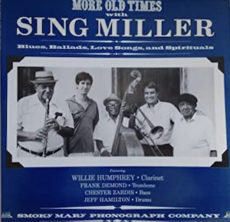
Sing Miller was born James Edward Miller on June 17, 1914 in New Orleans, Louisiana. He started his career as a singer with the Harmonizing Browns Quartet. His main instrument was banjo until late in the 1920s, when he moved to piano. He worked as a freelance musician with the Percy Humphrey band during the 1930s.
After serving in the military during World War II, he was in a band led by drummer Earl Foster from 1945 to 1961. He became a member of the Preservation Hall Jazz Band in New Orleans in the 1960s. He played in that band with Polo Barnes, Kid Sheik, Jim Robinson, and Kid Thomas Valentine.
His rare performances as a solo act included 1979 and 1981 when he went on tour in Europe. He recorded one album for Dixie Records in 1972 and one for Smoky Mary in 1978.
Pianist Sing Miller, who was a member of the Preservation Hall Jazz Band, passed away on May 18, 1990.
More Posts: history,instrumental,jazz,music,piano

Daily Dose Of Jazz…
Marilyn Montez Moore was born in Chicago, Illinois on June 16, 1930. Her vocal style was similar to that of Billie Holiday’s, at twenty-six she recorded her only solo album as a leader in 1957 on the Bethlehem label titled Moody Marilyn Moore. With Jackie Paris she recorde another album titled Oh, Captain.
She was the first wife of saxophonist Al Cohn, who played on Moody Marilyn Moore, and the mother of guitarist Joe Coh. After she and Cohn separated and later divorced, Moore was left to raise her family and never recorded again.
Singer Marilyn Moore, whose short career was limited to activity during the 1950s, passed away on March 19, 1992 at the age of 61 in Ft. Lauderdale, Florida.
More Posts: bandleader,history,instrumental,jazz,music,vocal

Daily Dose Of Jazz…
Born Jeannette Schwager on June 15th in the Netherlands, Jeannette Lambert grew up in Sudbury, Ontario, Canada. Her Dutch and Indonesian parents loved jazz, and she started singing at the age of nine. From the age of 12, she performed with her brother, guitarist Reg Schwager, at coffee houses and music festivals. She did not have to venture far to perform regular jam sessions, which were held at her house when she was a teenager.
Particularly inspired by the older jazz musicians who participated, especially Herbie Spanier, he encouraged her to improvise as freely as possible. While she studied film production at Toronto’s York University during 1984-1986, Lambert also attended the Banff Summer Jazz Workshop in 1985, singing with the Cecil Taylor Workshop Big Band and taking lessons from Jay Clayton, Dave Liebman, and Julian Priester.
After periods living in Paris, New York, and Amsterdam, she settled in Montreal, married drummer Michel Lambert, and co-founded the record label Jazz from Rant with her brother and her husband in 1991. Jeannette’s music is inspired and influenced not only by other jazz singers but by flamenco, fado, and jaipongan. In addition to her singing and recording, she writes music to her own poetry and is an internet filmmaker.
Her several recordings, primarily on the Jazz from Rant label, include free improvisations, collaborations with pianist Paul Bley, and two volumes of Bebop for Babies, jazz versions of children’s melodies. Vocalist, poet, record label owner Jennette Lambert continues to compose, perform and record,