

Daily Dose Of Jazz…
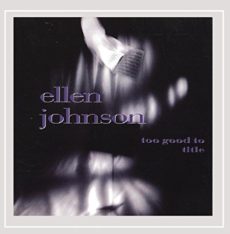
Ellen Johnson was born on December 18, 1954 in Chicago, Illinois. Surrounded by music as a child, her mother was a professional singer who played piano and her uncle had played clarinet in Glenn Miller’s Army Air Force Band.
Growing up in Chicago she studied guitar in high school but had originally planned to become a theater actress. However when she took voice lessons, Ellen became hooked on the music, and began singing in a local band while studying jazz with Willie Pickens at a music conservatory. Moving to the San Diego, California she earned a Master’s Degree from San Diego State University in Vocal Performance.
Notable for her work as an educator, Johnson has been teaching part of the voice faculties of the University of San Diego and the Old Globe Theatre, as well as conducted voice clinics since the mid-1980s. She has also performed special concerts of Duke Ellington’s Sacred Music.
With a wide range for jazz improvisation, in the mid -’90s she recorded her debut album, Too Good to Title. She also recorded a few songs on Bob Willey’s album Peace Pieces. Vocalist Ellen Johnson continues to perform, and record.

Inspire A Young Mind

More Posts: vocal
Daily Dose Of Jazz…
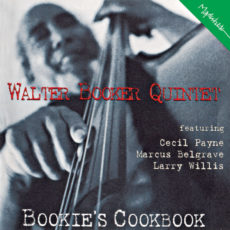
Walter Booker was born December 17, 1933 in Prairie View, Texas and moved with his family to Washington, D.C. in the mid-1940s. He played clarinet and alto saxophone in college with a concert band. In 1959 he began on bass while in the US Army, serving side-by-side in the same unit with Elvis Presley. He worked with Andrew White in Washington after his discharge, playing in the JFK Quintet during the early 1960s.
Moving to New York City in 1964, Booker was hired by Donald Byrd. After his stint with Byrd, he recorded and toured with Ray Bryant, Betty Carter, Chick Corea, Stan Getz, Art Farmer, Charles McPherson, Lee Morgan, Hank Mobley, Milt Jackson, Harold Vick, Thelonious Monk and Sonny Rollins. All this was done before joining the Cannonball Adderley Quintet in 1969, starting an association which lasted until Adderley’s death in 1975. He would go on to record and perform with Joe Zawinul, Joe Williams, Gene Ammons, Joe Chambers, Roy Hargrove, Archie Shepp, Kenny Barron and numerous others.
Walter’s next gig was a tour the United States with the Shirley Horn Trio, along with Billy Hart on drums. During the same time, Booker designed, built, and ran the Boogie Woogie Studio in NYC, a mecca for musicians from all over the world. Through the Eighties he played and recorded with Nat Adderley, Nick Brignola, Arnett Cobb, Richie Cole, John Hicks, Billy Higgins, Clifford Jordan, Pharoah Sanders, Sarah Vaughan, Leroy Williams, Marcus Belgrave, Roni Ben-Hur, Larry Willis, John HIcks and Phil Woods.
Booker married pianist Bertha Hope with whom he played in a trio that included drummer Jimmy Cobb. In addition to his own quintet, he also formed Elmollenium, based on the same core group as the Quintet plus Bertha and dedicated to playing the music of Elmo Hope.
Bassist Walter Booker, a highly underrated stylist whose playing was marked by voice-like inflections, glissandos and tremolo techniques, passed away in his Manhattan home on November 24, 2006, at the age of 72.
Sponsored By

www.whatissuitetabu.com
More Posts: bass
Daily Dose Of Jazz…
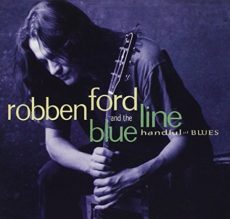
Robben Ford was born December 16, 1951 in Woodlake, California and raised in Ukiah, California. He began playing the saxophone at age 10 and the guitar at age fourteen. Robben and his brothers created the Charles Ford Blues Band in honor of their father.
By age 18, Ford’s band was hired to play with Charlie Musselwhite and they recorded two albums The Charles Ford Band and Discovering the Blues. He went on to record two albums with Jimmy Witherspoon titled Live and Spoonful. In the 1970s he joined the jazz fusion band, L.A. Express, led by saxophonist Tom Scott. In 1974 the band backed George Harrison on his American tour and played on the Joni Mitchell albums The Hissing of Summer Lawns and Miles of Aisles.
Leaving the L.A. Express in 1976, Robben recorded his debut solo album, The Inside Story with a band that later became the Yellowjackets. 1982 saw him appearing on the KISS album Creatures of the Night, playing lead guitar on the songs Rock And Roll Hell and I Still Love You. He worked with Miles Davis in 1986 and can be heard on Davis’ Montreux box set. He joined Philippe Saisse, Marcus Miller and J.T. Lewis as a member of The Sunday Night Band for the second and final season of the late-night NBC television program, Sunday Night in 1989.
He has recorded with Dizzy Gillespie, Georgie Fame, Rickie Lee Jones, Neil Larsen, David Sanborn, Bob Malach, Ruthie Foster, Larry Carlton and Charlie Haden, to name a few. In the 1990s he released several more albums and on into the new millennium, received five Grammy Award nominations, and was named one of the “100 Greatest Guitarists of the 20th Century” by Musician magazine. He has produced five instructional DVDs and performed on the soundtracks of the films Pink Cadillac, The Firm, No Way Home and The Whole Nine Yards.
He credits pianist and arranger Roger Kellaway and saxophonist and arranger Tom Scott as major influences on his musical development. Guitarist Robben Ford continues to cross genres of jazz, blues and rock with recording, performing and touring.
Dose A Day-Blues Away
More Posts: guitar
Daily Dose Of Jazz…
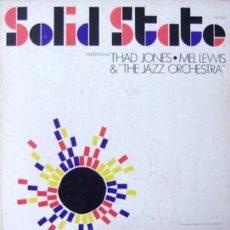
Jimmy Nottingham was born December 15, 1925 in New York City. His first professional job was with Cecil Payne in 1943 prior to serving in the Navy from 1944 to 45 and playing in Willie Smith’s band. Following his discharge from the service he worked with Lionel Hampton for two years and then with Charlie Barnet, Lucky Millinder, Count Basie and Herbie Fields through the rest of the decade.
He played Latin jazz from 1951–53, then was hired by CBS as a staff musician in 1954, working for the network for more than 20 years. In his spare time he played jazz with Budd Johnson, Dizzy Gillespie, Oliver Nelson, Benny Goodman, Thad Jones/Mel Lewis and Clark Terry. He recorded with Mose Allison, Joe Cain, Coleman Hawkins, Billy Byers, Seldon Powell, Charlie Mariano, Kenny Burrell, Tony Scott, Maynard Ferguson, Jimmy McGriff, Chico O’Farrill, Shirley Scott and Sonny Stitt among numerous others.
Trumpeter Jimmy Nottingham was such a valuable big band and studio musician that he spent most of his life playing anonymously in the background and had limited chances to solo. He never released an album as a leader, but did, record four songs for Seeco Records in 1957. He passed away at the age of 52 on November 16, 1978 in his home city.
Sponsored By

More Posts: trumpet

Daily Dose Of Jazz…
Viola Wells was born Viola Gertrude Wells Evans on December 14, 1902 in Newark, New Jersey, the first child of Robert Olivia Simmons and Earle Henry Wells, who had moved to Newark from Surry County, Virginia. When her mother died from giving birth to her sister Estelle, she briefly went to live with her maternal grandparents Rev. Morgan and Annie Simmons in Virginia, who only liked to listen to secular music. In contrast, his son “Uncle Charlie” was popular locally for his song and dance routines.
Returning to Newark in 1910 after her father remarried, she started to sing in her church’s Salika Johnson choir under the direction of her music and piano teacher, Ruth Reid. This choir performed in cities outside of New Jersey and WOR Radio in Newark invited her to sing on air to raise money for the first Black YMCA. Wells also sang in her high school glee club and competed in talent shows. At nineteen she married her first husband, tap dancer Howard Nicholas.
Her career began singing in traveling shows, once filled in for Mamie Smith and was on the Theater Owners Booking Association (TOBA) circuit by 1921. Viola frequently sang at local Newark jazz clubs, eventually moving to Harlem and finding singing engagements in nightclubs there. The Twenties saw her touring throughout the US with different bands and in the 1930s, her first big break came while touring with the Banjo Bernie Band from Baltimore and then with Ida Cox.
As the 30s came to a close she moved to Kansas City, where she ran a nightclub and headed a band. Moving back to Newark in the Forties, she met and married guitarist Harold Underhill and began singing at various New York City clubs, sometimes under her married name. She replaced Helen Humes as a singer in the Count Basie Orchestra. During that period in her career she was often billed as The Ebony Stick Of Dynamite and sang at United Service Organizations (USO) shows on military bases.
She retired from music in 1946 due to diabetes and in an effort to spend more time with her family after her father was murdered. Brought out of retirement by blues historian Sheldon Harris who helped revive her career in the 1960s, Viola recorded on the album Encore For The Chicago Blues released in 1968 by Spivey Records. She also produced a blues album in 1972 called Miss Rhapsody and toured with the Harlem Blues and Jazz Band in the 1970s.
Vocalist Viola Wells received many honors in her later years, including the key to Newark. She passed away on December 22, 1984 in Belleville, New Jersey. The book Swing City: Newark Nightlife, 1925-50 by Barbara J. Kukla is dedicated to her.
Take A Dose On The Road
More Posts: vocal