

Daily Dose Of Jazz…
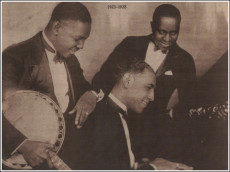
Louis Stanley Hooper was born on May 18, 1894 in North Buxton, Ontario, Canada but was raised in Ypsilanti, Michigan and studied piano at the Detroit Conservatory, playing locally in dance orchestras in the 1910s. Around 1920 he moved to New York City and recorded frequently with Elmer Snowden and Bob Fuller in the middle of the decade. He was known to perform with both of them in Harlem as well as with other ensembles.
Lou served for some time as the house pianist for Ajax Records, accompanying many blues singers on record, including Martha Copeland, Rosa Henderson, Lizzie Miles, Monette Moore and Ethel Waters. He was a participant in the Blackbirds revue of 1928.
In 1932 Hooper returned to Canada, where he played in Mynie Sutton’s dance band, the Canadian Ambassadors. Working locally as a soloist and in ensembles for the next two decades, he was brought back into the limelight by the Montreal Vintage Music Society in 1962.
Lou recorded a two-LP set with Bill Coleman titled UK LIve:Satin Doll, Vol. 1 & 2 in 1967 and released an album as a leader of ragtime piano tunes in 1973 titled Lou Hooper, Piano.
Wearing the educator hat, he taught at the University of Prince Edward Island late in his life and appeared regularly on CBC television in Halifax. Pianist Lou Hooper passed away on September 17, 1977 in Charlestown, Prince Edward Island. His papers, which include unpublished compositions and an autobiography, are now held at the National Library of Canada in Ottawa.

Give A Gift Of Jazz – Share

More Posts: piano
Daily Dose Of Jazz…
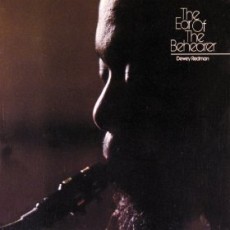
Walter Dewey Redman was born May 17, 1931 in Fort Worth, Texas. He attended I.M. Terrell High School and played saxophone in the school band with Ornette Coleman, Prince Lasha and Charles Moffett. After high school he briefly enrolled in the electrical engineering program at Tuskegee Institute in Alabama but became disillusioned with the program and returned home to Texas. In 1953, he earned a bachelor’s degree in Industrial Arts from Prairie View Agricultural and Mechanical University and while attending switched from clarinet to alto saxophone, eventually to tenor.
Following his degree, Redman served for two years in the Army and upon his discharge he began working on a master’s degree in education at the University of North Texas. While there he taught music to fifth graders in Bastrop, Texas and worked as a freelance saxophonist at night and on weekends around Austin, Texas. By 1957 he graduated in Education with a minor in Industrial Arts.
1959 saw him moving to San Francisco, California as result of an early collaboration with clarinetist Donald Rafael Garrett. He would go on to perform with Ornette Coleman, from 1968 to 1972 and recording New York Is Now!, among others. Dewey was also a part of Keith Jarrett’s American Quartet from 1971 – 1976, whose album The Survivors’ Suite was voted Jazz Album of the Year by Melody Maker in 1978.
In the mid-70s Redman formed the quartet Old And New Dreams with Coleman alumni Don Cherry, Charlie Haden and Ed Blackwell. They recorded four albums in the period to 1987. He performed and recorded as an accompanying musician with jazz musicians who performed in varying styles within the post-1950s jazz idiom, including drummer Paul Motian, Pat Metheny, Jane Bunnett, Anthony Cox, Cameron Brown, Billy Hart, Matt Wilson, Roswell Rudd, Randy Weston, Clifford Thornton, Jon Ballantyne, Michael Boclan, David Bond, Leroy Jenkins, Dane Belany and Michel Benita.
As a leader with more than a dozen recordings, Dewey established himself as one of the more prolific tenor players of his generation. Though generally associated with free jazz, he would also play standards and ballads reminiscent of the blues and post-bop mainstream and would sometimes hum into his sax while performing.
Tenor saxophonist Dewey Redman, who occasionally played alto saxophone, the Chinese suona and clarinet mainly in the free jazz genre, passed away from liver failure in Brooklyn, New York, on September 2, 2006. He was the subject of an award-winning documentary film Dewey Time and recorded two albums with his son Joshua.
Inspire A Young Mind
Daily Dose Of Jazz…
Woody Herman was born Woodrow Charles Thomas Herman on May 16, 1913 in Milwaukee, Wisconsin. His father had a deep love for show business and this influenced him at an early age. As a child he worked as a Vaudeville singer and tap-dancer, then started to play the clarinet and saxophone by age 12.
1936 saw him joining the Tom Gerun band and his first recorded vocals were Lonesome Me and My Heart’s at Ease. He also performed with the Harry Sosnick Orchestra, Gus Arnheim and Isham Jones, the latter writing numerous popular songes including It Had To Be You. When Jones retired Woody acquired the orchestra, which became known for its orchestrations of the blues. They first recorded for the Decca label as a cover band, eventually getting their first hit with Woodchopper’s Ball in 1939.He went on to have hits with The Golden Wedding and Blue Prelude.
As bebop was gradually replacing swing Herman commissioned Dizzy Gillespie as an arranger and he provided him three arrangements of Woody‘n You, Swing Shift and Down Under in 1942, heralding a change in the music. By 1945 Herman was with Columbia Records, recording the First Herd, the very successful Laura, the theme song to the 1944 movie of the same name. That group became famous for its progressive jazz that was heavily influenced by Duke Ellington and Count Basie. By the end of 1946 the big band era was over and he disbanded his only financially profitable group.
In 1947, Herman organized the Second Herd that remained together until 1987. This band was also known as The Four Brothers Band derived from the song and featured three tenor and one baritone saxophone of Zoot Sims, Serge Chaloff, Herbie Steward and Stan Getz. In the band was also Al Cohn, Gene Ammons, Lou Levy, Oscar Pettiford, Terry Gibbs and Shelly Manne and they had hits with Early Autumn and The Goof and I.
Herman would go on to perform in movies with Billie Holiday and Louis Armstrong, record for RCA, Capitol, MGM and Verve record labels, put together his Third Herd and variations of the New Thundering Herd and by the Seventies was touring and working more in jazz education by offering workshops and taking on younger sidemen.
The 1980s saw Herman’s return to straight-ahead jazz, dropping some of the newer rock and fusion approaches he had used the previous decade. He continued to perform with his health in decline, chiefly to pay back taxes that were owed because of his business manager’s bookkeeping in the 1960s. Herman owed the IRS millions of dollars and was in danger of eviction from his home. He eventually passed leadership duties to reed section leader Frank Tiberi.
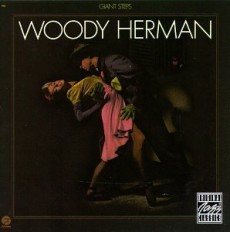
Clarinetist, alto and soprano saxophonist, singer and big band leader Woody Herman was awarded two Grammys for Best Big Band Jazz Album for Encore and Giant Steps, The Grammy Lifetime Achievement Award, had won Down Beat, Esquire and Metronome polls. He was the feature of a documentary film titled Woody Herman: Blue Flame- Portrait of a Jazz Legend, and was a featured half-time performer at Super Bowl VII. He passed away on October 29, 1987.
Dose A Day-Blues Away
Daily Dose Of Jazz…
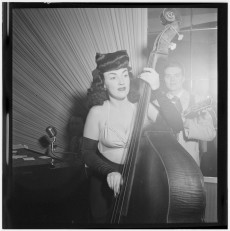
Bonnie Wetzel was born Bonnie Jean Addleman on May 15, 1926 in Vancouver, Washington. She learned violin as a child and was an autodidact on bass.
She played with Ada Leonard in an all-female ensemble and soon after worked in a trio with Marian Grange. Bonnie married trumpeter Ray Wetzel in 1949 and the pair worked in the Tommy Dorsey Orchestra in 1951.
Wetzel played in the Beryl Booker Trio with Elaine Leighton in 1953. They toured Europe in 1953-54 and recorded for Discovery Records. She also played with Herb Ellis, Charlie Shavers, Roy Eldridge and Don Byas. During the 1950s she freelanced in New York City. Double-bassist Bonnie Wetzel, who never led a recording session in her short career, passed away on February 12, 1965, at the age of 38.
Take A Dose On The Road
More Posts: bass
Daily Dose Of Jazz…
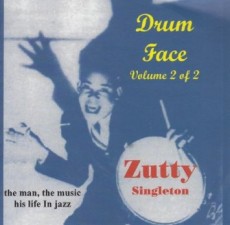
Born Arthur James Singleton on May 14, 1898 in Bunkie, Louisiana, Zutty” Singleton was raised in New Orleans. By the time he was seventeen he was working professionally with Steve Lewis in 1915. He served with the Navy during World War I and after returning to New Orleans he worked with Papa Celestin, Big Eye Louis Nelson, John Robichaux and Fate Marable.
Leaving for St. Lois, Missouri, he played in Charlie Creath’s band before moving on to Chicago, Illinois. There he played with Doc Cooke, Dave Peyton, Jimmy Noone as well as theater bands. He joined Louis Armstrong’s band with Earl Hines and between 1928-1929 performed on the landmark recordings Louis Armstrong and His Hot Five. He then moved to New York City with Armstrong.
During the next decade he would play with Armstrong and also Bubber Miley, Tommy Ladnier, Fats Waller, Jelly Roll Morton and Otto Hardwick. He also played in the band that backed Bill Robinson. In 1934, Singleton returned to Chicago but by 1937 was back in New York playing with Mezz Mezzrow and Sidney Bechet.
1943 saw Zutty moving to Los Angeles, where he led his own band, played for motion pictures, and in 1944 was featured on Orson Welles’s CBS radio series, The Orson Welles Almanac. He later worked with Slim Gaillard, Wingy Manone, Eddie Condon, Nappy Lamare, Art Hodes, Oran “Hot Lips” Page and Max Kaminsky.
Between 1943 and 1950 he appeared in the films Stormy Weather, New Orleans and Young Man With A Horn. Retiring after suffering a stroke in 1970, drummer Zutty Singleton passed away in New York City on July 14, 1975, aged 77.
Give The Gift Of Knowledge
More Posts: drums